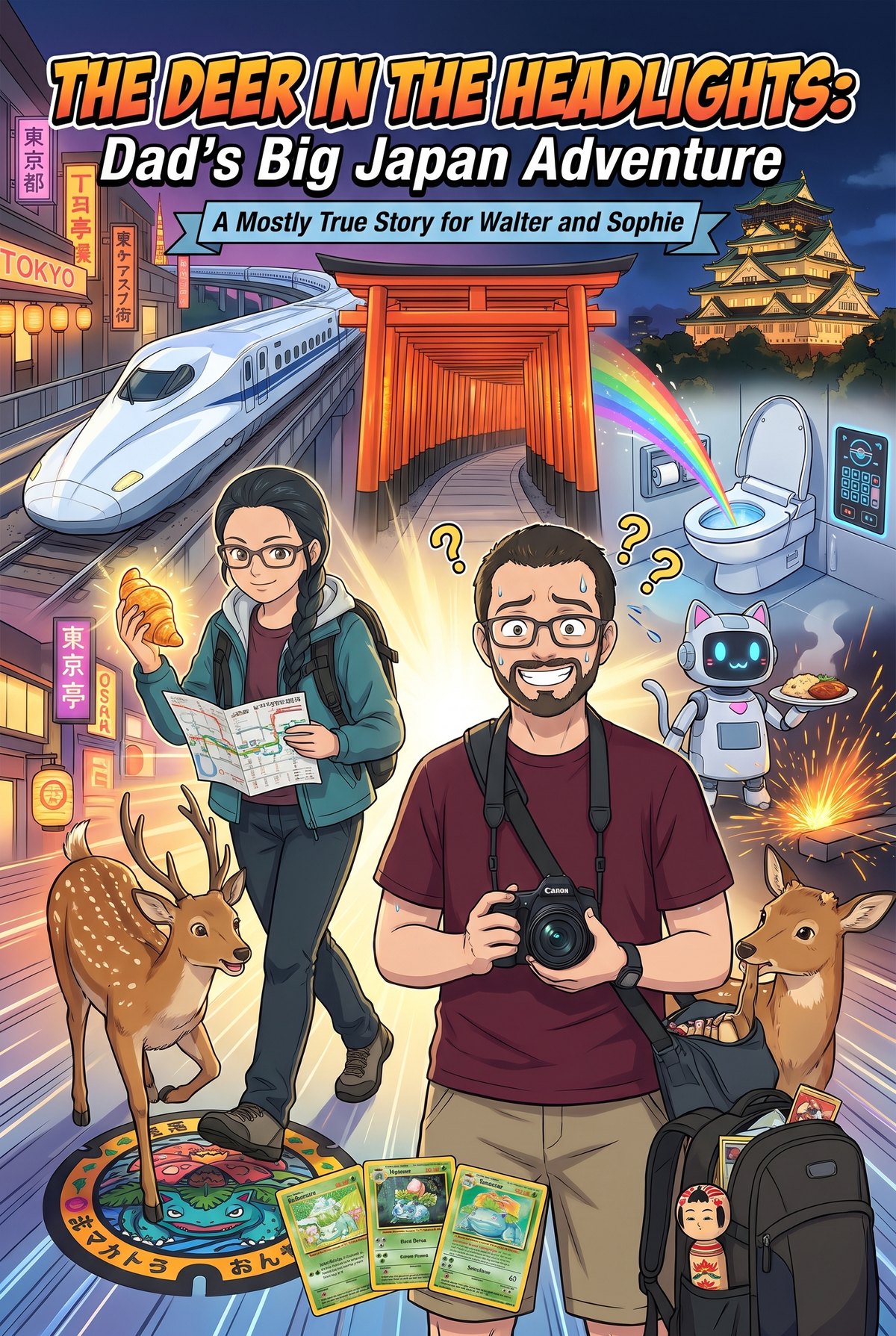
The Deer in the Headlights:Dad's Big Japan Adventure
For Walter and Sophie
Japan20-30 October 2026
Eleven days. Five cities. Two very different travellers. One camera that never got a rest.
Written by Dad | Updated 12 November 2026
A note from Dad
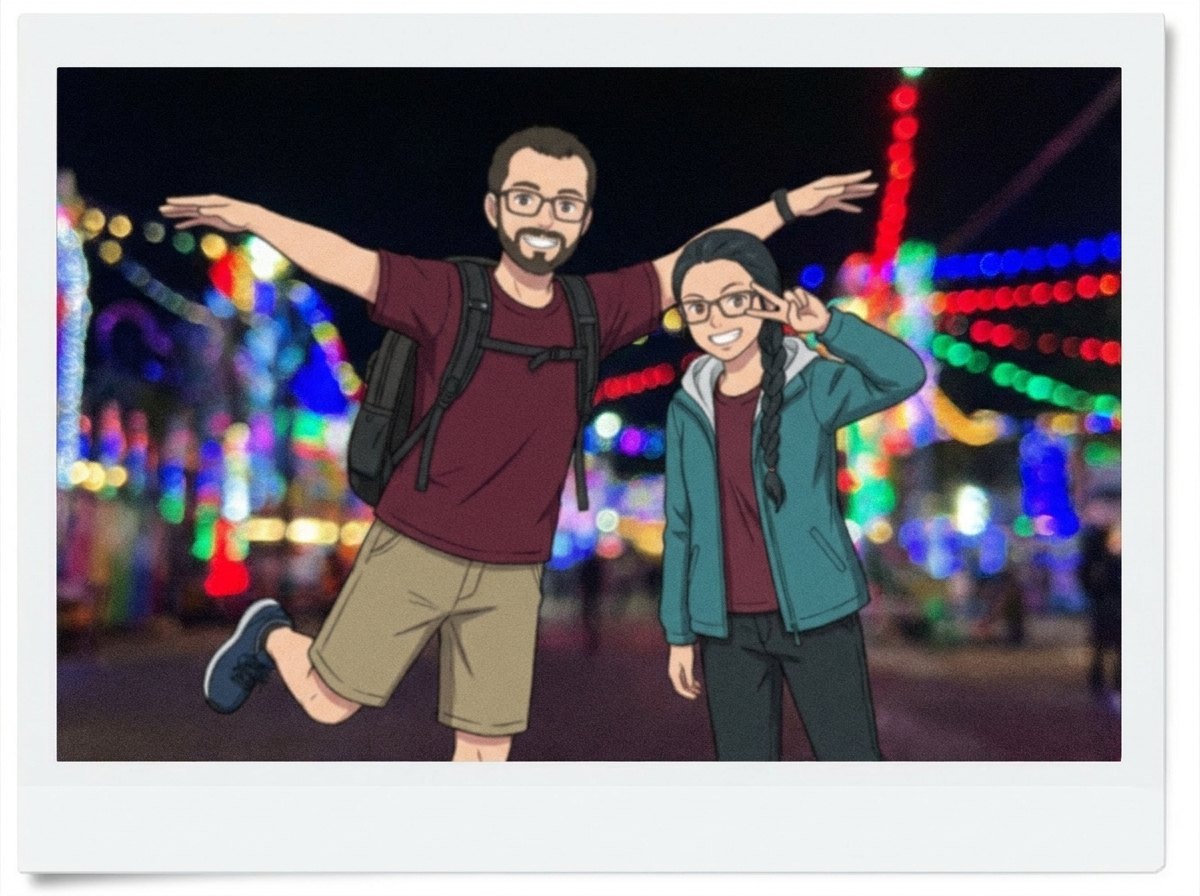
Walter and Sophie, this is the mostly true story of what happened when your dad went to Japan for eleven days with Jess, one camera and absolutely no idea what he was doing.
Almost everything in this story happened. The dialogue, sound effects, imaginary animal opinions and occasional dramatic exaggeration may or may not have occurred exactly like that. Japan's history, places and customs are real. Dad's ability to follow directions remains under investigation.
The deer, the toilets and the earthquake are all completely real.
Each chapter has the same parts, so you always know what is coming:
The storyWhat actually happened (more or less).
Did you know?Quick facts that pop up in the middle of the action.
JAPAN FACT FILEReal facts about the places and the people, so you learn something while laughing at me.
WORD OF THE DAYOne Japanese word to try out on each other.
DAD'S LESSONThe thing I learnt that day, usually the hard way.
Meet the Characters
Every good adventure story has a brave explorer. This one has me instead.
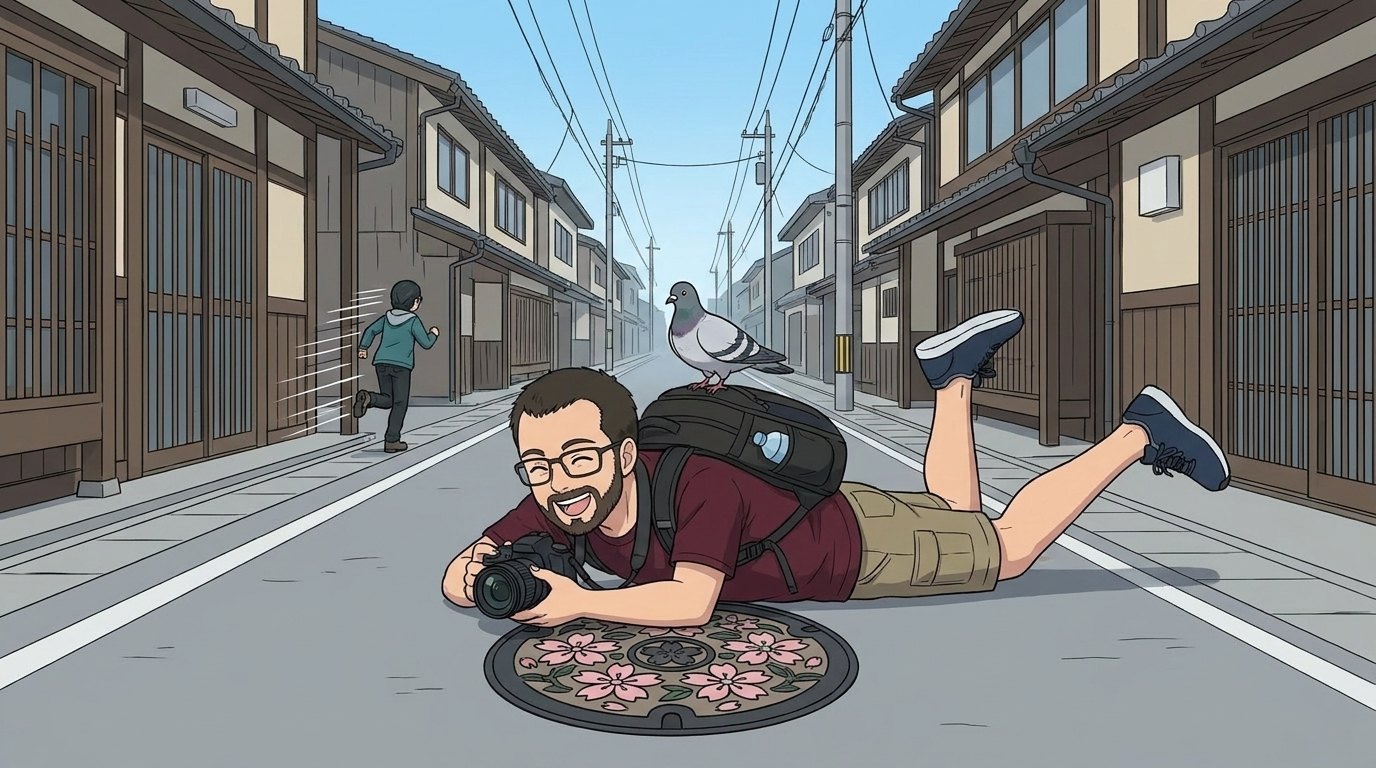
There are two sorts of travellers. One sort can walk straight past a drain cover. The other sort stops, crouches down and photographs it from six different angles. I am the second sort!
Drain cover photographer
I had never been overseas before. Well, I once went on a school trip to Tonga for a week, back in Year 8. So let's say I had never been overseas without my school principal joining me. Japan was going to be my first proper trip to another country, and I was about as ready as Minnie is for a bath after going to the creek and walking in stinky mud.
Luckily, I was not going alone.
Jess
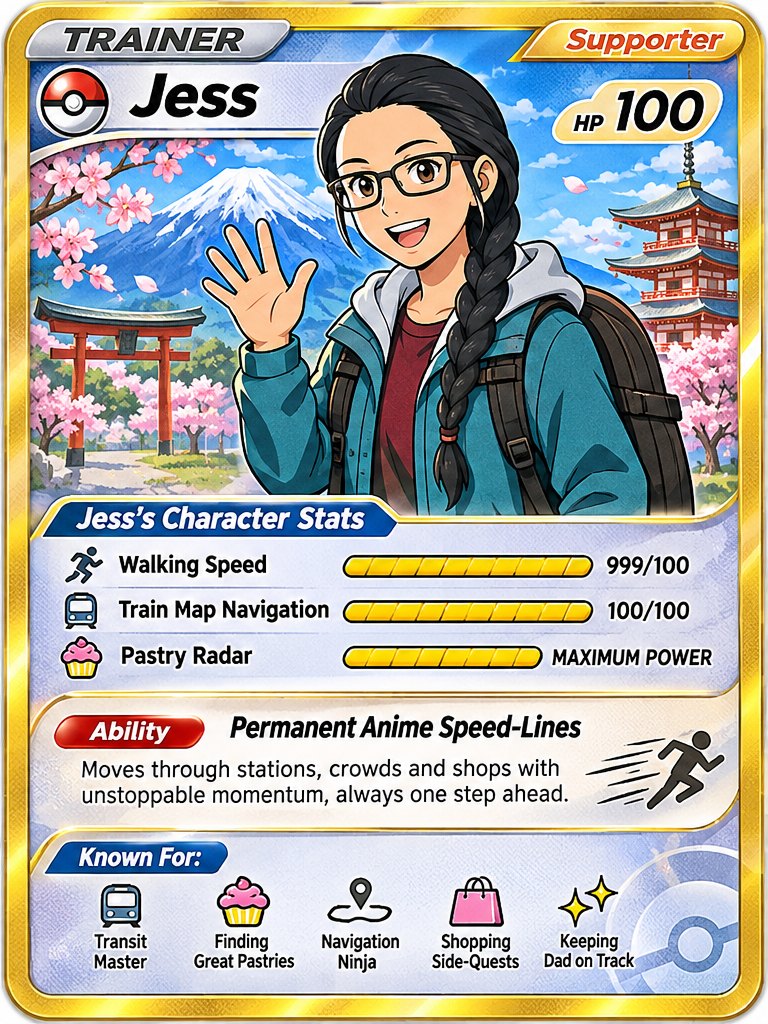
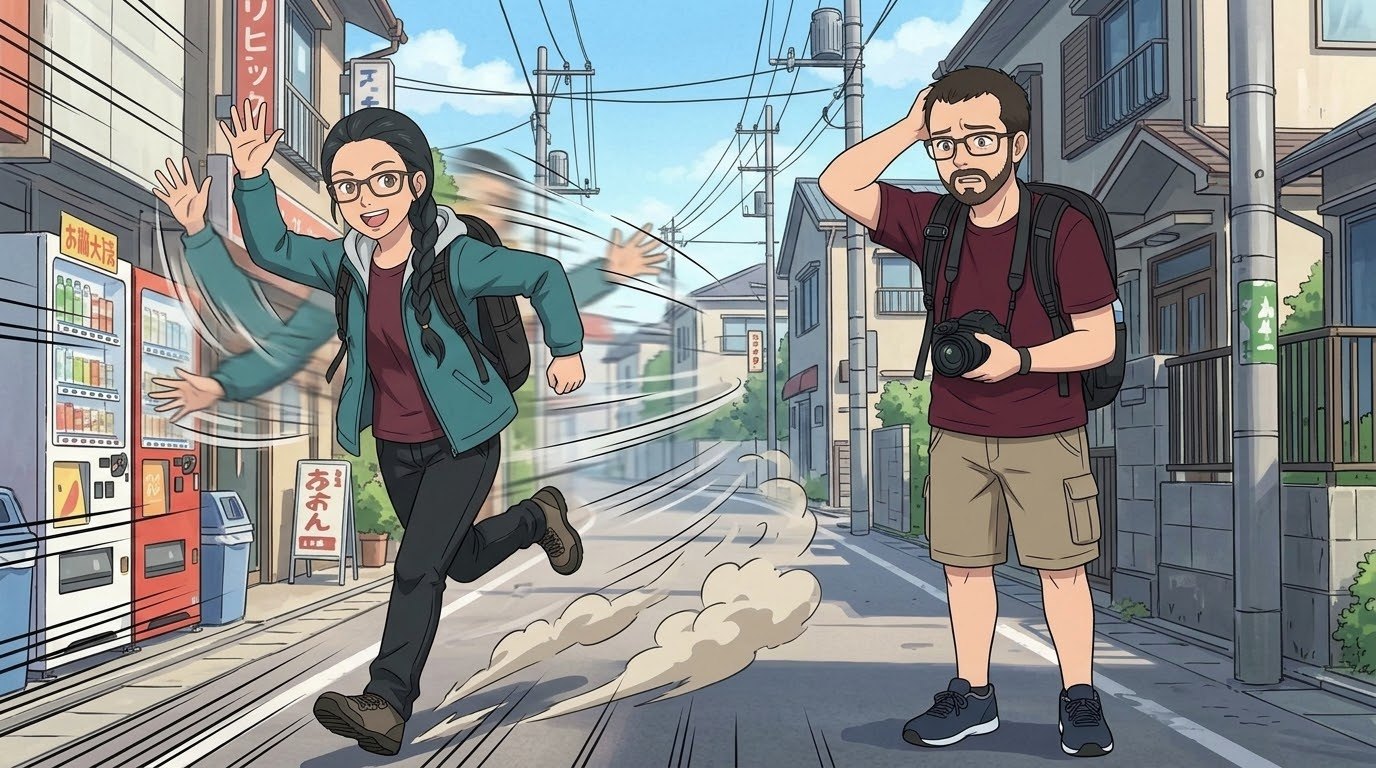
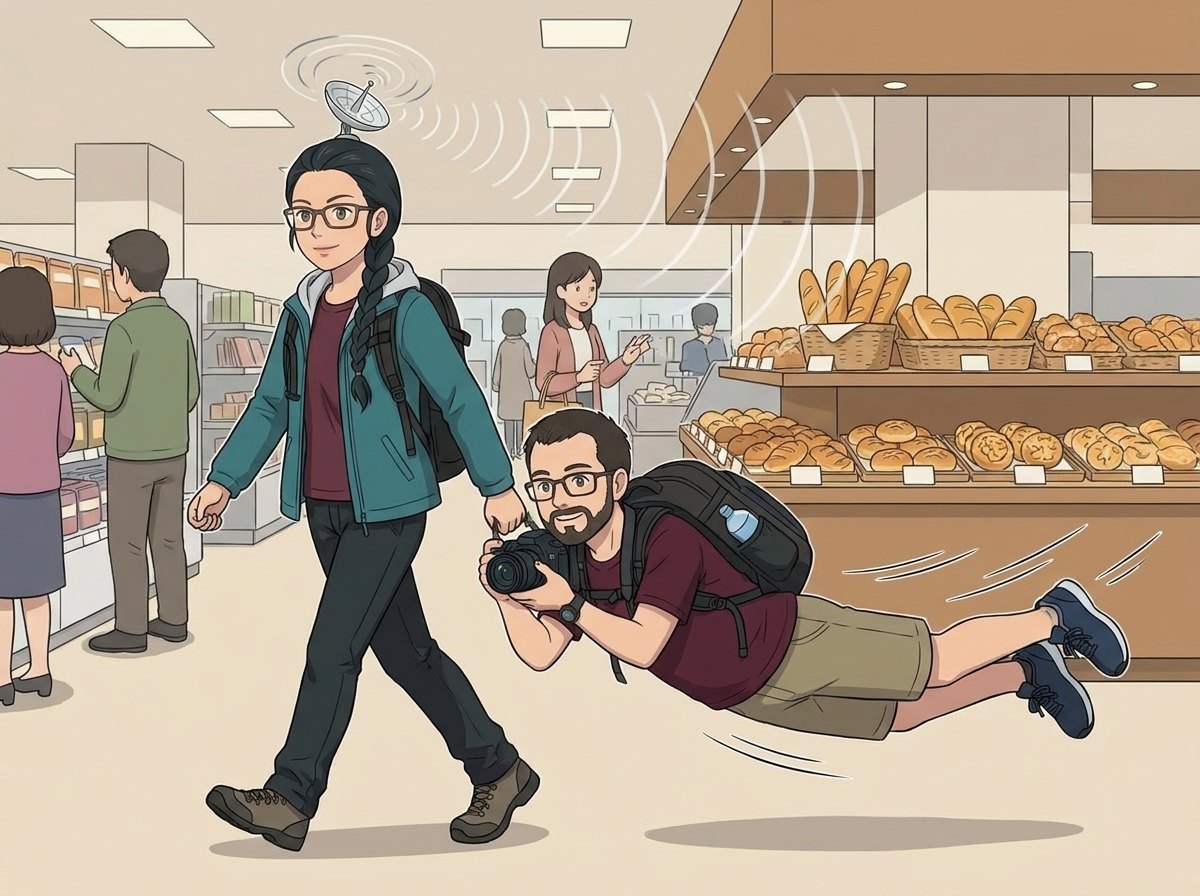
Jess is a Master Traveller. She walks at approximately the speed of sound, can read a train map upside down in three seconds flat, and has a superpower called The Pastry Radar, which lets her sniff out the best bakery in any city from five kilometres away. She packs light, plans properly and doesn't get lost. Jess is the sort of person who arrives at the airport two hours early with snacks sorted into labelled zip-lock bags.
Jess had a plan for this trip. Naturally, it was a good plan.
Jess's trainer card
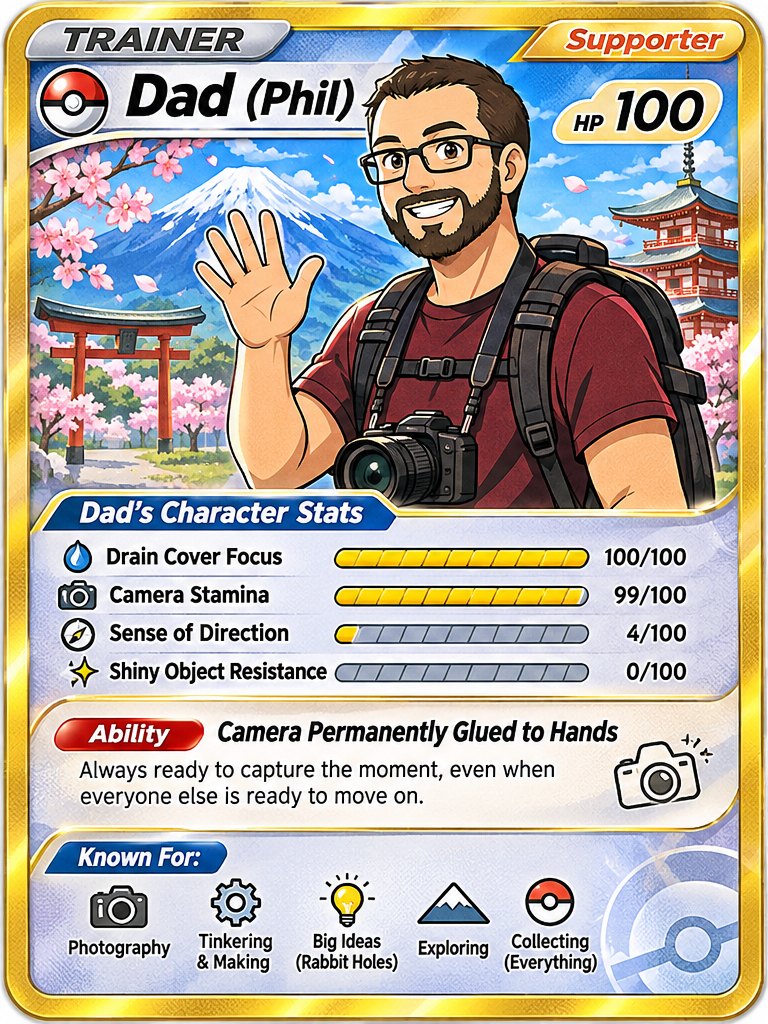
Dad
While Jess moved through Japan like a sleek, organised ninja, I moved through Japan like an excited golden retriever who had just been let off the lead in a sausage factory. If something was shiny, mechanical, down a dark alley, bolted to the ground or moving, I had to stop and take forty-seven photos of it.
Jess at full speed
Some people say that I have the attention span of a golden retriever. I think that is unfair to Buddy. Buddy at least finishes chasing the ball... squirrel!
Jess quickly worked out that she could pack an entire day of sightseeing into the time it took me to photograph a single Japanese drain cover.
Dad's trainer card
The Camera
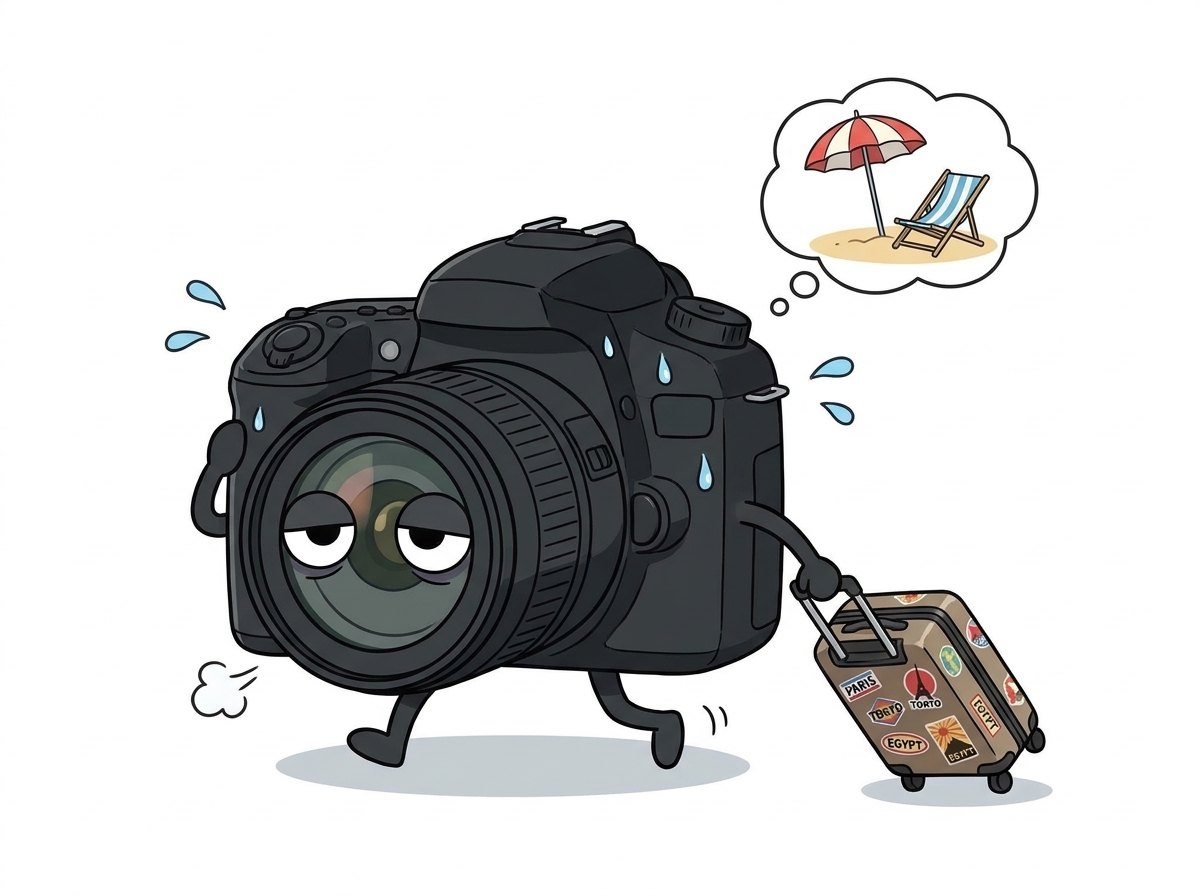
My Canon came too. It never got a day off. By the end of the trip it had taken thousands of photos, and I am fairly sure it was begging for a holiday of its own.
The tired camera
The Toilet
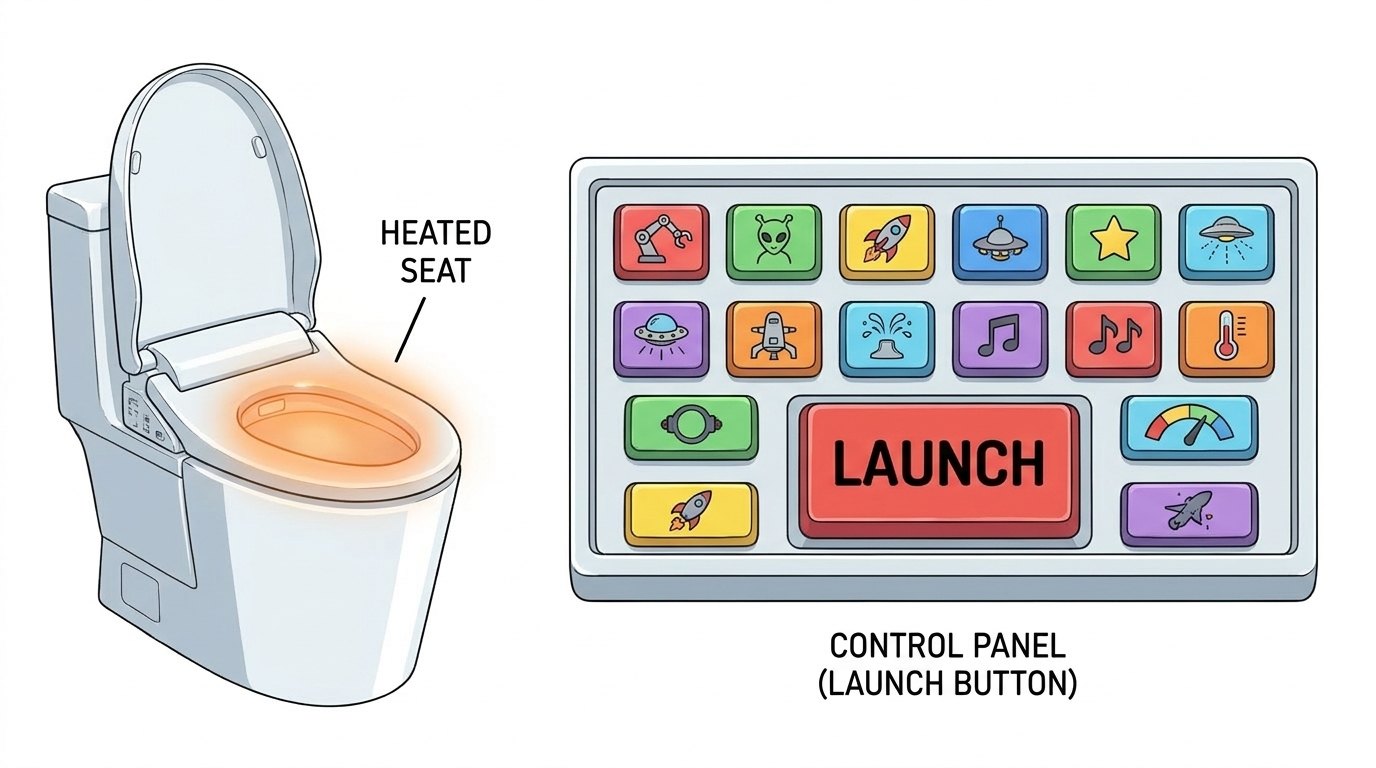
Yes, the toilet gets its own introduction. Most Japanese toilets have heated seats, a control panel with enough buttons to launch a satellite, and a mind of their own. They are basically built by NASA. Toilets appear in this story far more often than I planned. You have been warned.
The toilet
The Mission
Before we left, you two gave me jobs. Walter wanted some Japanese Pokémon cards, ideally a Venusaur. Sophie wanted a traditional Japanese doll and some photos of the bowing deer. These were serious missions.
If a Pokémon appeared in a shop window, I would investigate. If Jess or I spotted a doll, I would investigate. If I spotted a little mechanical gadget that looked as though it might have a motor in it, I would also investigate, even though nobody had asked me to.
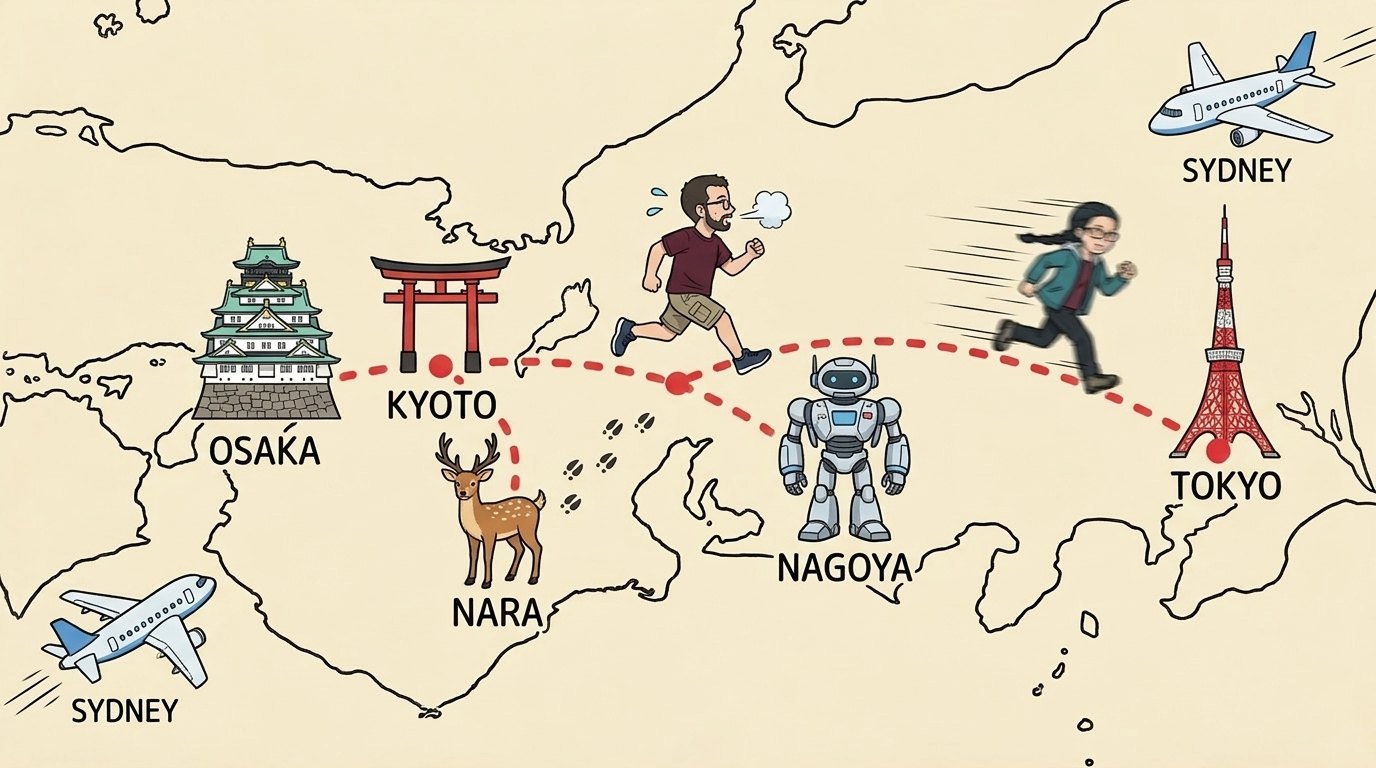
So picture it. Eleven days. Five cities: Osaka, Kyoto, Nara, Nagoya and Tokyo. One very organised woman. One man who gets distracted by shiny things. One camera.
Map of Japan
Over those eleven days I forged a real Japanese knife, got headbutted by sacred deer in typhoon rain, raced a bullet train on foot, and survived an earthquake while sitting on the toilet. I was a deer in headlights the entire trip, and Jess was the person behind the steering wheel wondering what on earth she had signed up for.
The best thing about Japan, I would discover, was that an ordinary day could contain a centuries-old temple, a singing robot, a masterpiece of craftsmanship, a train station and a toilet that plays music.
The most dangerous thing about Japan, I would discover, was that every one of those things required me to stop and have a closer look.
Japan fact file
Japan is made up of more than 14,000 islands, but almost everyone lives on the four big ones: Hokkaido, Honshu, Shikoku and Kyushu. We spent our whole trip on Honshu, the biggest.
Japan is two hours behind Sydney in October, so I did not even get jet lag. I just got confused, which is normal for me.
こんにちは
Word of the day
Konnichiwa
say it: kon-NEE-chee-wah
Hello or good afternoon.
A friendly greeting during the day. Add a little bow.
Dad's lesson
If you travel with someone who is better at travelling than you, say thank you a lot. And carry the bags.
Day1
Osaka Drift and the Spaceship Toilet
Tuesday 20 OctoberSydney → Osaka
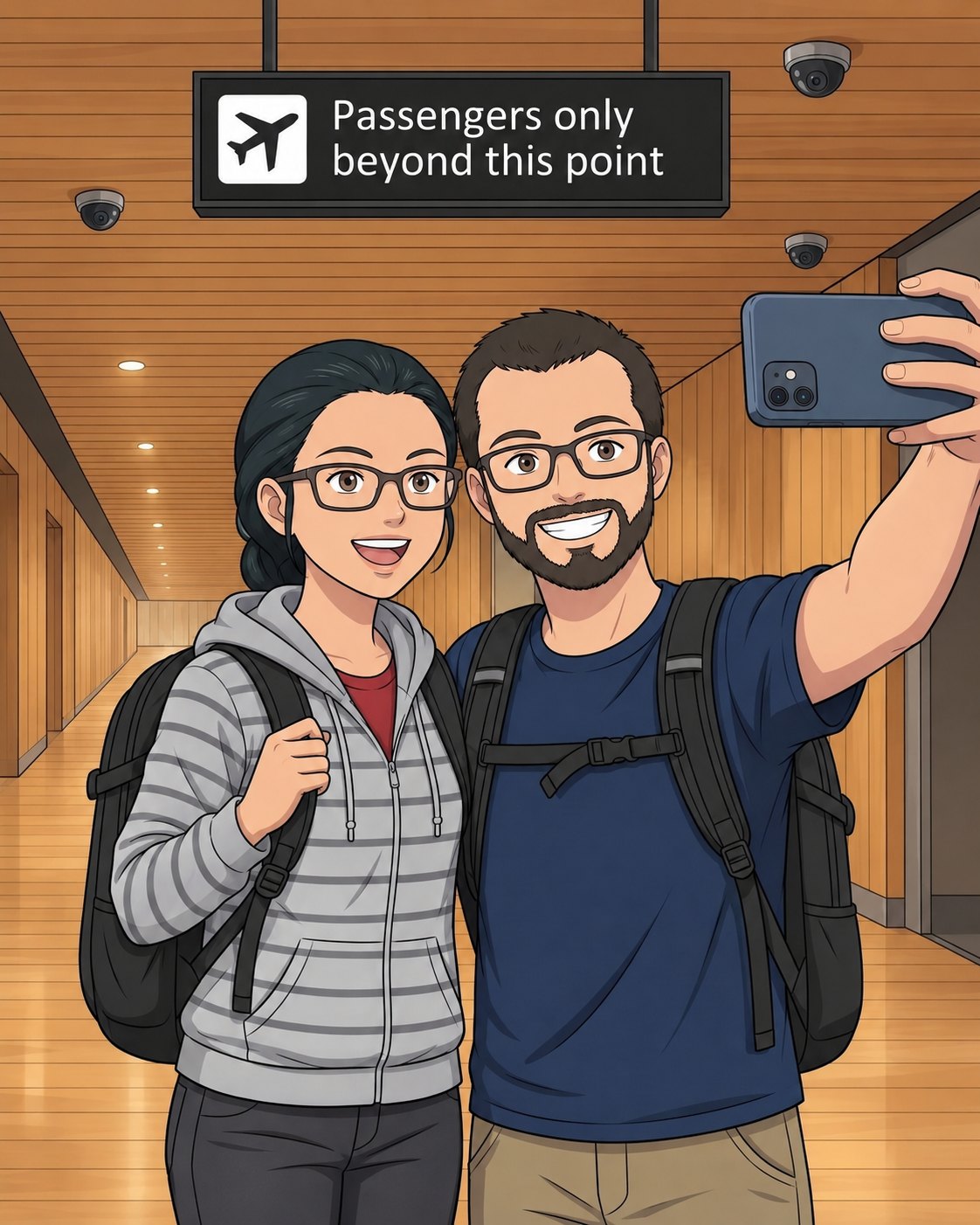
Our adventure began at Sydney Airport. We hugged Alice, Jess's mum, goodbye. I held the camera up for a selfie at the departure gate, and that was the moment it stopped being a plan and became a trip.
Departure gate
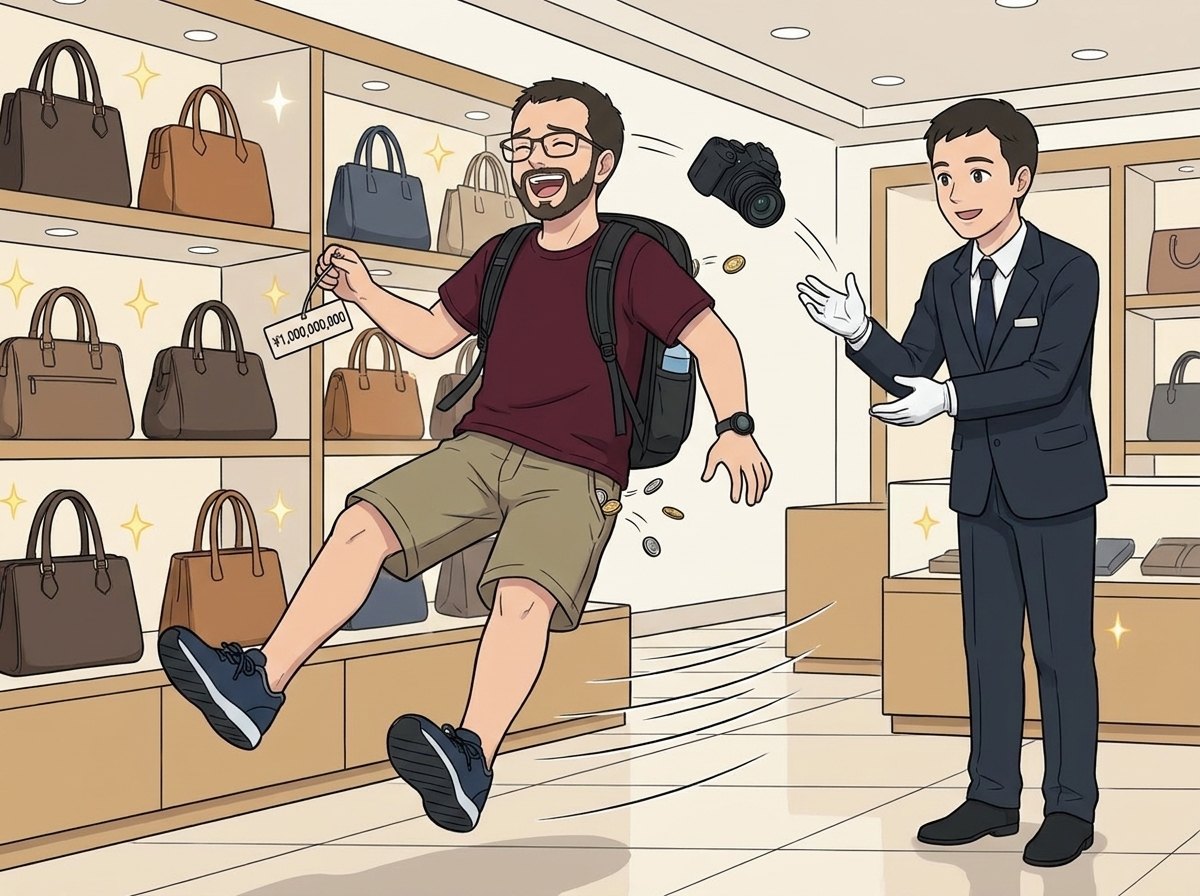
Then Jess led me "air-side". That is the fancy international zone, filled with shops so expensive that just breathing near them costs fifty dollars. We walked past Gucci and Tiffany's (which I thought was a breakfast restaurant), and I patted my trusty couch-leather wallet from Paddy's Markets, very glad it was staying safely in my pocket.
The price tag
Far more impressive was the McDonald's, where burgers zoomed down from the kitchen on a conveyor belt, right near a giant robot face bolted to the floor. Jess probably should have taken my excitement as a warning.
The flight Our Jetstar flight left (mostly) on time. First miracle of the holiday. I had the window seat and spent nine hours like Buddy with his head out the car window, listening to music and playing random word games with Jess.
Window seat
Kansai Airport When we landed in Osaka, the air felt like warm soup. Japan is in the Northern Hemisphere, so its seasons run opposite to ours: our spring is their autumn. Even so, it was hot and sticky. This was my first geography lesson, delivered by a wall of warm air.
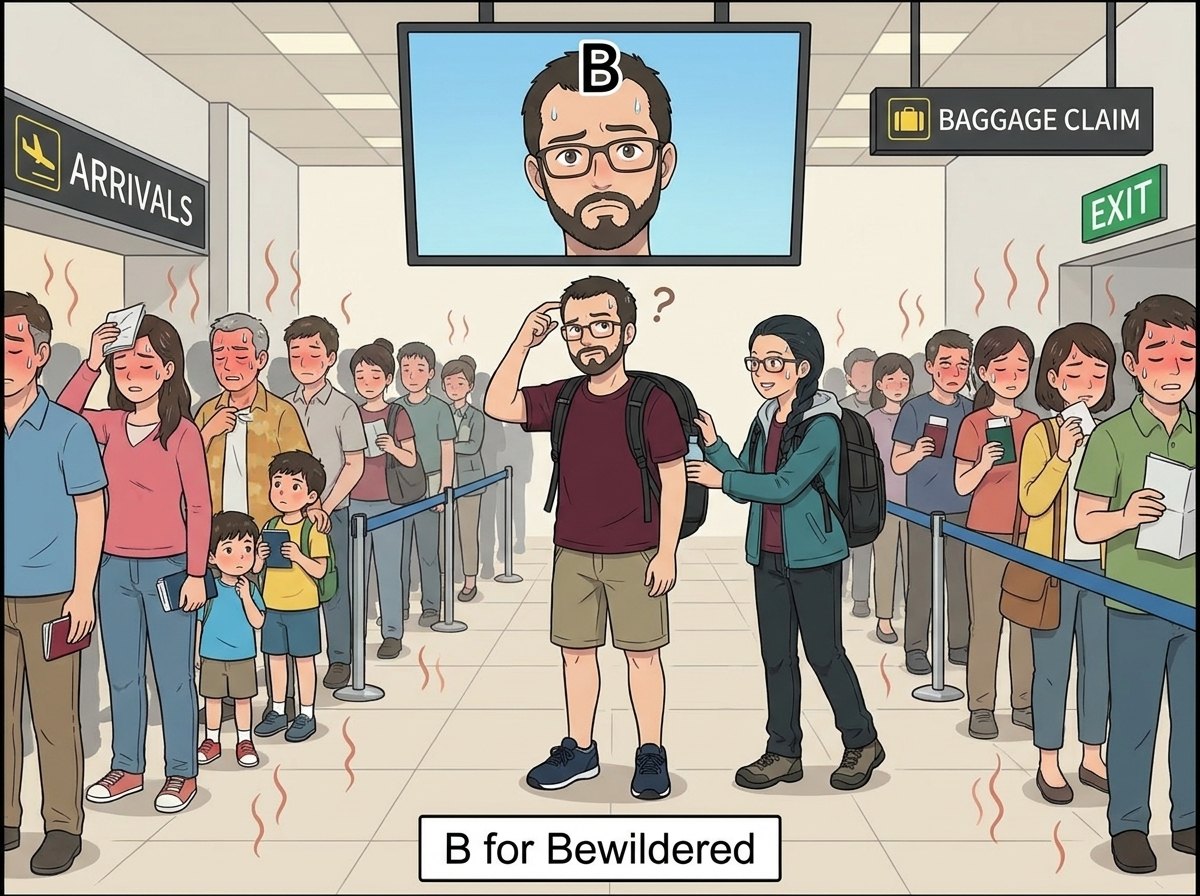
The queue to get into Japan took more than an hour, and the airport computers turned everyone into characters from an old video game. First you scan your passport and pose for a no-smiling photo. Then, as you walk down the hall, your face pops up on giant screens with a big letter floating over your head, telling you which lane to join: A, B, C or D.
Nobody knew what the letters meant. We decided they stood for Adults, Bewildered (definitely our lane), Children and Delirious.
B for Bewildered
The reason we thought that was that the system sent the mum and dad in front of us to Gate A on the far right, and wanted to send their three-year-old to Gate C at the other end of the building. I imagined the airport computer announcing: "ADULTS TO THE RIGHT. SMALL CHILD TO THE LEFT. AUSTRALIAN DAD, PLEASE STOP ASKING QUESTIONS."
The family sensibly ignored the robot overlords and stayed together. Good call.
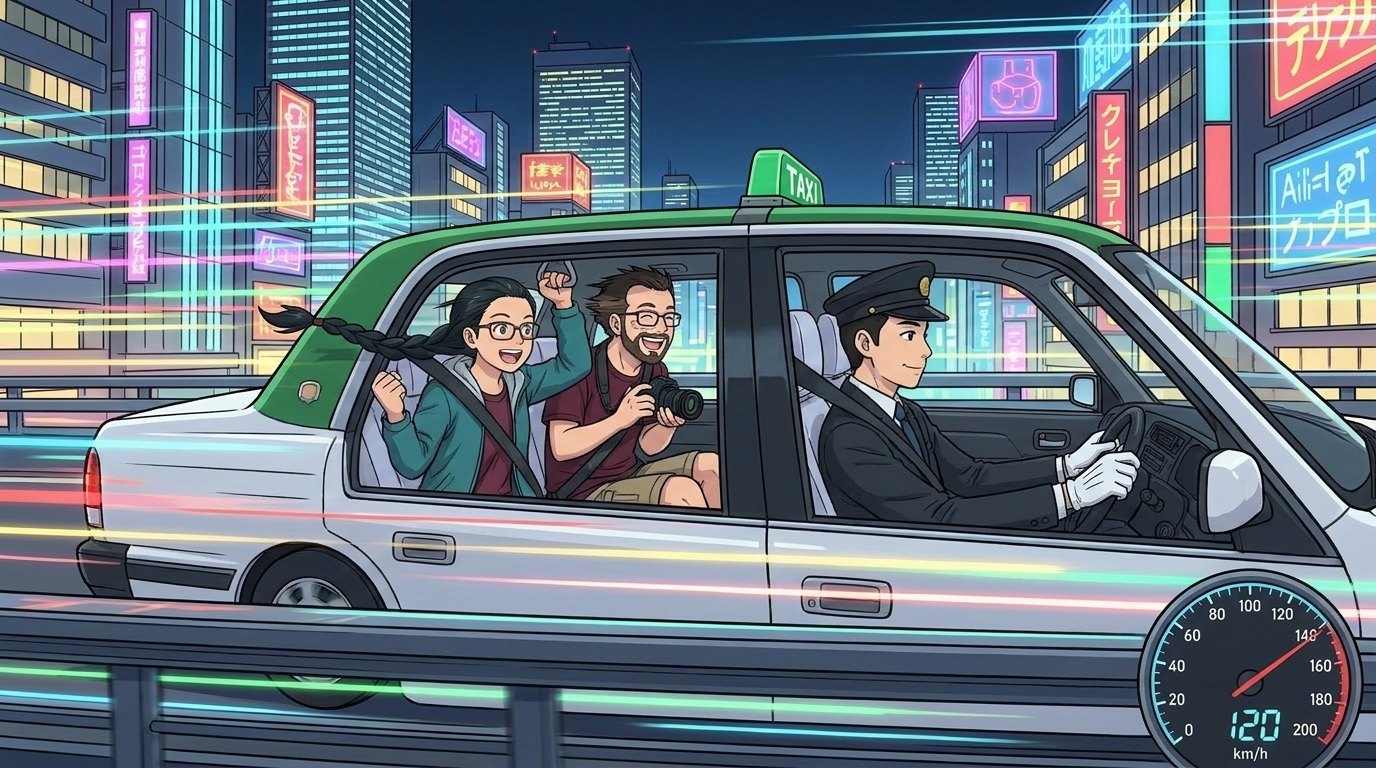
Osaka Drift Outside, Jess and I climbed into the back of a taxi. Our driver clearly believed he was starring in a car-racing movie. The speed limit was 60 to 80 kilometres an hour the whole way. He did 120. For more than an hour. He wove past everything on the road while the glowing towers of Osaka blurred past our windows and Jess and I held on to our seats.
Rollercoaster taxi
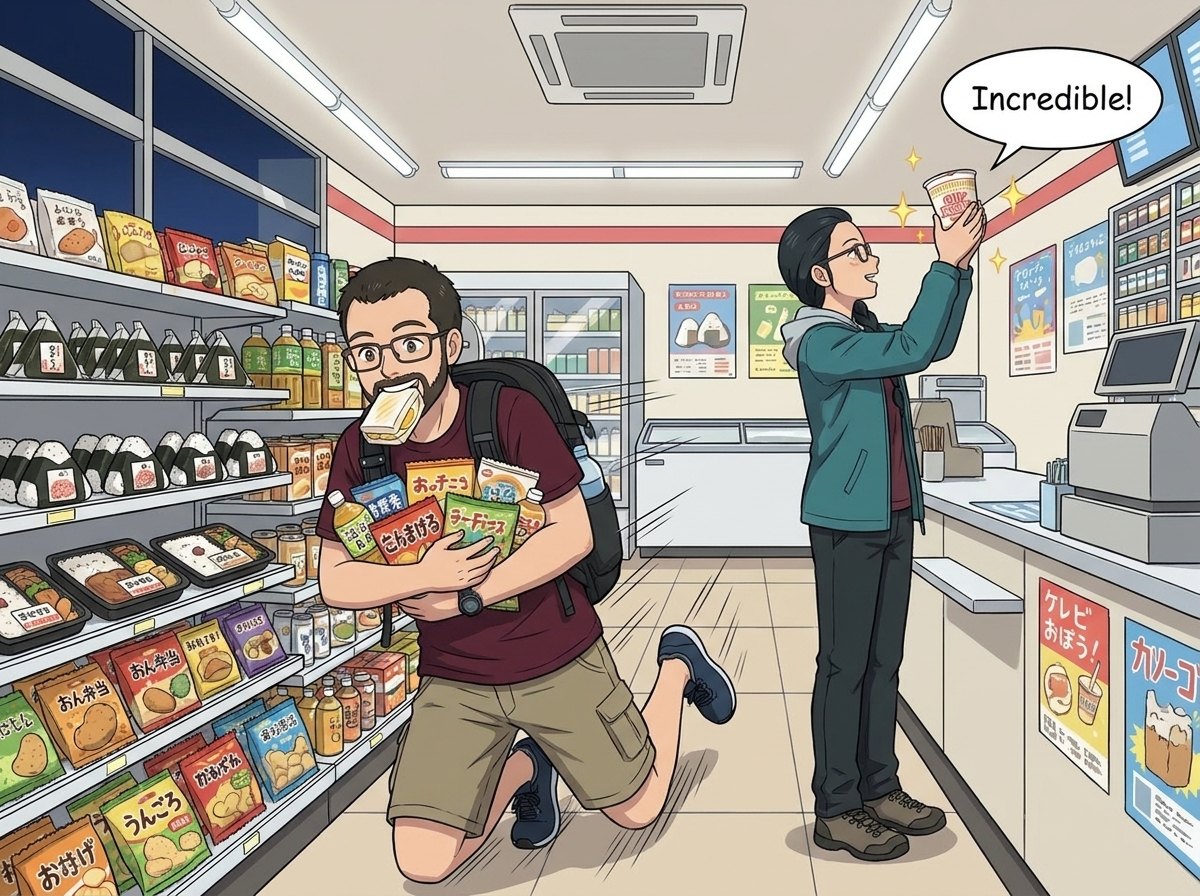
The konbini By the time we reached the hotel it was late, so dinner came from the Lawson around the corner.
I devoured a bowl of roast pork ramen and a legendary egg sando. Jess tried her very first pot of Cup Noodles. Her mind was completely blown, mostly because she could not work out how a bloke from Orange knew more about Asian instant noodles than she did.
First konbini
This was one of the few times I was the expert.
The final boss Then came the final boss of Day 1: the hotel toilet.
Boss battle 1DADVSTHE NASA SPACESHIP TOILET
I did not even need to go. I just wanted to test-drive it. The moment I sat down, I jumped. The seat was heated! A surprising number of toilet seats in Japan are warm, which is lovely, but it plays a trick on your brain. It feels suspiciously like an invisible stranger was sitting there three seconds before you walked in.
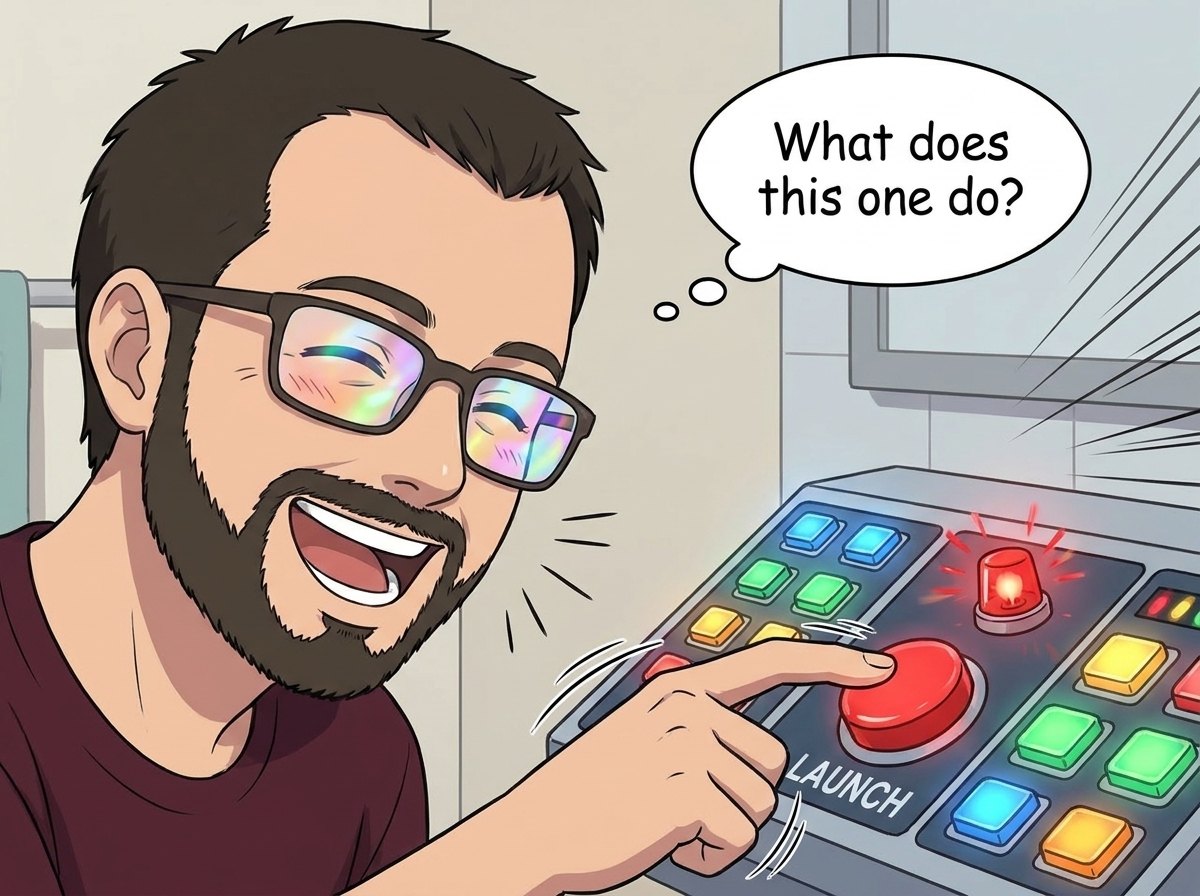
Next to my knee was a control panel with more buttons than the Space Shuttle. I do not read instructions. You both know this. The buttons had little pictures on them, which were no help at all, so I pressed them all.
The button
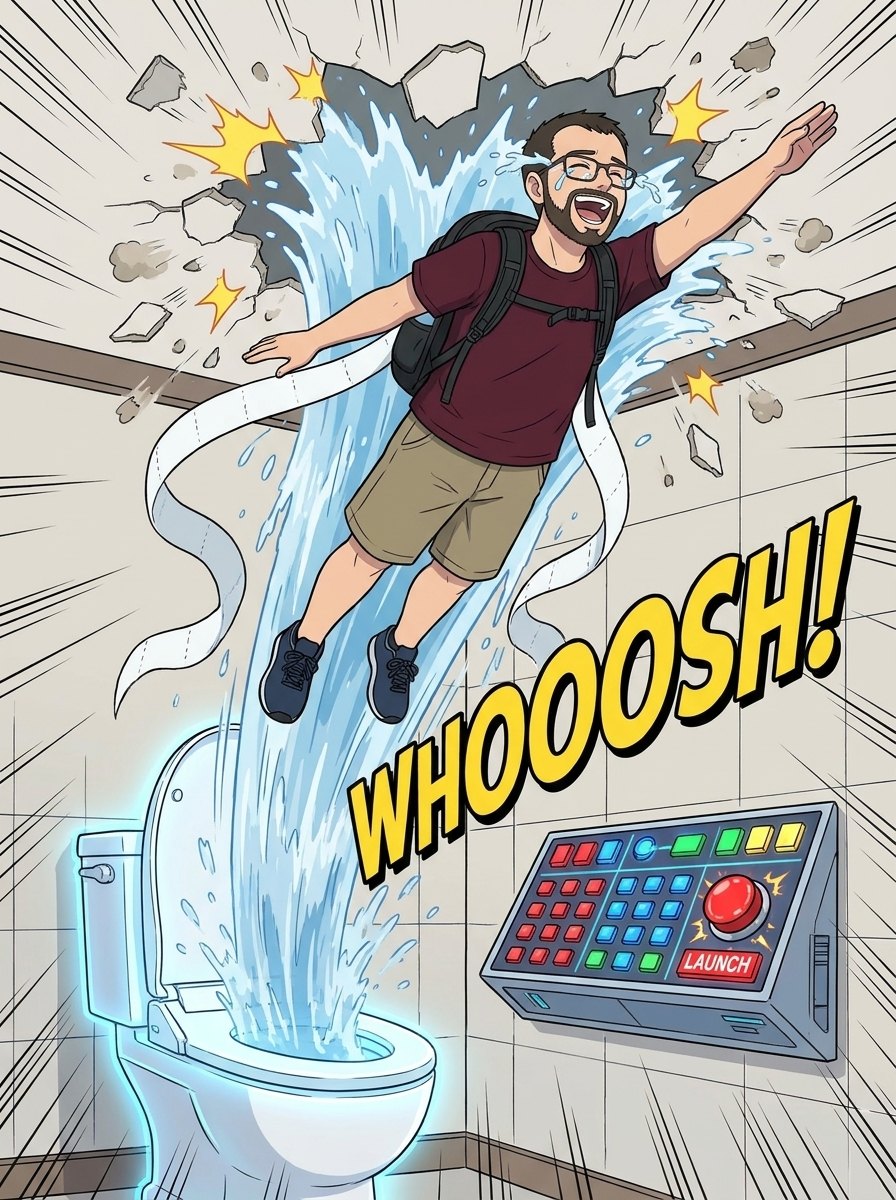
Heat. Spray. Wiggle mode. Wide mode. Massage. One played music. One made a noise like a small jet engine starting up. One was a turbo-blaster that I am fairly sure was designed to strip paint off a fence.
Lift-off
Even finding the flush is a puzzle. More than once on this trip I pressed the power button by mistake and shut the whole toilet computer down instead. At least I never hit the ejector seat.
It was such an unusual sensation that I laughed so hard I nearly fell off. And I now believe I know the secret of why Japanese people are so cheerful.
Japan fact file
Kansai Airport is built on a man-made island in Osaka Bay. Engineers piled up enough rock and soil to make a whole island, then built the airport on top. The man-made island has gradually settled over time, and engineers designed ways to adjust some of the structures.
Taxi doors in Japan open and close by themselves. The driver presses a button. Do NOT grab the door. It will fight you.
Japan drives on the left side of the road, just like Australia. The cars still felt faster.
The high-tech toilet is called a washlet. The company Toto made the first one in 1980, and today most homes have one. Buttons often include a heated seat, a warm-water spray, a dryer, a deodoriser and a button that plays a flushing sound to cover up any embarrassing noises.
コンビニ
Word of the day
Konbini
say it: KON-bee-nee
Convenience store.
The best shop in the world.
Dad's lesson
Everybody is a beginner at something. On day one I was a beginner at airports, taxis and toilets, all at once. Being new at things is not embarrassing. It is where the fun and curiosity starts!
Day2
Knives, Neon and the Great Emergency
Wednesday 21 OctoberOsaka
Jess was up before the sun, walking the streets and photographing fancy drain covers (see, it is not just me). She discovered our hotel was one block from the Tosabori River and a little island called Nakanoshima, with a grand old red-brick hall on it, and that the hall was hosting a light show that very night. Our evening plan, found by accident before breakfast.
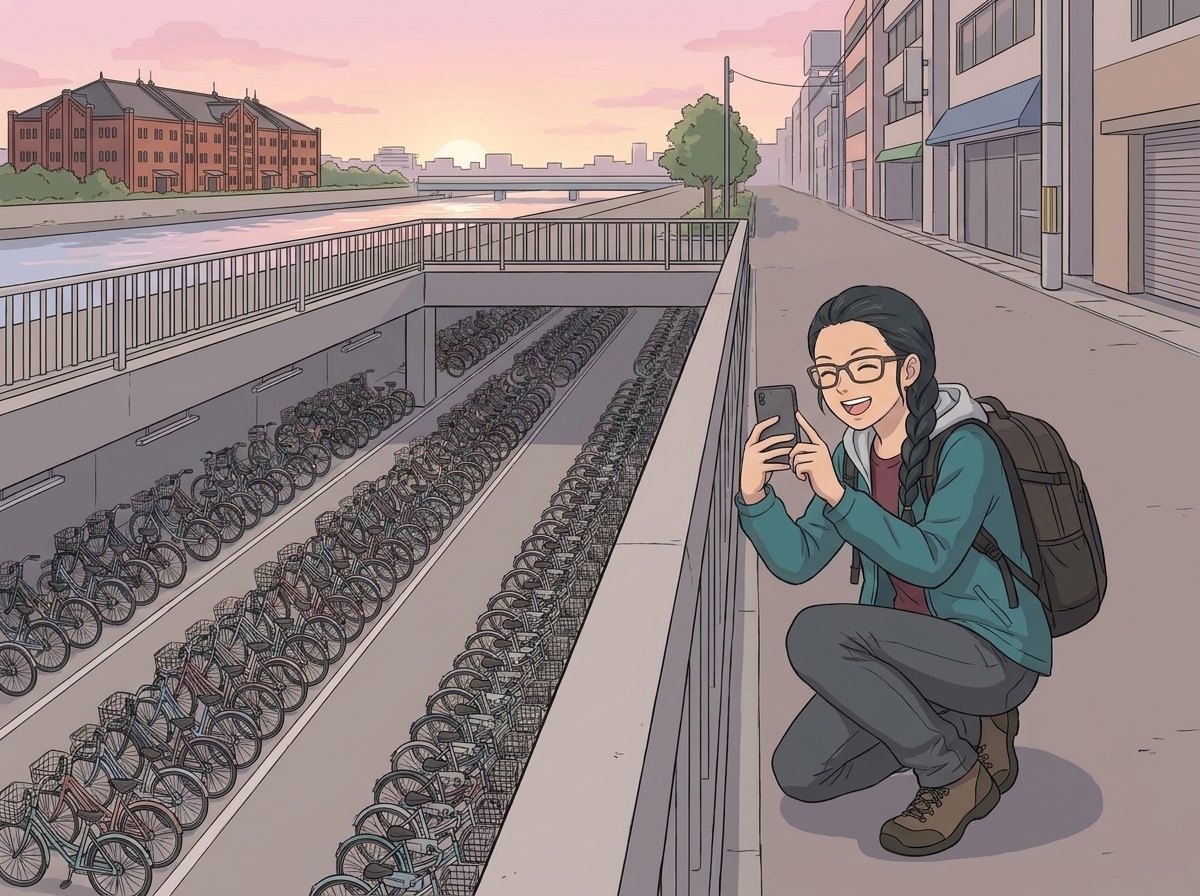
She also found an underground car park just for bicycles. Hundreds of bikes, parked in neat rows, under the footpath.
Bicycle car park
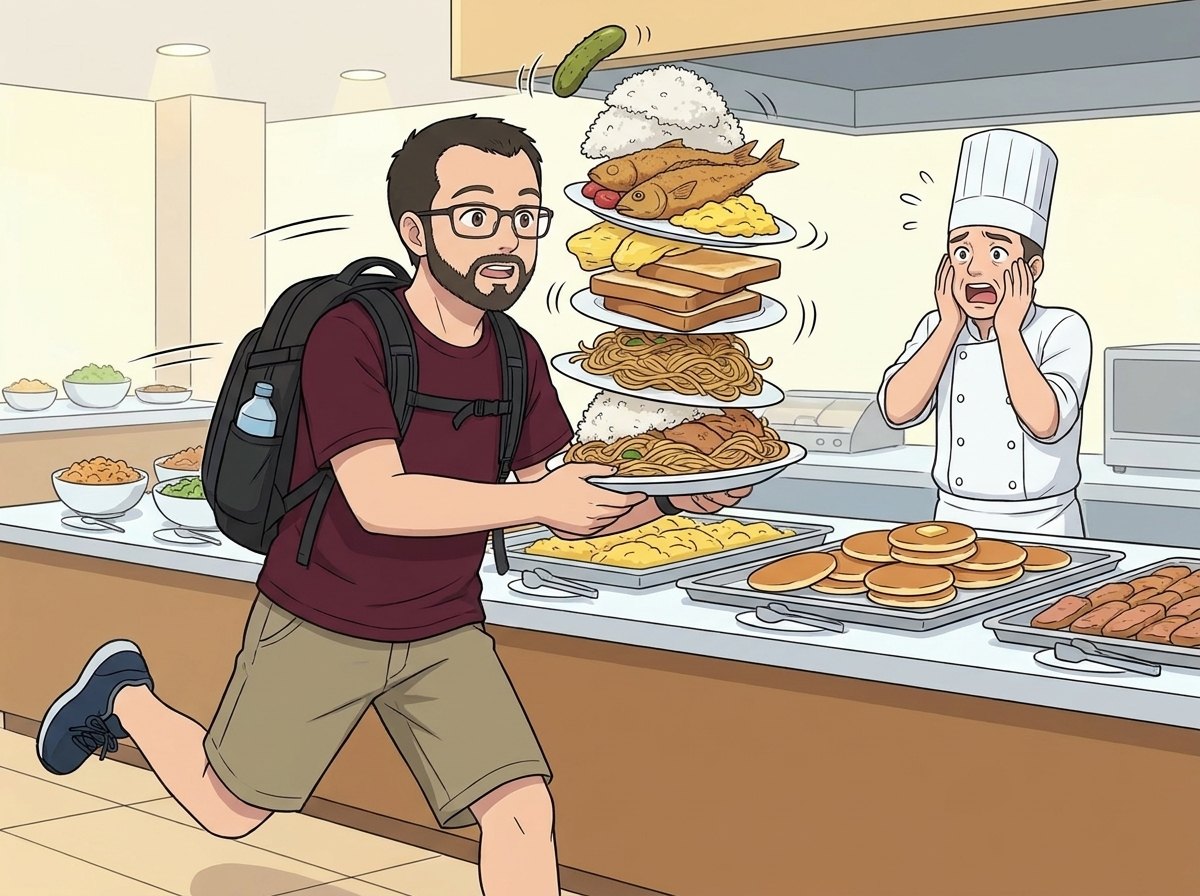
Breakfast was a giant hotel buffet of Japanese and Western food. I tried everything I had never seen before. Pickles. Fish. Rice with raw egg. Some kind of slimy bean. A mountain of mystery.
Breakfast tower
This turns out to be important later.
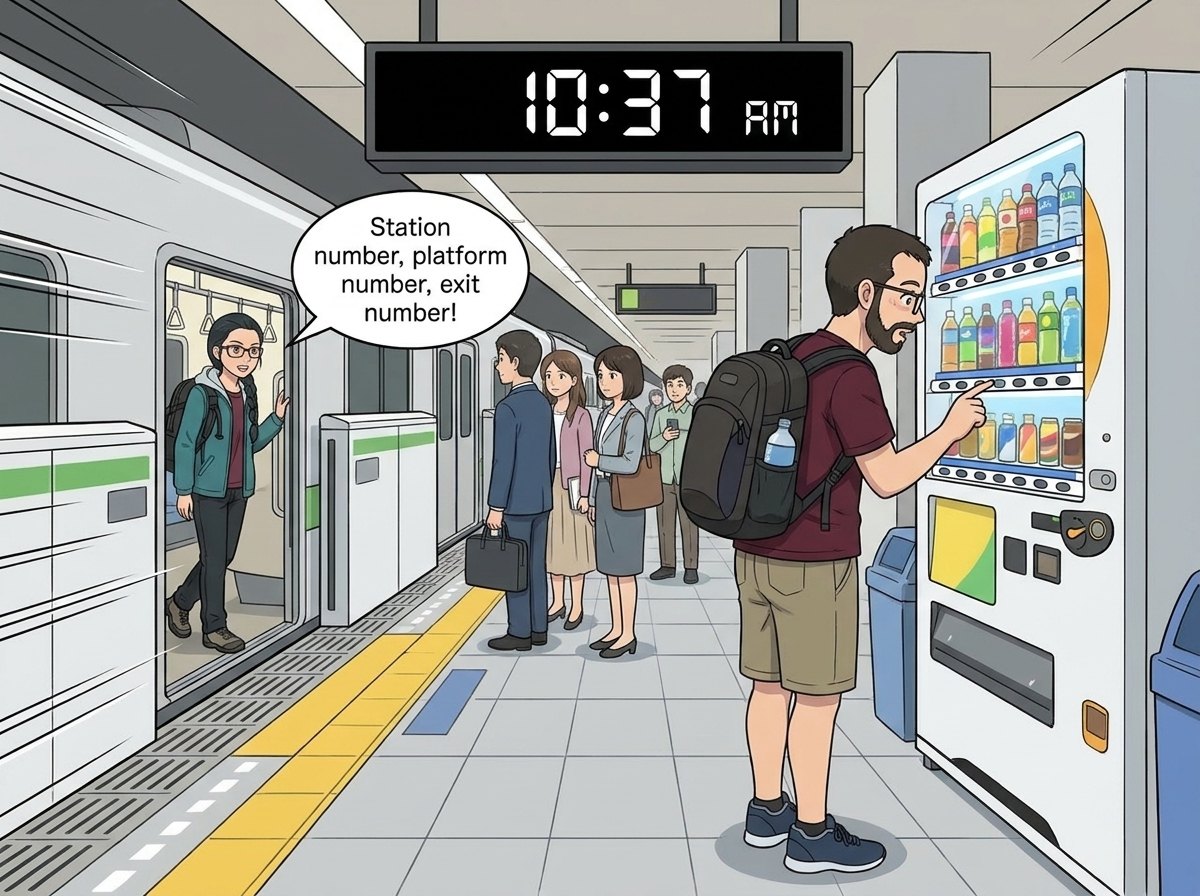
The train Then came my first Japanese train.
To stop me getting lost forever, Jess taught me her Golden Rule of Trains: only look at three things in Google Maps. The Station Number. The Platform Number. The Exit Number. Ignore everything else.
I nodded wisely while staring at a shiny vending machine, and understood approximately zero per cent of it.
Exactly on time
The train arrived at exactly the second the sign said it would.
My stomach, however, did not run to a timetable.
The Emergency One hour after leaving the hotel, standing beneath Tsutenkaku Tower in a neighbourhood called Shinsekai, my breakfast decided it wanted to leave. Urgently.
I was prepared. For weeks before the trip I had practised saying "Toire wa doko desu ka?" ("Where is the toilet?"). Whenever I tried it on a real Japanese person, they stared at me in polite confusion. Luckily, I also had a toilet-finder app and emergency tissues. The app pointed around the corner to a public toilet we had just walked past.
It was not a heated, singing spaceship toilet.
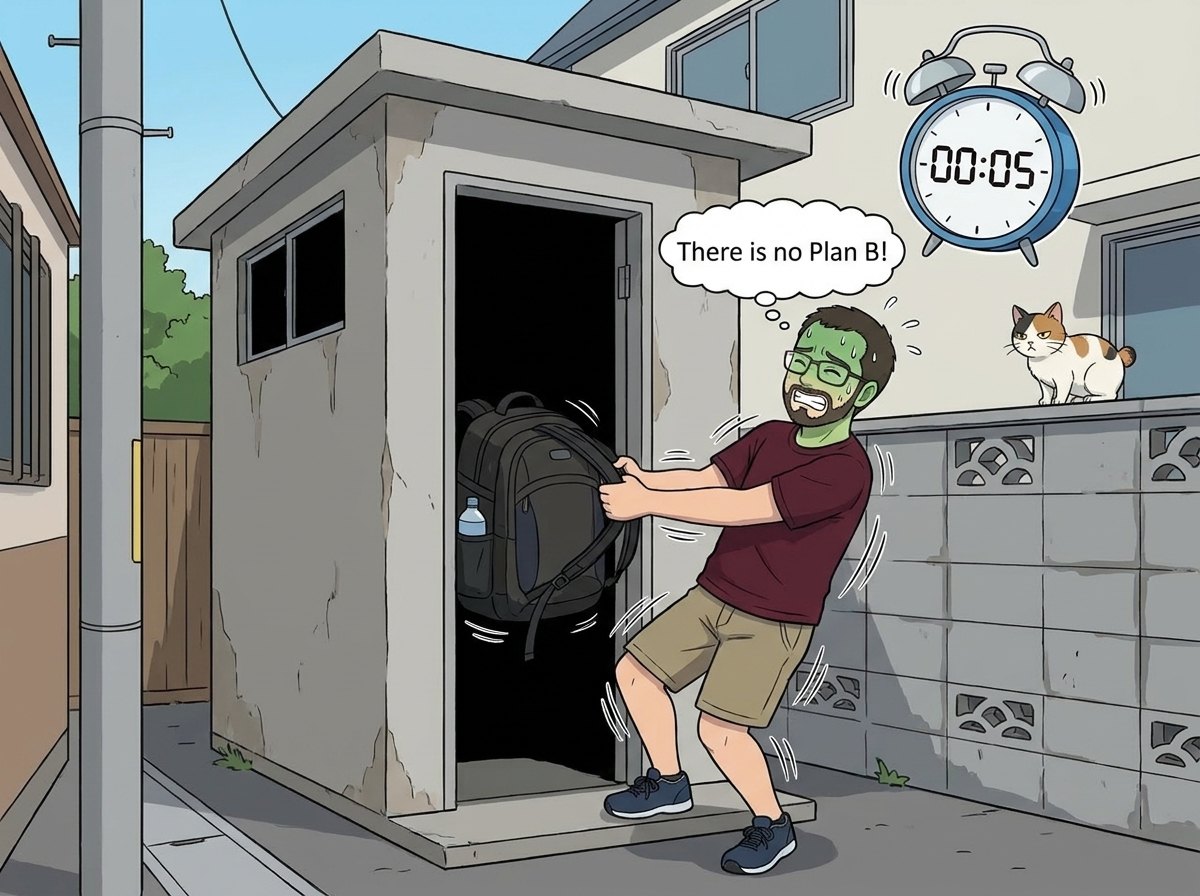
Boss battle 2DAD & HIS CAMERA BAGVSTHE 1941 CONCRETE SQUAT TOILET
It was a squat toilet. A hole in the ground with a footprint either side, in a gloomy concrete bunker that looked like it was built in 1941 and last cleaned the same year. The next toilet was ten minutes away. There was no Plan B.
The door opened inwards. My camera backpack would not fit past it. The clock was ticking. I stood there wrestling the bag, the door and destiny, thinking: what have I done, and more importantly, what have I eaten?
The emergency
Twenty-four hours earlier I had been enjoying a heated, musical, NASA-grade spa toilet. Now I was playing solo Twister in a concrete phone box with a camera bag jammed against my spine and a countdown.
The squat toilet won on points. I vowed to respect(ish) the hotel buffet from that day forward.
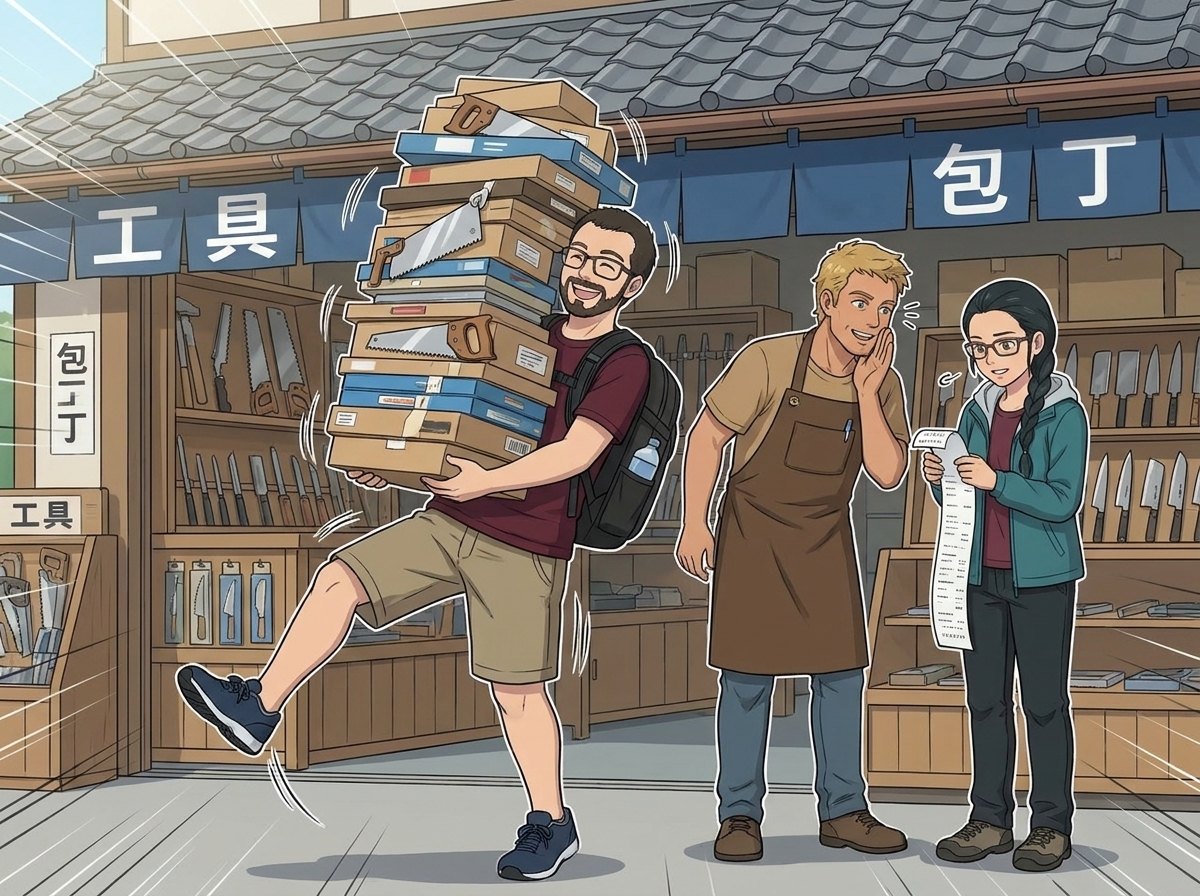
Tower Knives Once I had survived, we visited a shop called Tower Knives. Sending a maker into a Japanese tool shop is dangerous. I did not buy a single kitchen knife. I bought razor-sharp Japanese pull saws and tool blades instead.
Too many blades
(Fun fact: Many Western saws cut when you push them, which can bend the blade, so the metal has to be thick. Japanese saws cut when you pull, so the blade can be super thin and make laser-neat cuts.)
The salesman turned out to be from the Gold Coast, with a New Zealand accent. When he saw (pun intended) my pile of tools he leant in and whispered a tip: there was another shop across town, a leather shop, run by a short, round, bald man who rides a Harley-Davidson motorbike and is known to everyone as Japanese Uncle Fester.
We wrote it down. We had a quest.
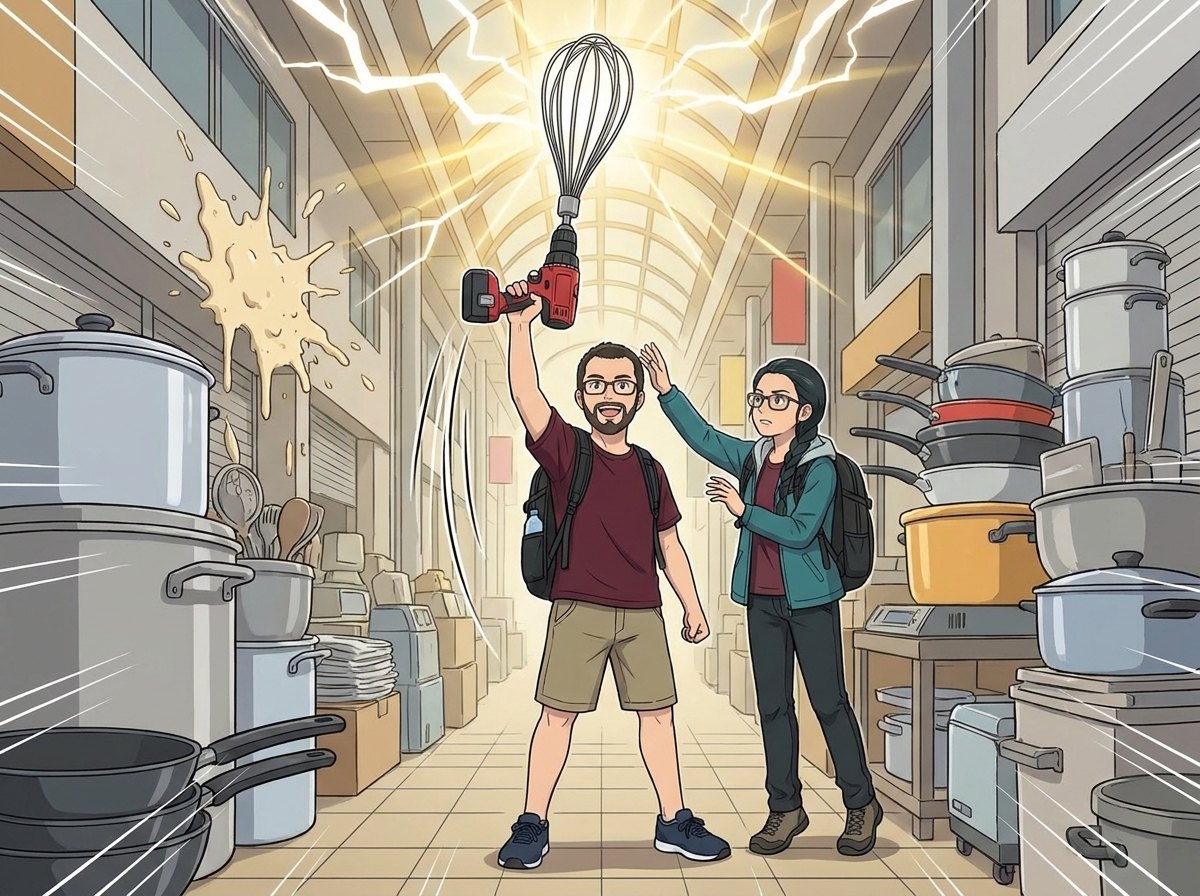
Kitchen Street Next stop was Doguyasuji, the arcade where Osaka's restaurant chefs buy their gear. Pots the size of bathtubs. Knives a metre long. A whisk so enormous that it attaches to a power drill, so you could mix a bathtub of cake batter. If it had fitted in my suitcase, it would be in our kitchen right now.
The drill whisk
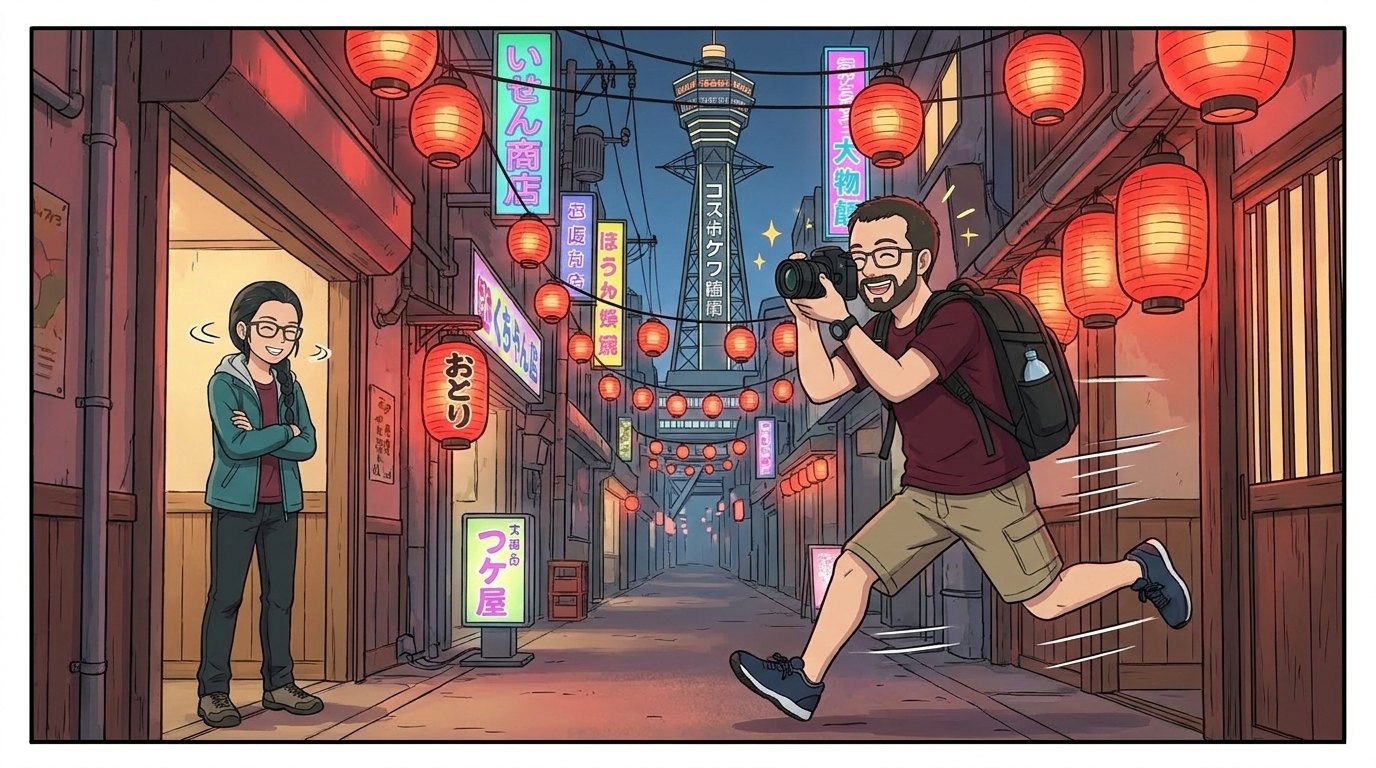
Then I photographed neon signs, lanterns, wires and alleyways until my camera begged for mercy.
Neon alley
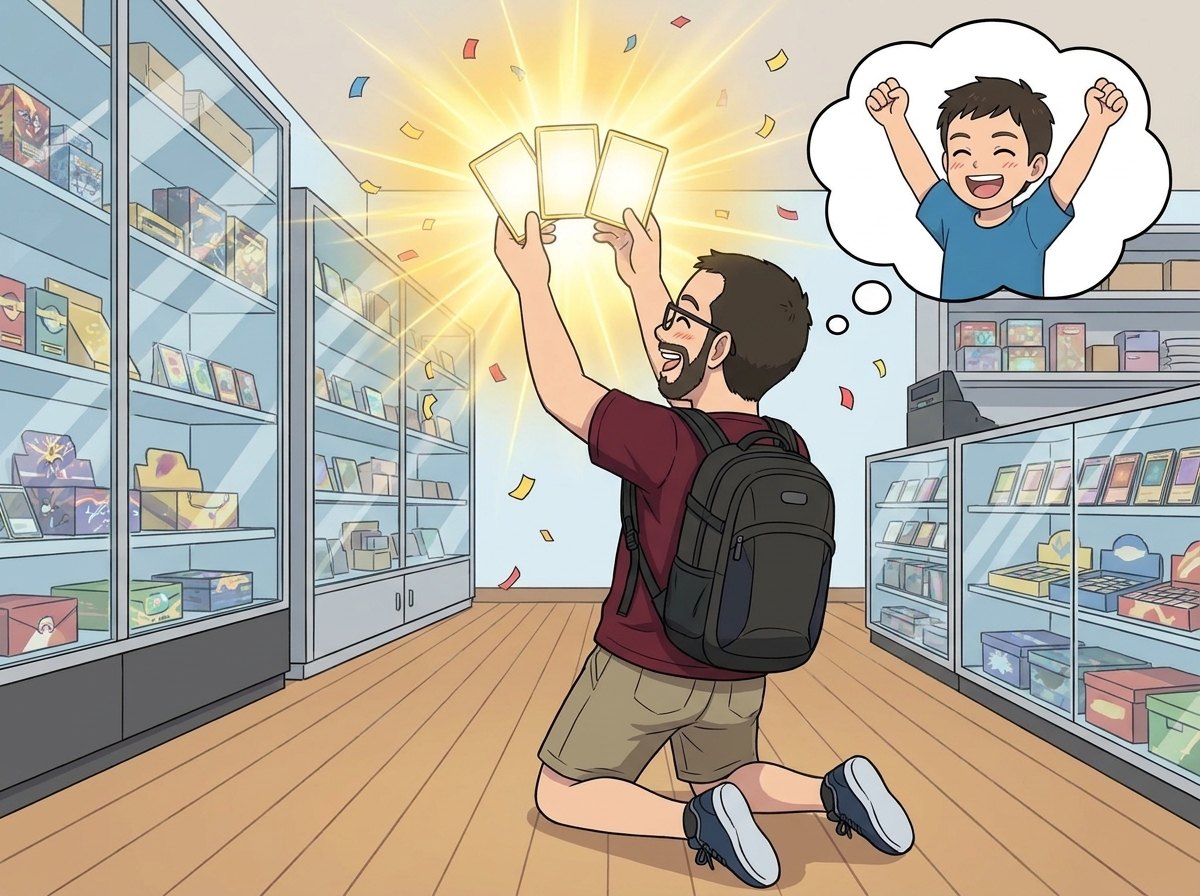
The Hunt Begins Osaka's Pokémon card shops are stacked wall to wall with glass cabinets of tiny cardboard rectangles, some with price tags that would buy a second-hand car. We searched. We squinted. And we came away with three: a Bulbasaur, an Ivysaur AND a Venusaur. The full evolution line.
Mission complete
Mission One: Complete on day two! (Of course, we still checked out every single Pokémon card shop we passed for the rest of the trip, just to see what else was out there. That is how I later tracked down the other cards and the ultimate bonus treasure: an original 1996 Japanese "Pocket Monsters" Bulbasaur card in mint condition!)
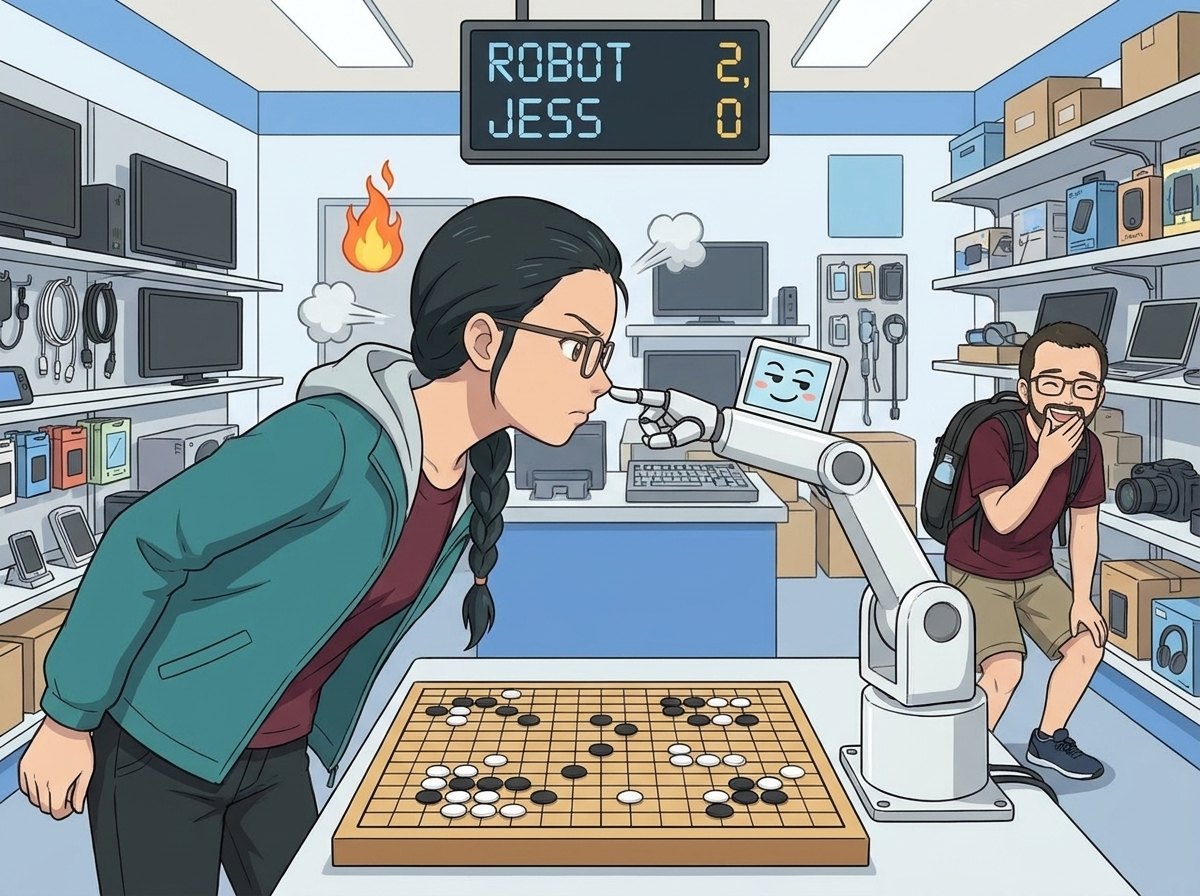
Beaten by a Robot Later, in Edion, a ten-storey technology store with floor after floor of gadgets, I wandered around in awe of the robots. Jess sat down to play an ancient board game called Go against a robot arm.
Boss battle 3JESSVSTHE SILENT GO ROBOT
The screen was entirely in Japanese, so she could not read the instructions or tell what difficulty it was set to.
The robot beat her. She played again. The robot beat her again.
Beaten by a robot
The robot said nothing. Somehow that made it worse.
She took it very, very personally.
The Light Show That night we walked over to the island for the Nakanoshima Art Lights. There was a special spot where an assistant takes your glamorous holiday photo for Instagram. Neither of us knew how to do an Instagram pose. It did not matter. Every single photo came out blurry.
The Instagram pose
Japan had delivered its second day: tools, trains, robots, Pokémon and a toilet I would prefer never to meet again.
Japan fact file
Shinsekai means "New World". It was built in 1912 and designed to look like Paris in the north and New York's Coney Island in the south.
Tsutenkaku Tower is 108 metres tall. The original was modelled on the Eiffel Tower. Inside sits a grinning statue called Billiken, the god of "things as they ought to be". People rub the soles of his feet for luck.
Japan has several kinds of toilets, including the space-age washlet and the old-fashioned squat toilet. Squat toilets are getting rare, but you still find them in parks, old stations and when it's an emergency.
Osaka's knife-making tradition comes from the nearby town of Sakai, where blacksmiths have been forging blades for more than 600 years. They once made weapons and later became famous for kitchen knives.
Pokémon was invented in Japan in 1996 as a Game Boy game. The name is short for "Pocket Monsters". The trading cards came out the same year.
Go is one of the oldest board games in the world, over 2,500 years old. It has simple rules and more possible games than there are atoms in the universe, which is Jess's excuse.
トイレは どこですか?
Word of the day
Toire wa doko desu ka?
say it: TOY-reh wah DOH-koh dess kah
Where is the toilet?
I practised this for weeks. Nobody understood me once. Pointing, plus a small worried dance, works better.
Dad's lesson
Jess's Golden Rule of Trains: station number, platform number, exit number. Nothing else matters. I understood this in theory from day two. In practice, it took a little longer.
Day3
Giant Oysters, Uncle Fester and the Cheesecake That Would Not Be Defeated
Thursday 22 OctoberOsaka
Some people travel to see castles. Others travel to visit museums.
Jess and I began our third day in a seafood wholesale market.
In most countries, a day of shopping is boring. In Japan, a day of shopping is an expedition.
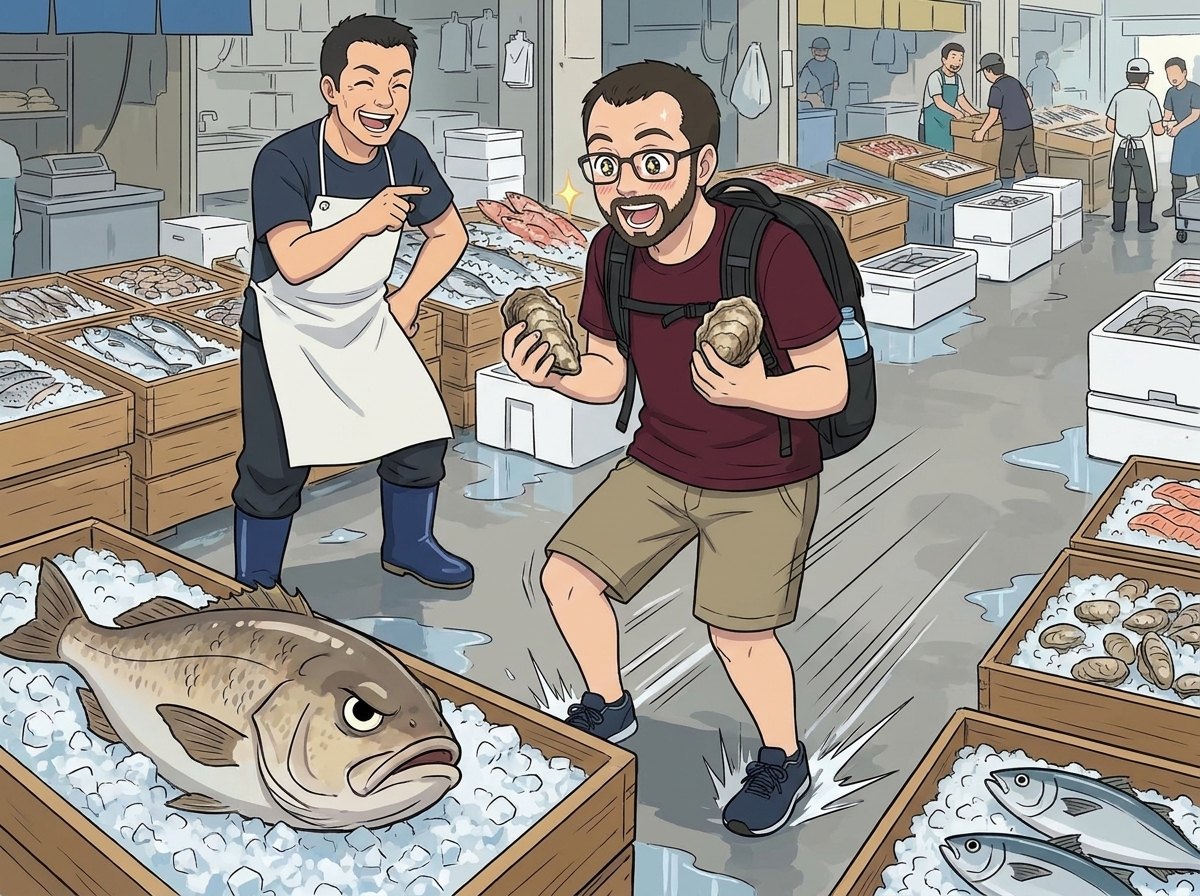
The fish market Kizu Market is where Osaka's restaurant chefs buy their seafood, and it is not designed for tourists. There were oysters the size of my fist. There were fish I did not know existed, fish with faces like grumpy teachers, fish that looked like they had been designed by a five-year-old with a packet of crayons.
The fish market
My one regret: I had already eaten the hotel breakfast and could not fit any in. (No toilet emergencies today, in case you were wondering. I know you were.)
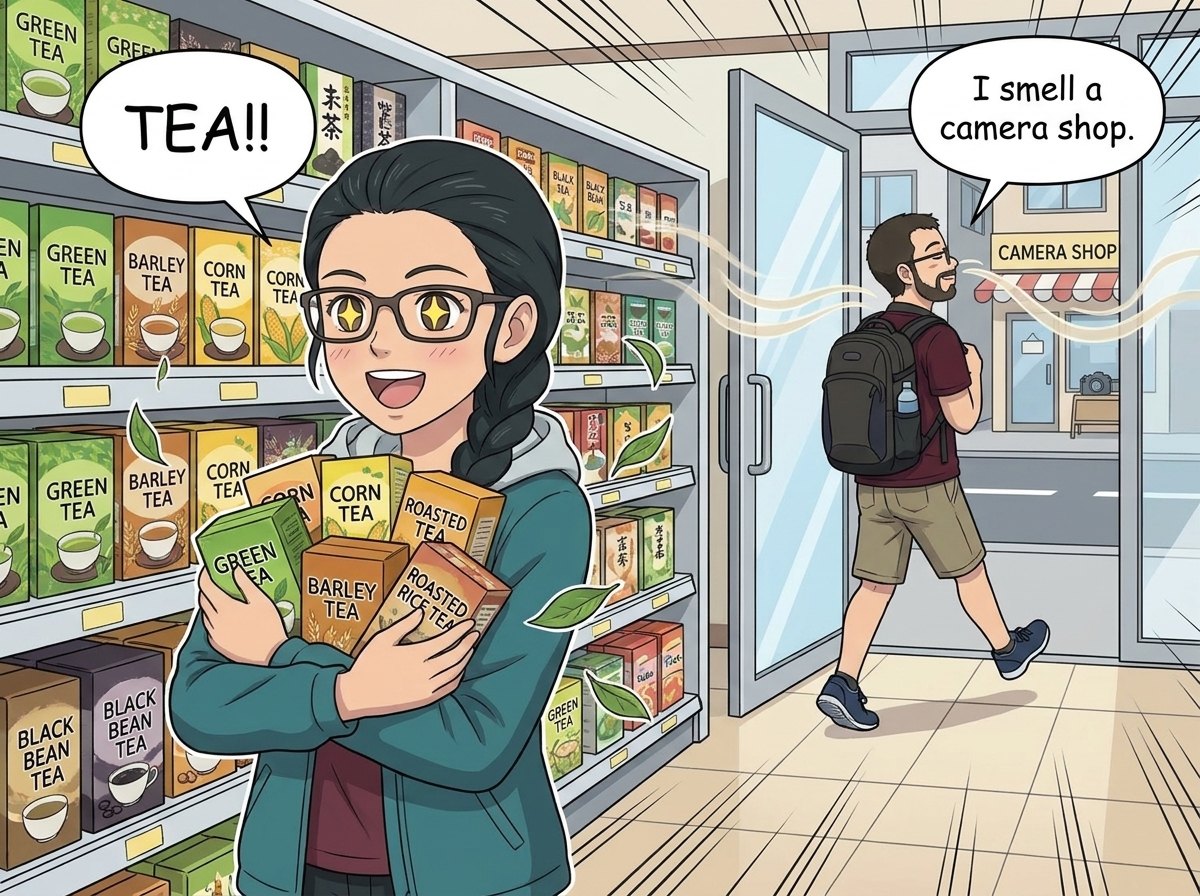
TEA!! Next we went to a chef's supermarket. Then Jess found the tea aisle.
"Phil. Look at this."
Her voice had changed. This was no longer shopping. This was a scientific discovery.
Green tea. Roasted barley tea. Corn tea. (Later in the trip she found black bean tea, and it became her absolute favourite.) And genmaicha, green tea mixed with toasted puffed rice, which is basically Rice Bubbles in a cup. She lit up like a Christmas tree and explained every single one to me while I nodded, quietly trying to take it all in.
Here is the thing about Jess and me. I can find a camera shop from three streets away. Jess can find tea and pastries from three suburbs away. Between us we make a very strange pair of sniffer dogs.
The tea aisle
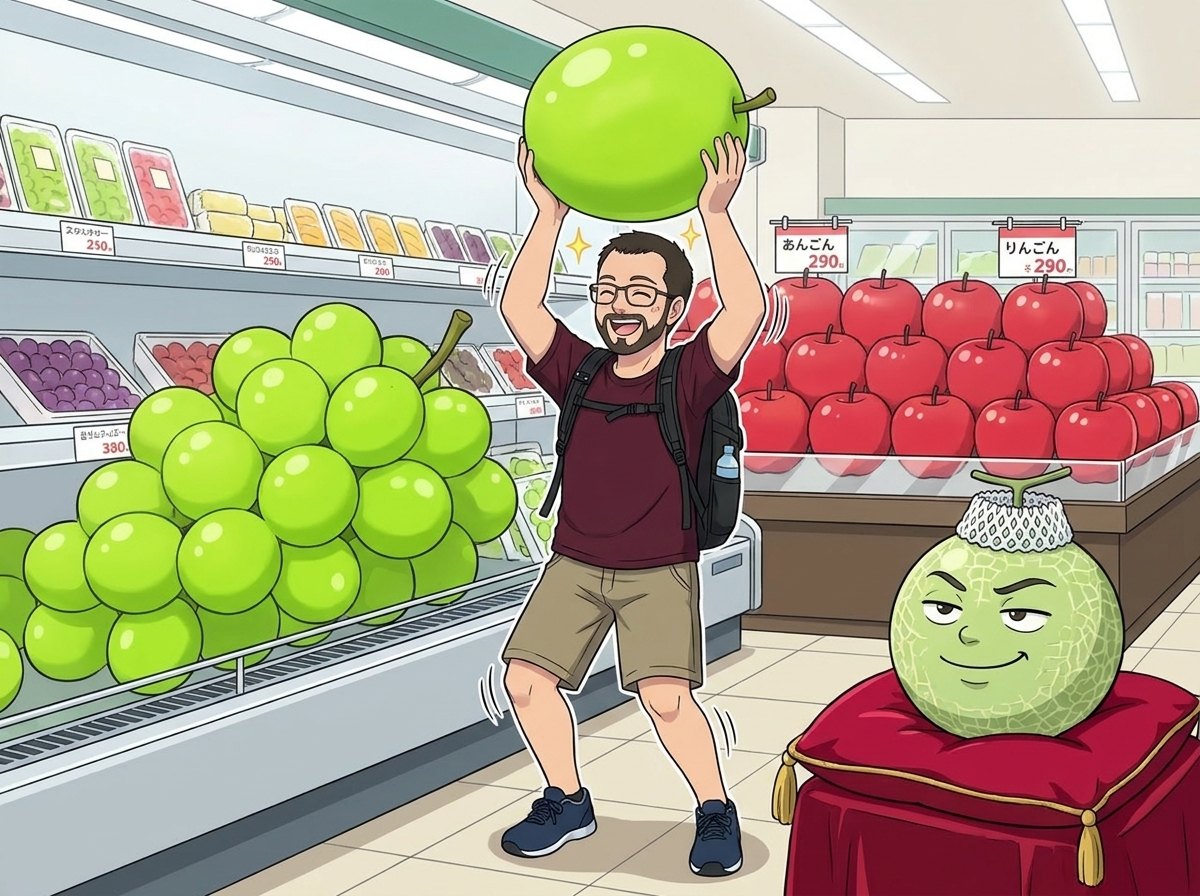
Giant fruit Lunch came from Life, the supermarket where ordinary Osaka families do their weekly shop (like Woolworths). And here is something that blew my mind: Japanese fruit is ENORMOUS. Grapes the size of golf balls. (I checked that they were not secretly plums wearing grape costumes.) Apples the size of your head. Every strawberry looks like it was polished by a jeweller for a royal portrait. And there are aisles and aisles of sushi!!
Giant fruit
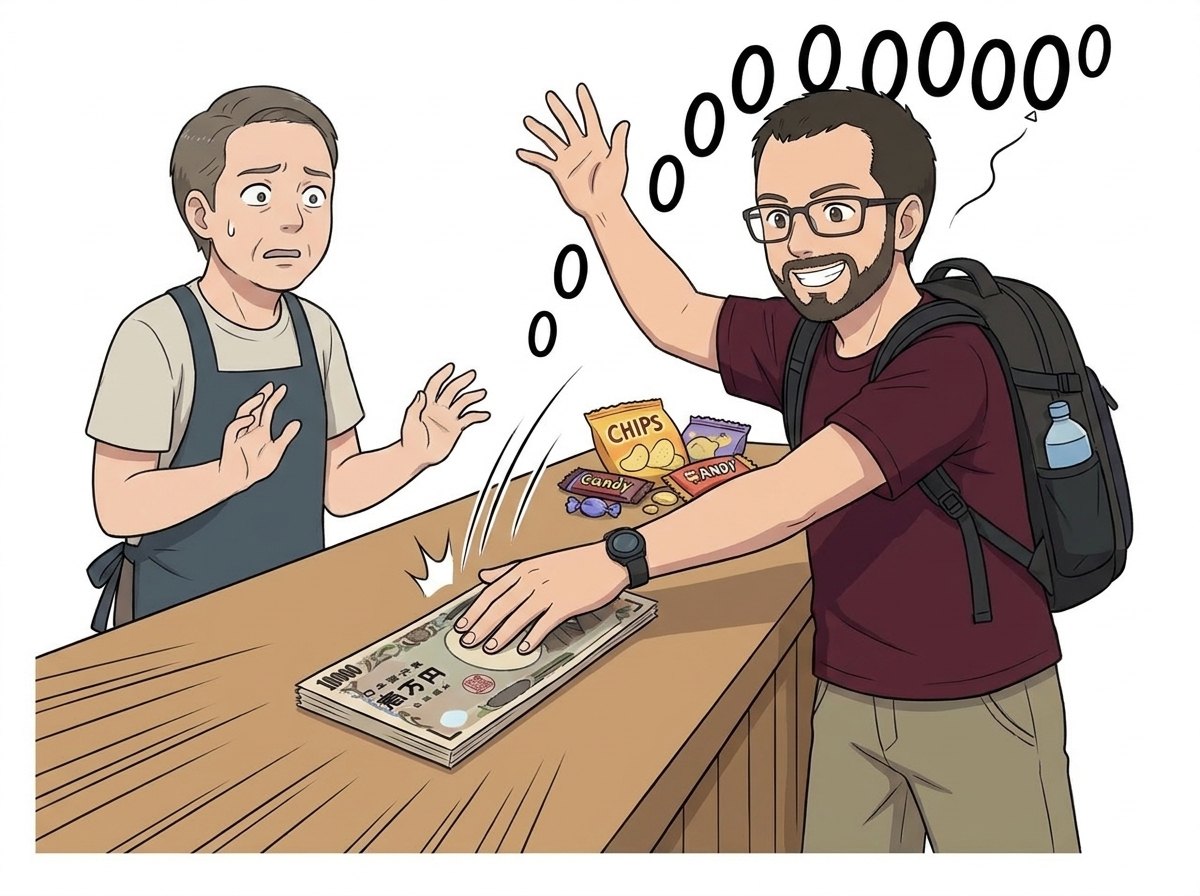
Paying at the register, however, revealed The Trouble With Zeros.
The ¥1,000 and ¥10,000 notes look quite similar when you are in a hurry. So I kept handing over hundred-dollar notes to pay for ten-dollar snacks, and having most of it politely handed back.
Even worse was the time the bill was ¥10,000 and I proudly handed over ¥1,000 with a big grin. I received a look of quiet horror, and the polite Japanese version of "bless your cotton socks".
The zeros
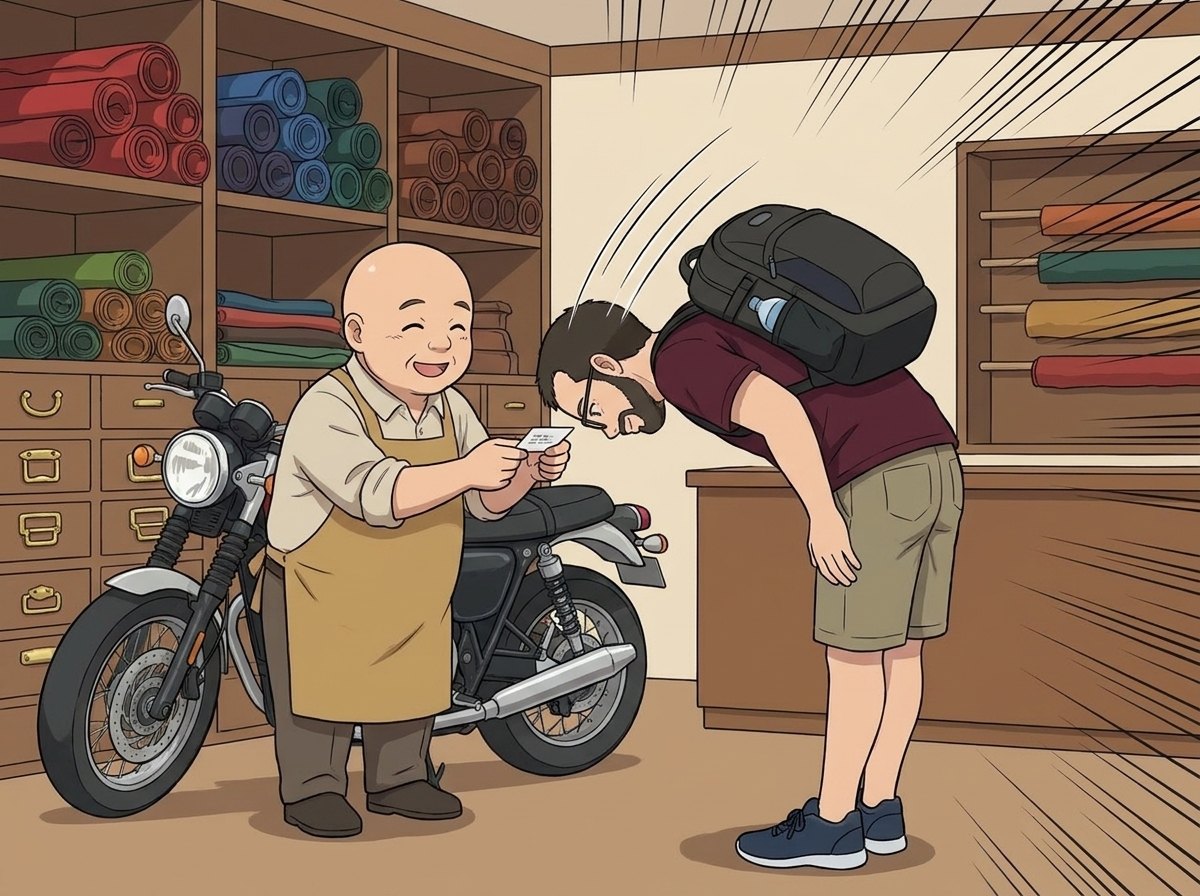
Japanese Uncle Fester Remember the tip from the knife shop? After lunch we made the pilgrimage across town to Leather Phoenix, and it was an Aladdin's cave. Walls of leather hides in every colour. Drawers of brass buckles. Racks of tools I did not know the names of but immediately wanted.
And there, behind the counter, exactly as advertised: a short, round, bald, smiling man who rides a Harley-Davidson. The legend, in the flesh.
He handed me his business card, which in Japan you must take with BOTH hands and a polite nod, and look at carefully, like it is a tiny precious gift. Then he told me he ships to Australia.
The business card
Dangerous information.
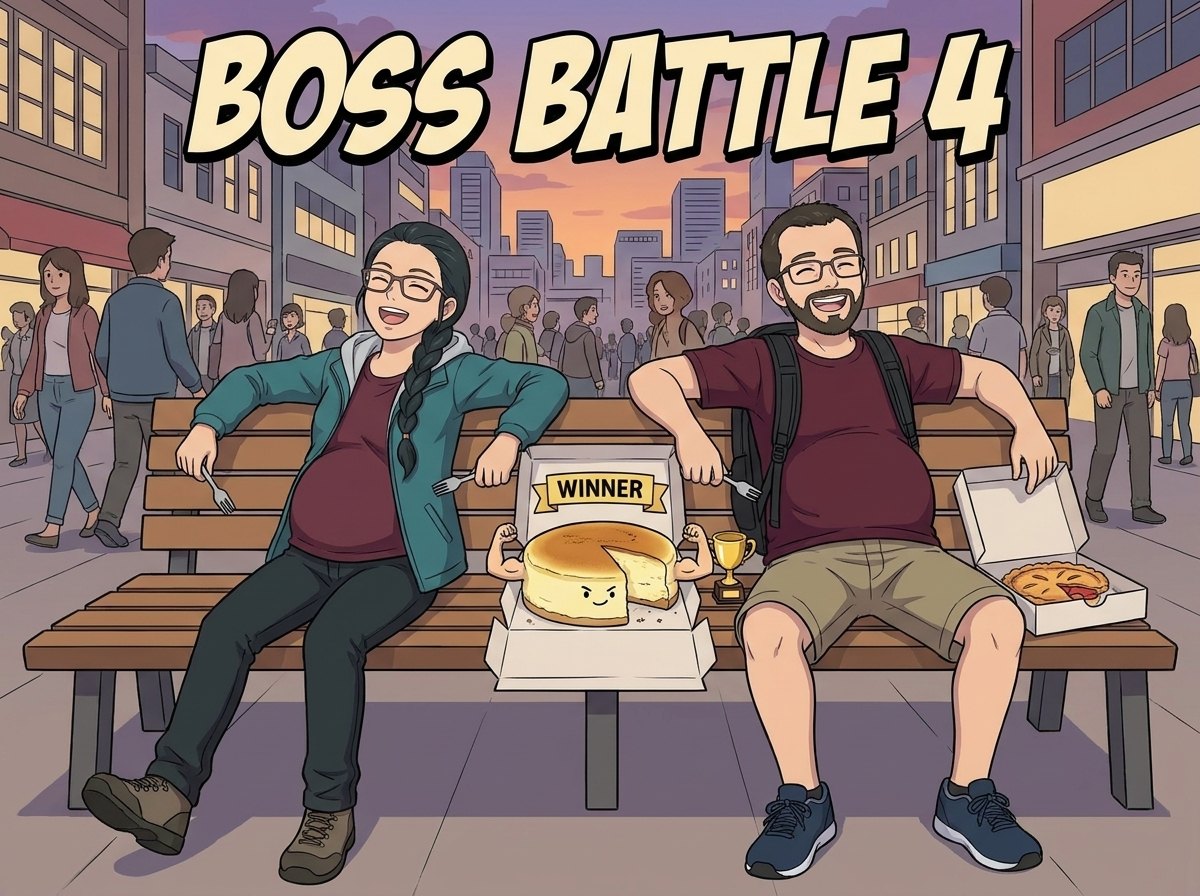
The Cheesecake In Umeda, Jess's Pastry Radar locked on to Rikuro's, a famous bakery that sells a soufflé cheesecake so soft and fluffy that it wobbles like jelly. They ring a bell every time a fresh batch comes out of the oven.
Jess announced she could eat an entire family-size one by herself. I bought the apple pie as a backup.
So we wandered the streets of Umeda carrying a wobbling cheesecake and a warm pie like two people carrying a sleeping baby, until we found somewhere comfortable we were allowed to sit... we think.
Boss battle 4JESS & DADVSTHE GIANT WOBBLING CHEESECAKE
"Half a cheesecake and half an apple pie each?" I suggested.
"Easy," said Jess.
We ate.
We paused.
We looked at the cake.
The cake looked back.
It won. Despite all our big talk, the two of us combined could only eat half.
The cheesecake wins
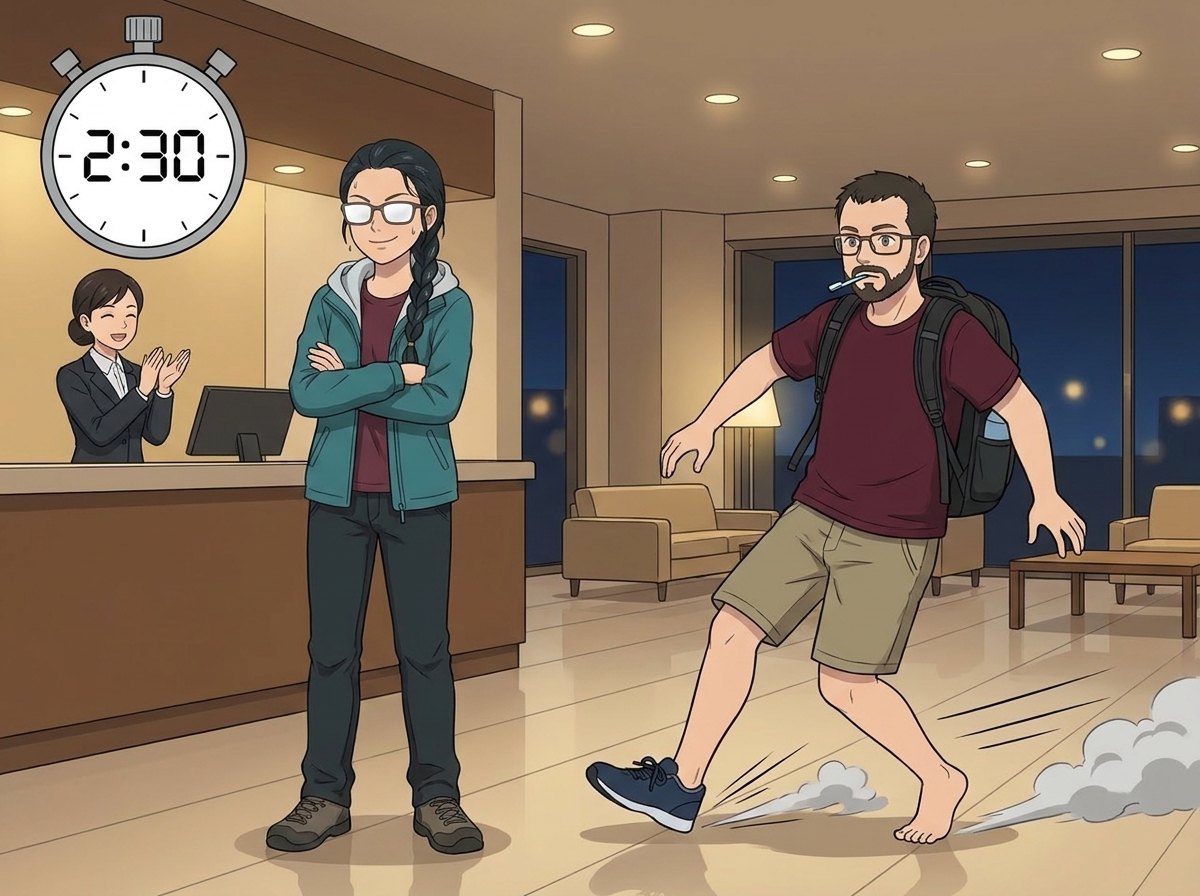
Two and a half minutes We had said goodnight. Then I discovered that Osaka Castle was lit up with a light show that evening. I messaged Jess: interested?
She replied: "About to hop in the shower, ready in three minutes."
She was ready in two and a half. INCLUDING the shower. She beat me to the lobby. I still do not understand how this is physically possible.
Two and a half minutes
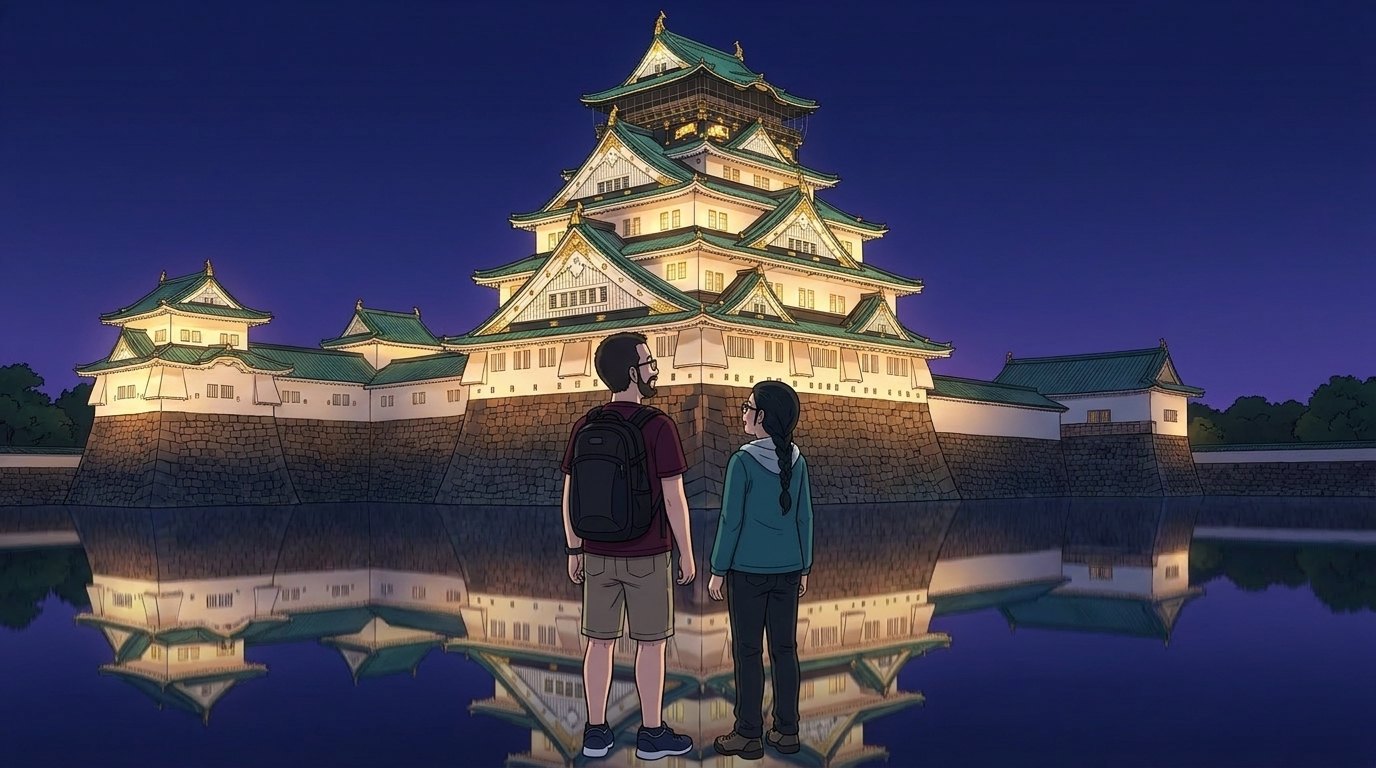
The tree There was a story projected onto the castle that we watched, then the castle stayed lit up. The castle was spectacular, glowing gold and white against the night sky.
Osaka Castle at night
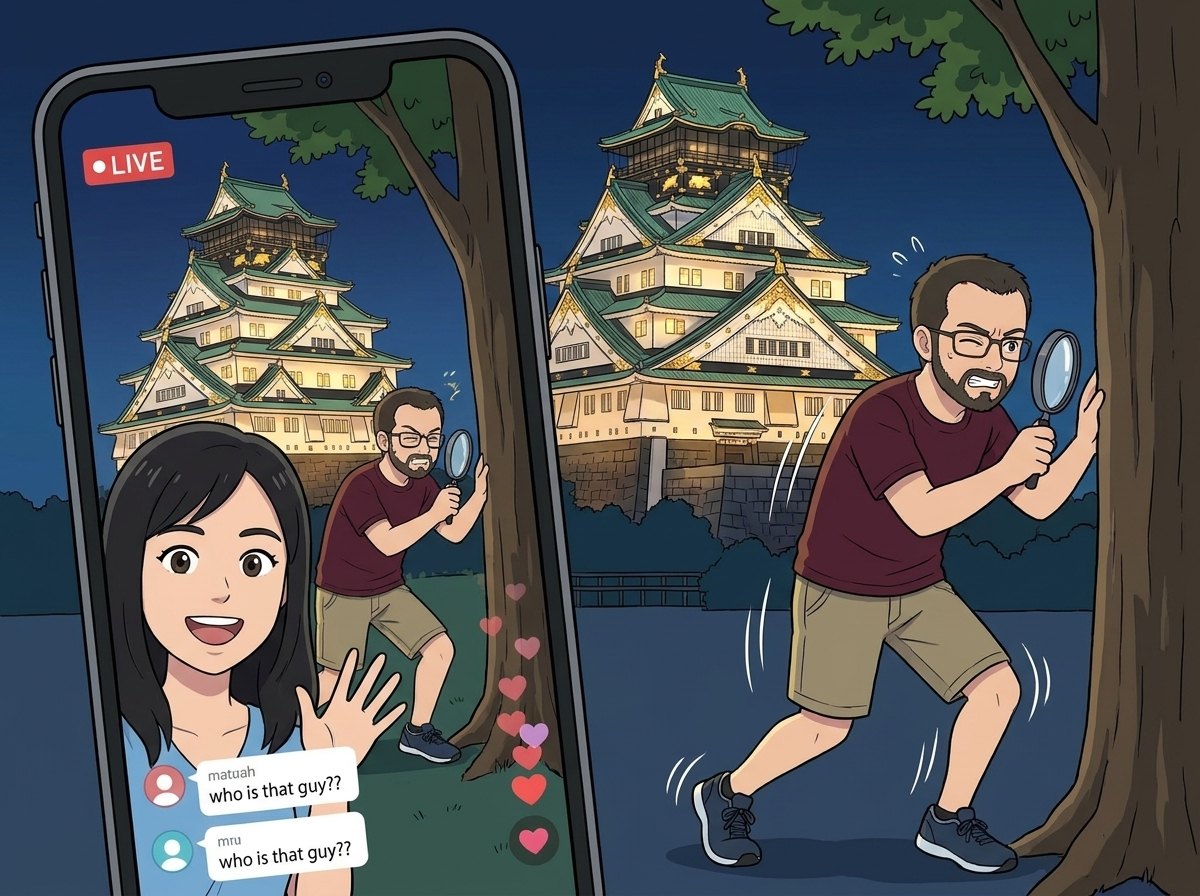
While walking around it, I spotted a group of young people pointing their phones very seriously at a tree. A tree!
Thinking there must be a rare owl or a giant beetle in the branches, I crept up right behind them and squinted hard at the leaves. I stared at the tree. I stared harder.
Two minutes later I realised the phones were in selfie mode. They were not photographing the tree at all. They were live-streaming themselves to their fans, with the glowing castle behind them.
Live-stream photobomb
So if you ever watch a video of Osaka Castle at night and see a confused dad from Orange wander into the background and stare deeply at a completely empty tree, that is your father. Hello.
Japan fact file
Osaka Castle was first built in 1583 by a warlord called Toyotomi Hideyoshi. It has burnt down, been blown up and been rebuilt several times. The castle you see today was rebuilt in 1931 and even has a lift inside.
The castle's stone walls contain some of the biggest stones ever moved by hand. The largest, the Octopus Stone, weighs about 108 tonnes, as much as 20 elephants.
Business cards (meishi) are a big deal in Japan. A person's card stands for their hard work and who they are. You give and receive them with both hands, read them carefully, and never shove them in your back pocket. That would be like sitting on someone's cat.
Japanese fruit is expensive because farmers grow it to be perfect, sometimes one melon per vine, each wrapped in its own little hat. Fancy fruit is often given as a special gift.
You will notice there are almost no rubbish bins on the street. People carry their rubbish home. The streets are spotless anyway, and I even got several photos of people scrubbing walls and footpaths during the trip.
おいしい!
Word of the day
Oishii!
say it: oy-SHEE
Delicious!
Say it after your first bite and watch the chef smile.
Dad's lesson
Money in Japan comes in big numbers, and the notes look alike. Count your zeros. Then count them again.
Day4
The Birthday Ballerina and the Tornado of Balls
Friday 23 OctoberOsaka → Kyoto
Happy birthday, Jess!
Today was Jess's birthday, which meant there was only one sensible plan: do absolutely everything she wanted, at exactly the speed she wanted.
This was a terrifying prospect for a man who needs fifteen minutes to photograph one drain cover.
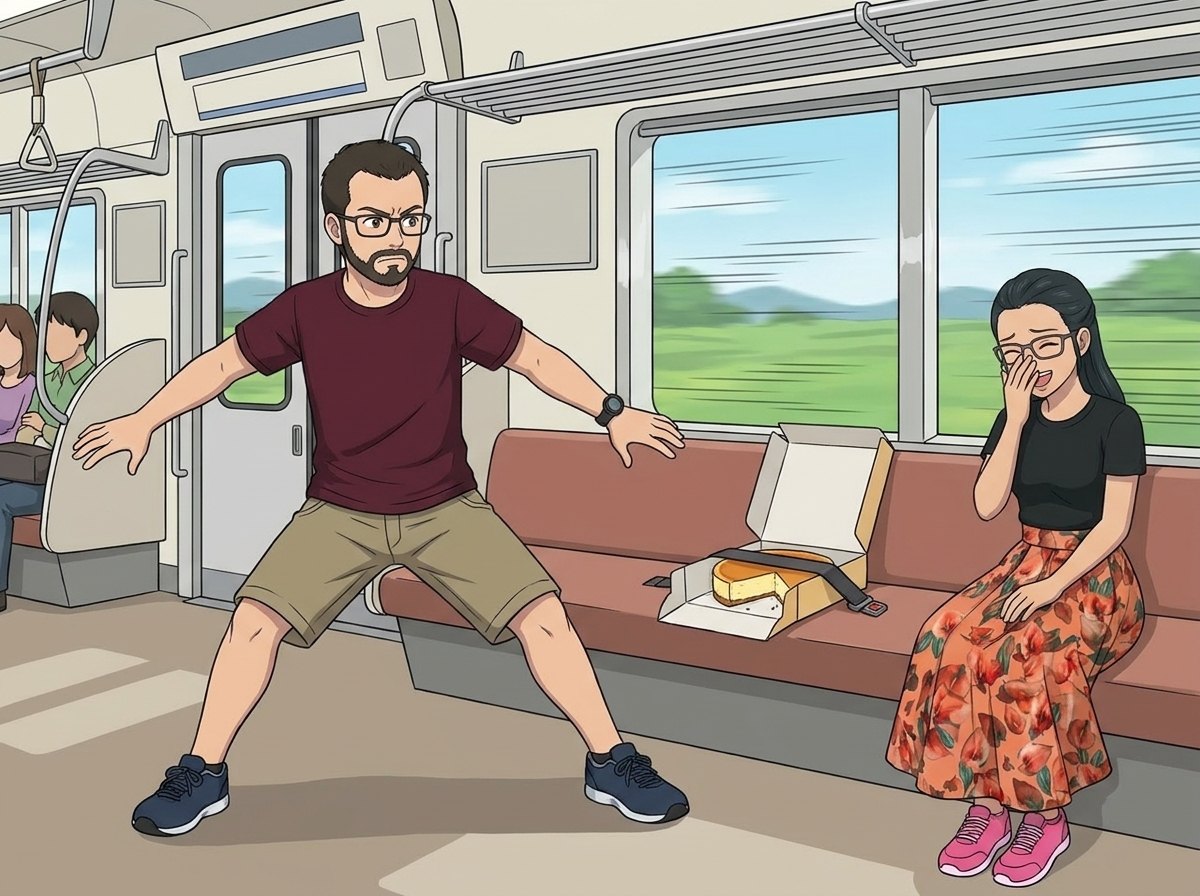
We caught the train to Kyoto, Japan's ancient capital, and the first thing we did was check our bags into the hotel. The second thing we did was check in the leftover cheesecake. The dessert had now crossed between cities. At this rate it would need its own train ticket.
The cheesecake's train ride
Kyoto is famous for old temples, gardens, traditional houses and craftsmanship. But our first birthday stop was not an ancient temple. It was the future.
TeamLab Biovortex This was the birthday girl's pick: a giant art museum with no paintings on the walls. Instead, the art is made of light, projections and sensors, and every room moves when you move.
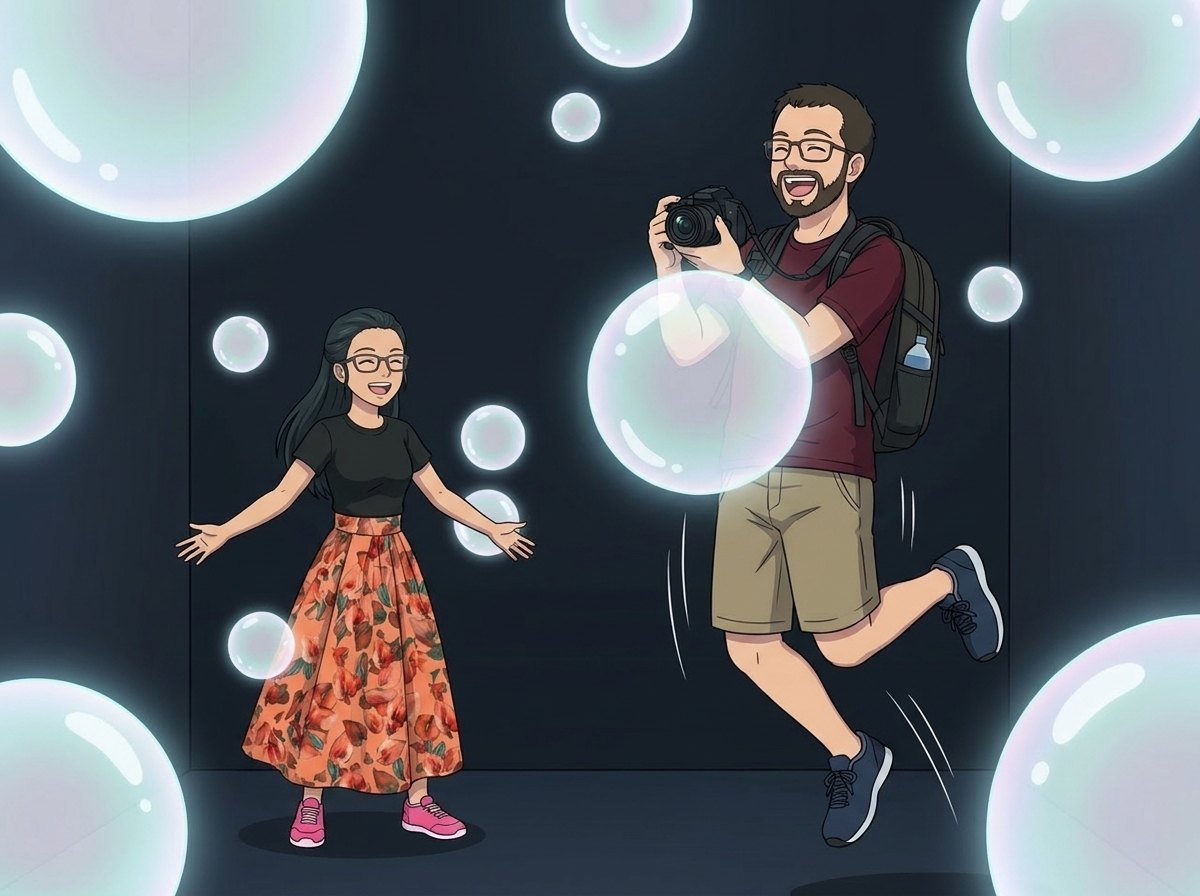
One room was three storeys high and filled with enormous soap bubbles, drifting down like clouds and floating straight through you.
The bubble room
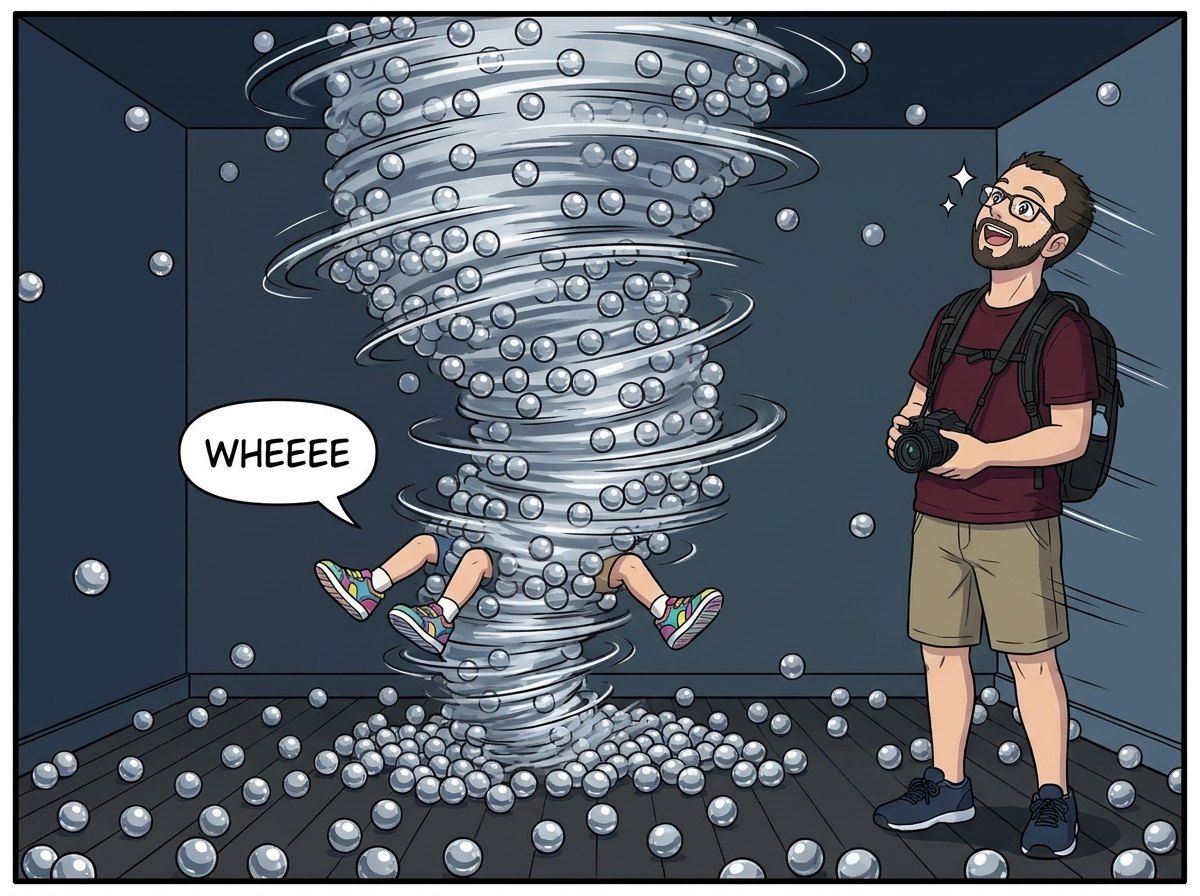
Another room had thousands of shiny silver balls sucked up into a tornado, then sideways, then down. One small child disappeared completely inside the tornado and was only found when the balls changed direction and popped him back out. (The child was fine. Delighted, actually.)
The tornado of balls
There were giant glowing eggs you could rock and spin. There were lights that followed your footsteps.
Jess wore a long, flowing skirt that caught the rainbow lights like a kaleidoscope, and she spun through the rooms like a turbo-charged ballerina in a music box. People thought she was filming for Instagram. Nope, she was just having fun.
The birthday ballerina
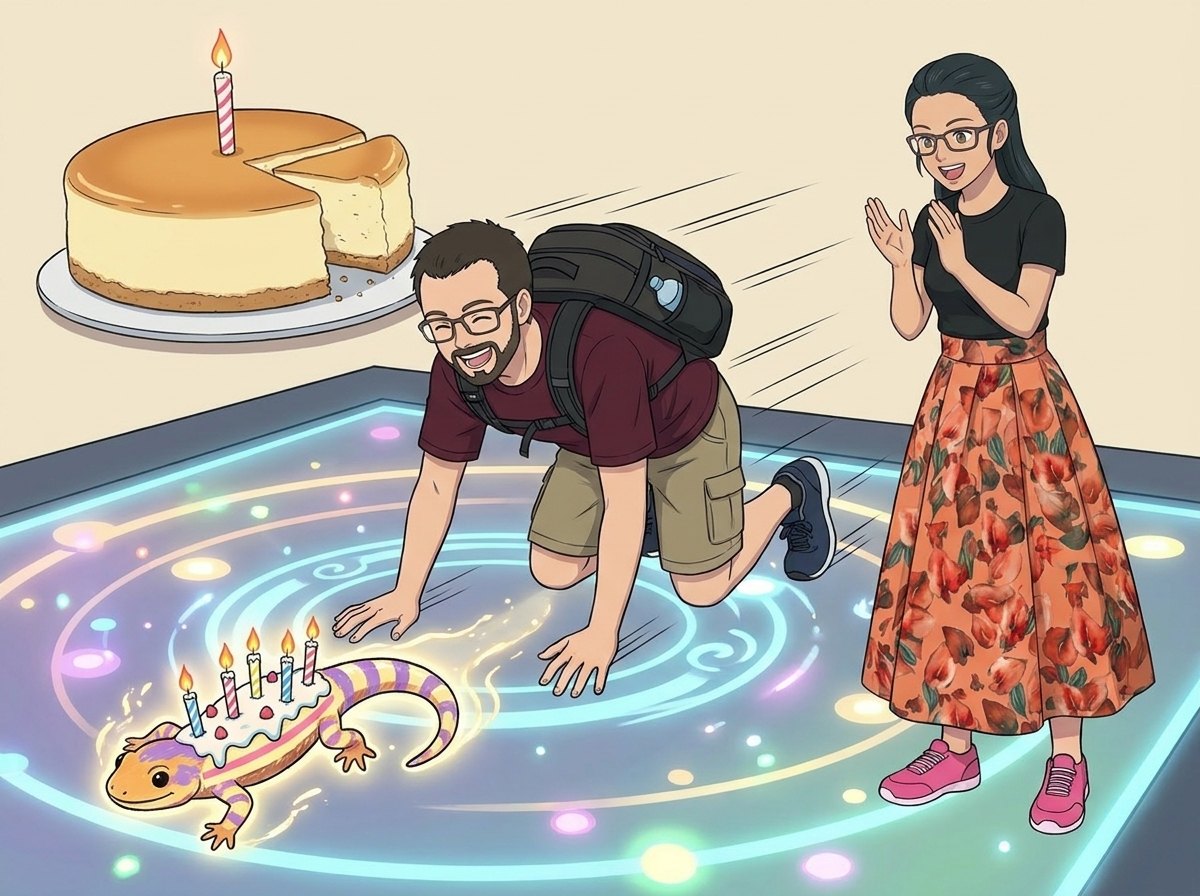
The creative zone Here is where Jess's artist side took over. You colour in an animal on paper, a machine scans it, and your animal appears alive on the floor, walking around. Then you stomp on it and it SPLATS.
Jess coloured in animals for both of you. I coloured a waterdrop of our family and a salamander to look like a birthday cake for Jess, because I did not think the cheesecake could hold the weight of candles.
The salamander cake
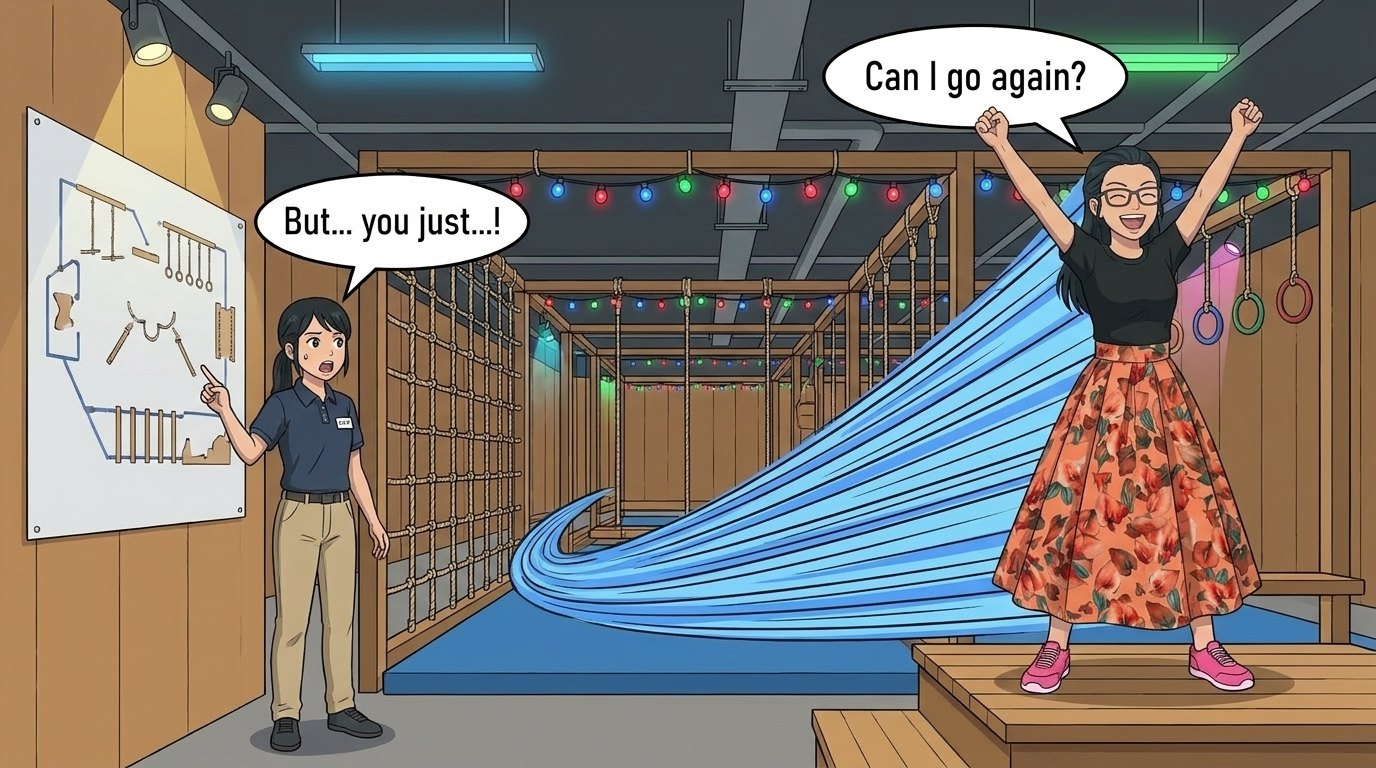
The rope course The attendant explained the route to Jess very carefully for about two minutes. Jess finished the course in a world-record fifteen seconds, ran back to the start and asked to go again. She spent longer listening to the instructions than she spent on the actual course.
The rope course
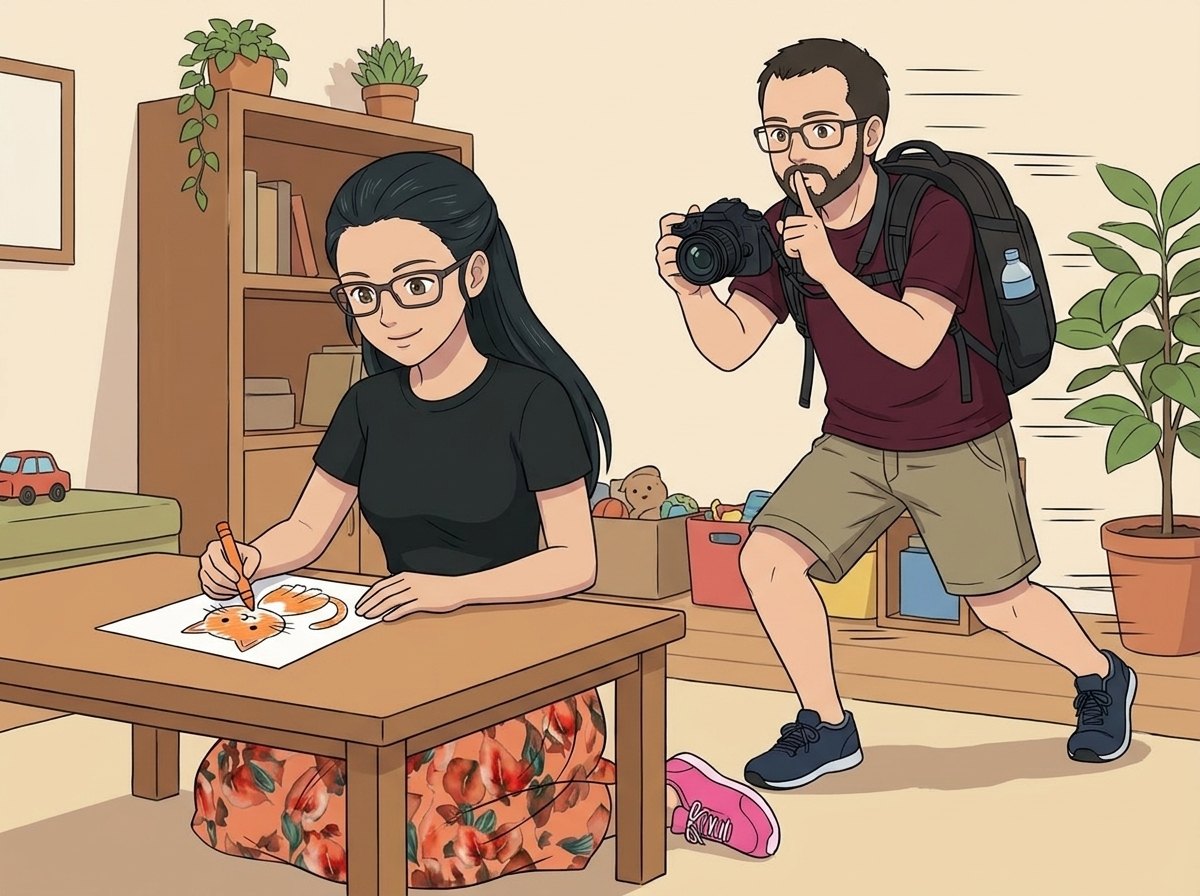
I even managed to photograph Jess sitting still. Once. Creating art. It is the rarest photo from the whole trip.
Jess sitting still
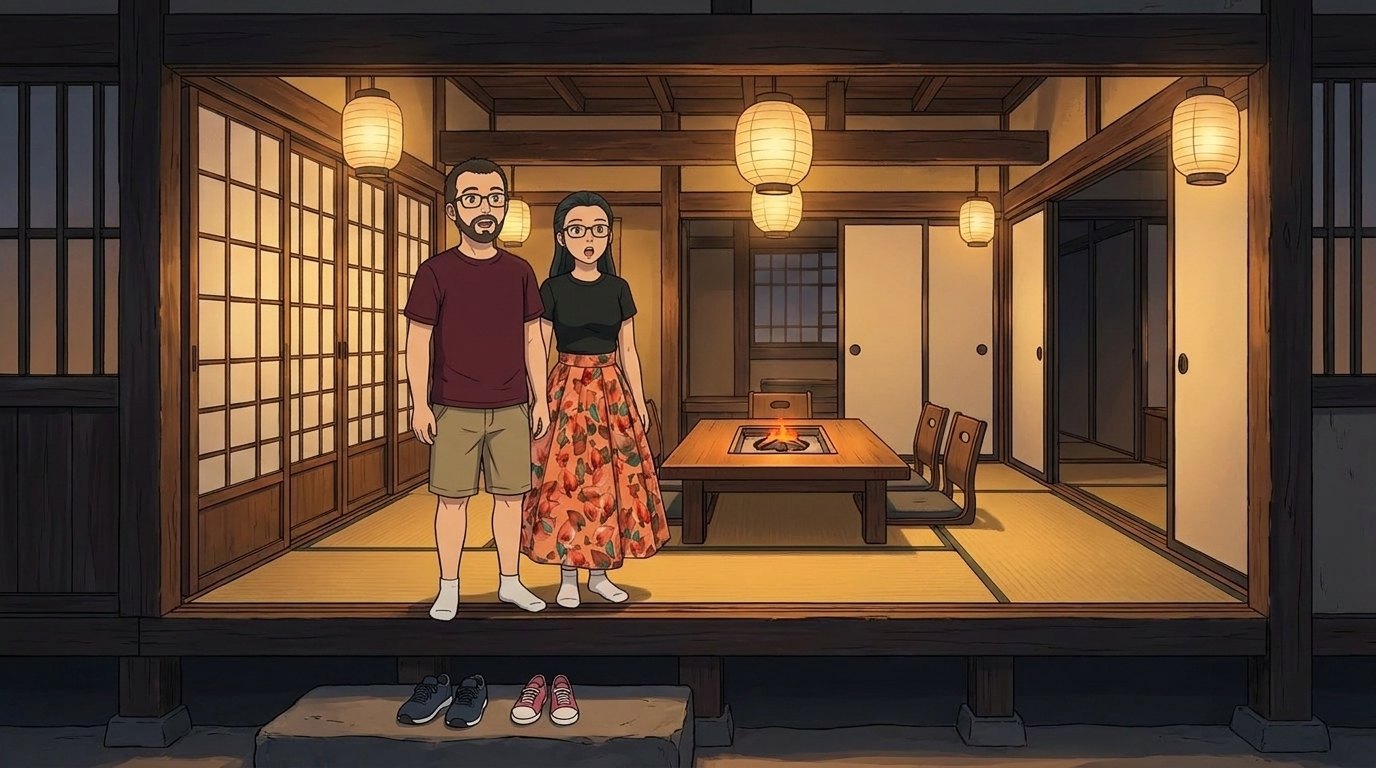
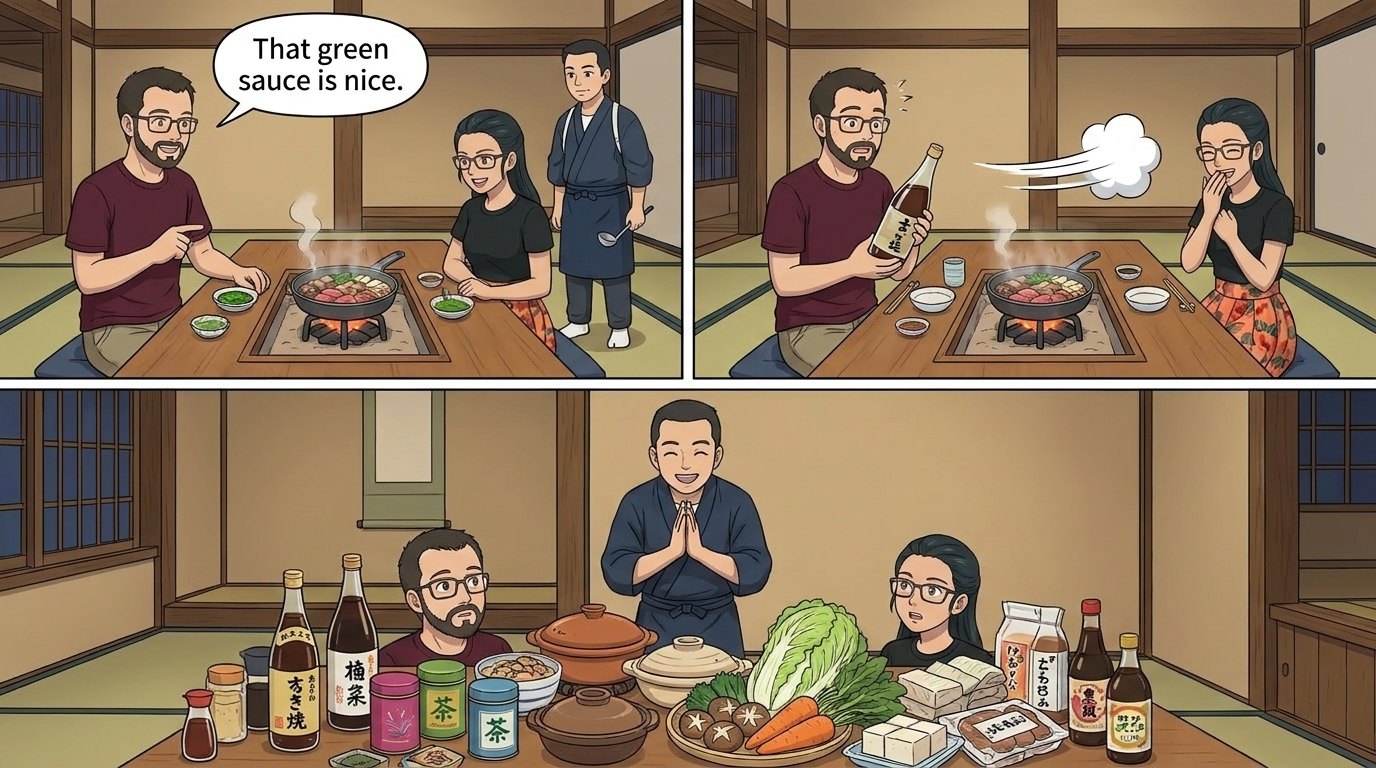
The birthday dinner Jess's birthday feast was in a 100-year-old townhouse, where an amazing assortment of dishes was slowly brought out and cooked right in front of us on a charcoal hearth built into the middle of our table. The main event was smoky, melt-in-your-mouth wagyu beef sukiyaki.
The old townhouse
I said, "That green chilli-citrus sauce is delicious." (It is called yuzu kosho.)
The chef vanished into the kitchen. He came back and presented me with a brand-new bottle to take home.
Five minutes later, Jess said she liked the tea. She was given a bag of tea to take home too.
Compliment the chef
(Note to self: next time, compliment the chef's sports car.)
Japan fact file
Kyoto was the capital of Japan for more than 1,000 years, from 794 until the emperor's court moved to Tokyo in 1868. It has about 1,600 Buddhist temples and 400 Shinto shrines.
teamLab is a group of hundreds of artists, computer programmers, engineers and mathematicians who work together to make digital art all over the place. Their exhibitions attract visitors from around the world.
A machiya is a traditional wooden townhouse. They are narrow at the front and very long at the back, partly because land was expensive and narrow street fronts made practical use of city space. People nicknamed them "eel beds".
Wagyu means "Japanese cow". The beef is graded for quality and marbling, and the very top grade is A5. Ours was A4, which is still far fancier than anything Dad cooks. The cattle are raised with great attention to their care and feeding.
Sukiyaki is cooked at the table in a shallow iron pan. There are different explanations for its name, including a story about farmers once cooking meat on their spades.
お誕生日 おめでとう!
Word of the day
Otanjoubi omedetou!
say it: oh-tan-JOH-bee oh-meh-deh-TOH
Happy birthday!
Dad's lesson
Slow down and watch other people enjoy things. Some of the best photos from the trip were of people and animals in their element.
Day5
Ten Thousand Gates and One Wrong Pin
Saturday 24 OctoberKyoto
I had booked a taxi to Fushimi Inari Shrine. I had checked the map. I had tapped the destination. I was practically a professional traveller now.
Which is why, naturally, we ended up somewhere else.
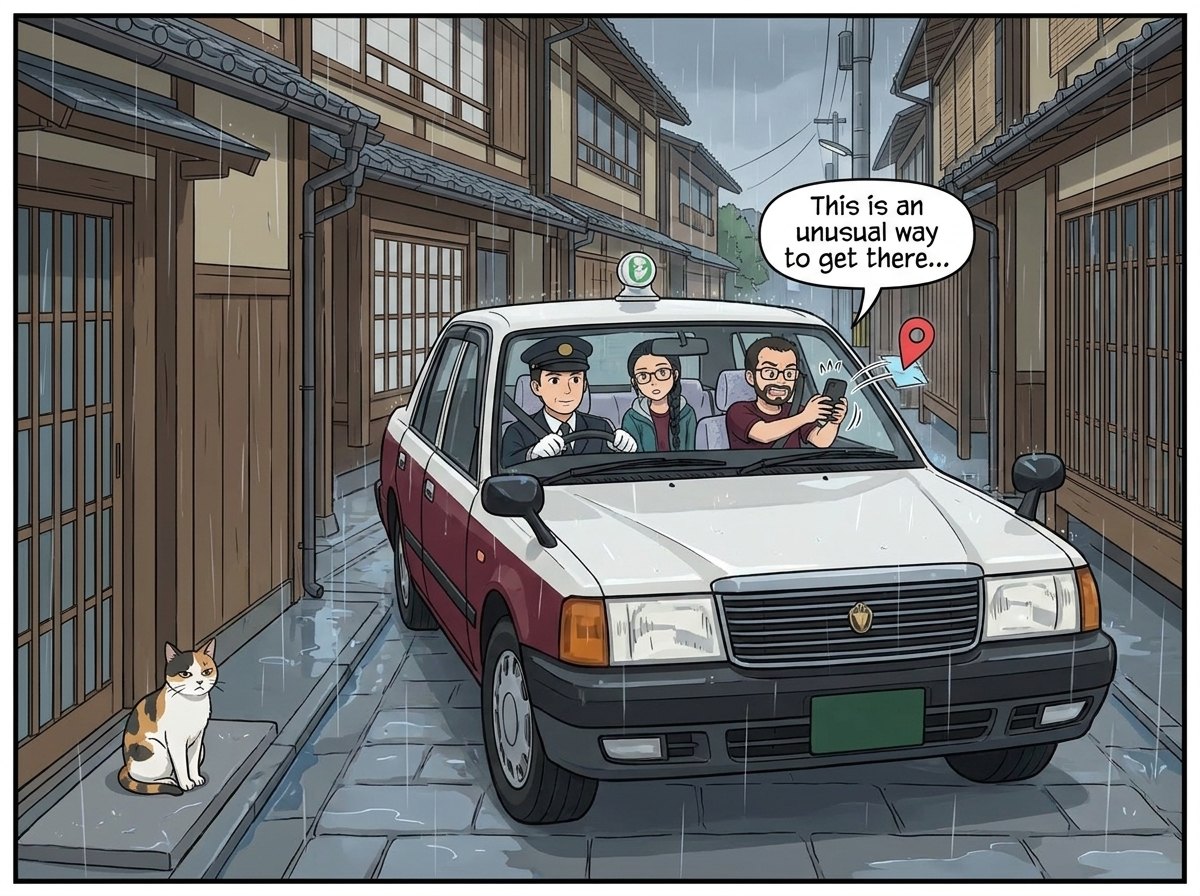
The wrong pin The taxi squeezed down tiny, ancient lanes barely wider than a skateboard, past wooden houses, with zero tourists in sight. What a clever secret shortcut, I thought.
"This is an unusual way to get there," said Jess, in the voice she uses when she already knows the answer.
The wrong pin
I checked my phone. I had dropped the pin in the wrong spot. About a kilometre from the right spot, actually. We asked the driver to carry on to the real gates, and he did, and I got a free tour of secret old Kyoto out of my mistake. Jess got another story to tell at dinner parties.
Fushimi Inari Eventually we arrived at Fushimi Inari Taisha, Kyoto's most famous shrine. It is a Shinto shrine. Shinto is a tradition that began in Japan, and it is all about respect for kami: sacred spirits found in nature, in special places and in many other parts of life.
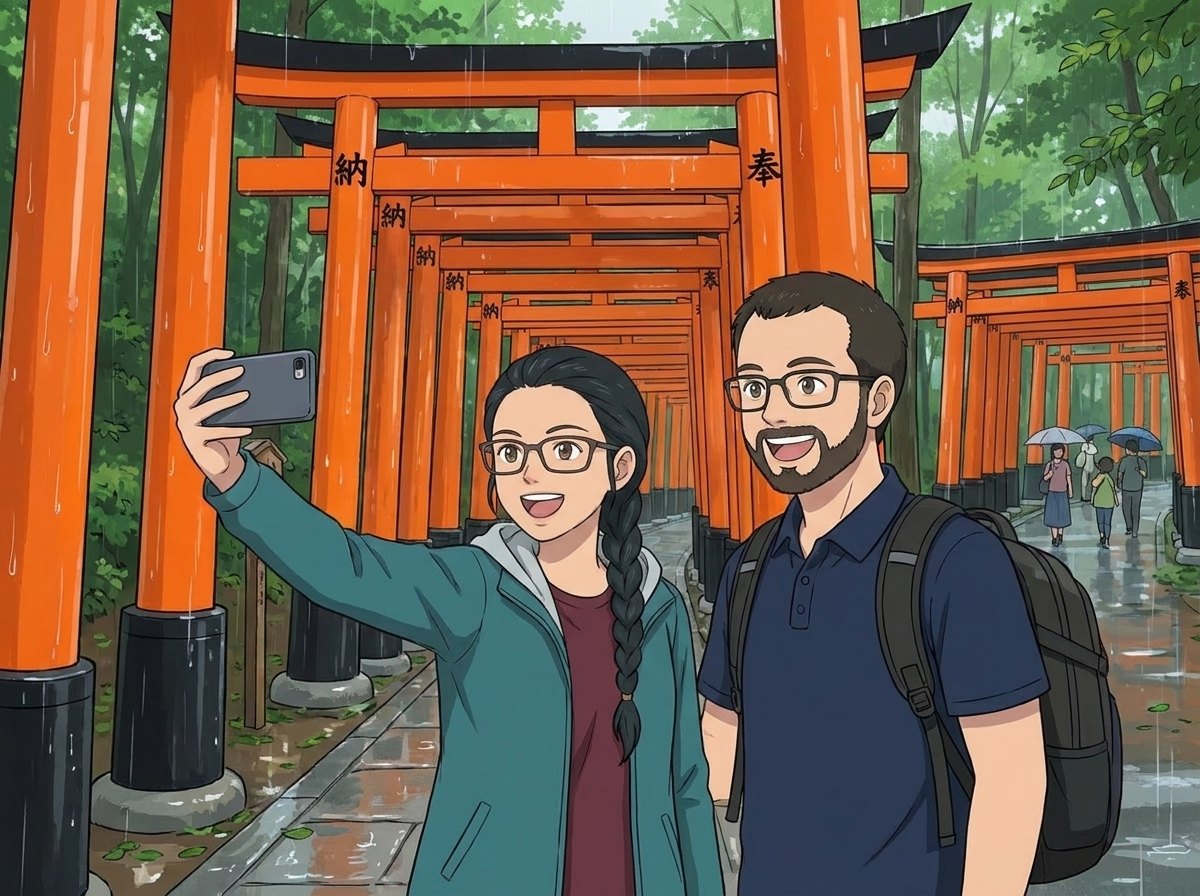
This is the shrine where thousands of bright orange-red gates called torii march up the side of a mountain, one after another, so close together they make a tunnel.
Gates selfie
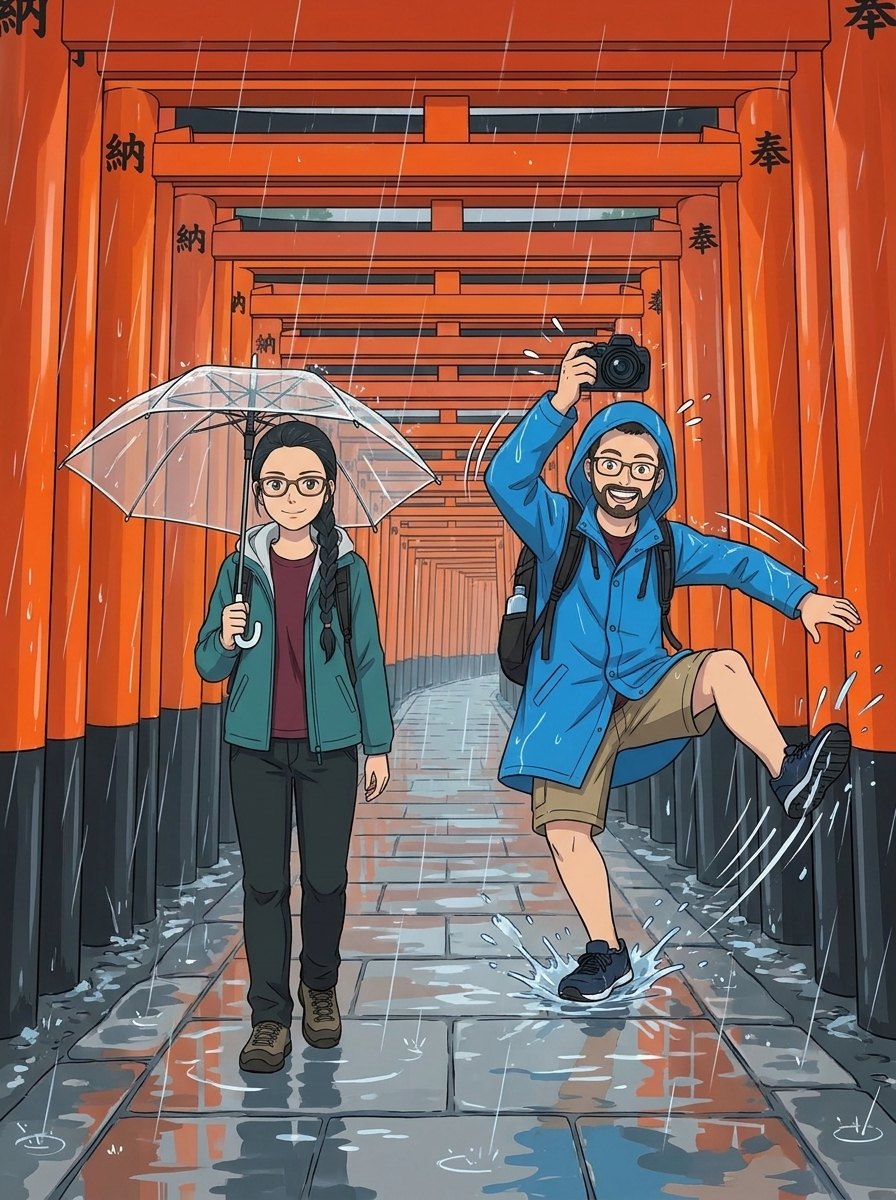
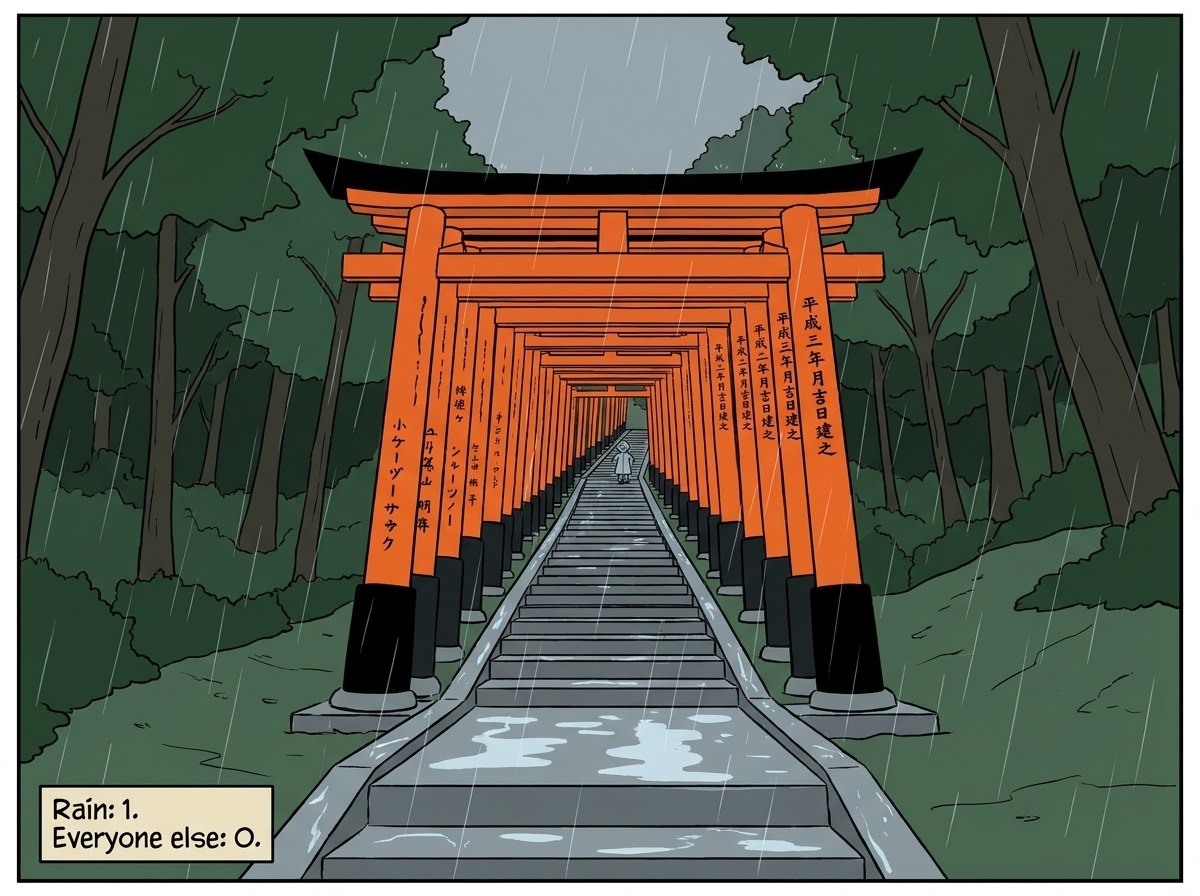
On a sunny day there are so many people that you shuffle through shoulder to shoulder. But it was pouring. The crowds stayed home. We walked through the glowing tunnels almost alone, rain dripping off the gates, and I got photos that you normally only see in books.
Ten thousand gates
Rain: 1. Everyone else: 0.
Empty gates
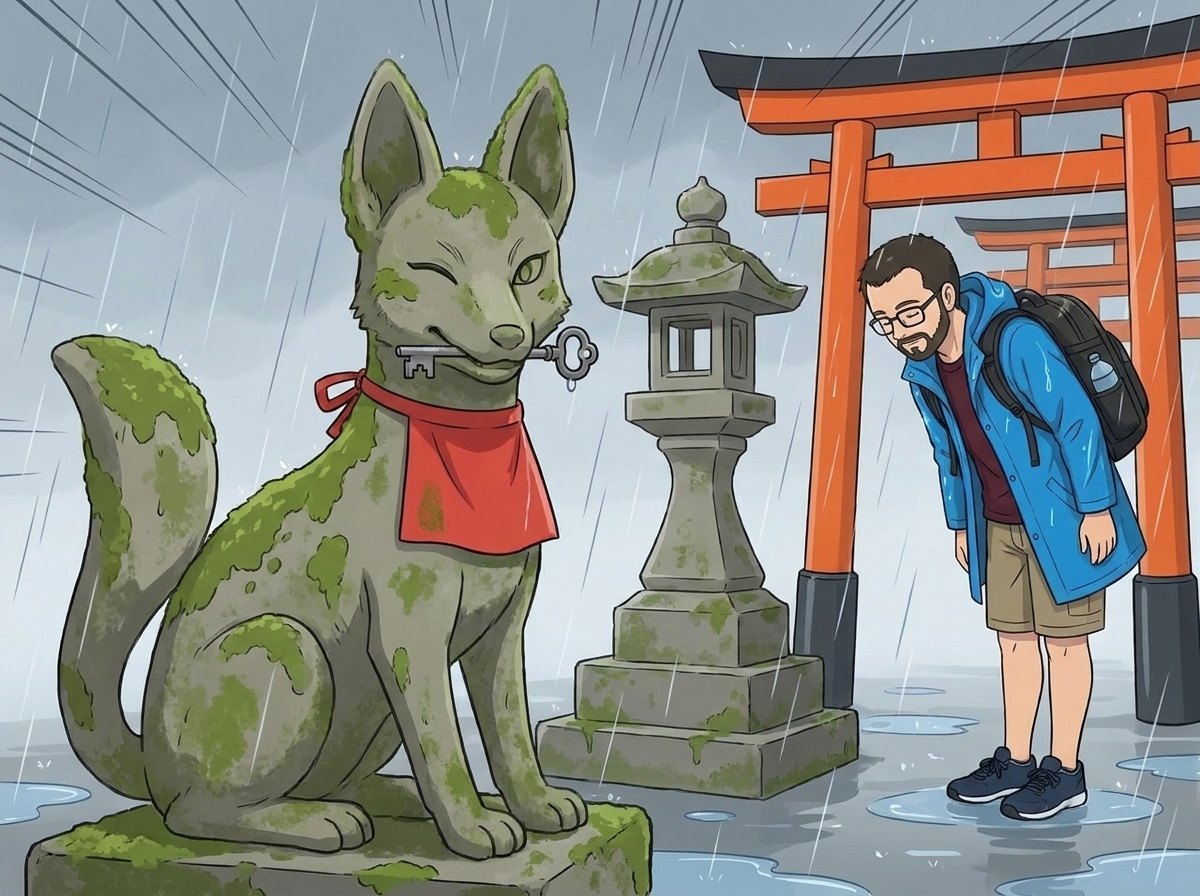
Stone foxes sat everywhere, some wearing little red bibs. The fox, or kitsune, is the messenger of Inari, the god of rice and good harvests. Some foxes hold a key in their mouths. That is the key to the rice storehouse.
The fox with the key
Kintsugi In the afternoon we went to Gion, the old entertainment district, for a craft lesson.
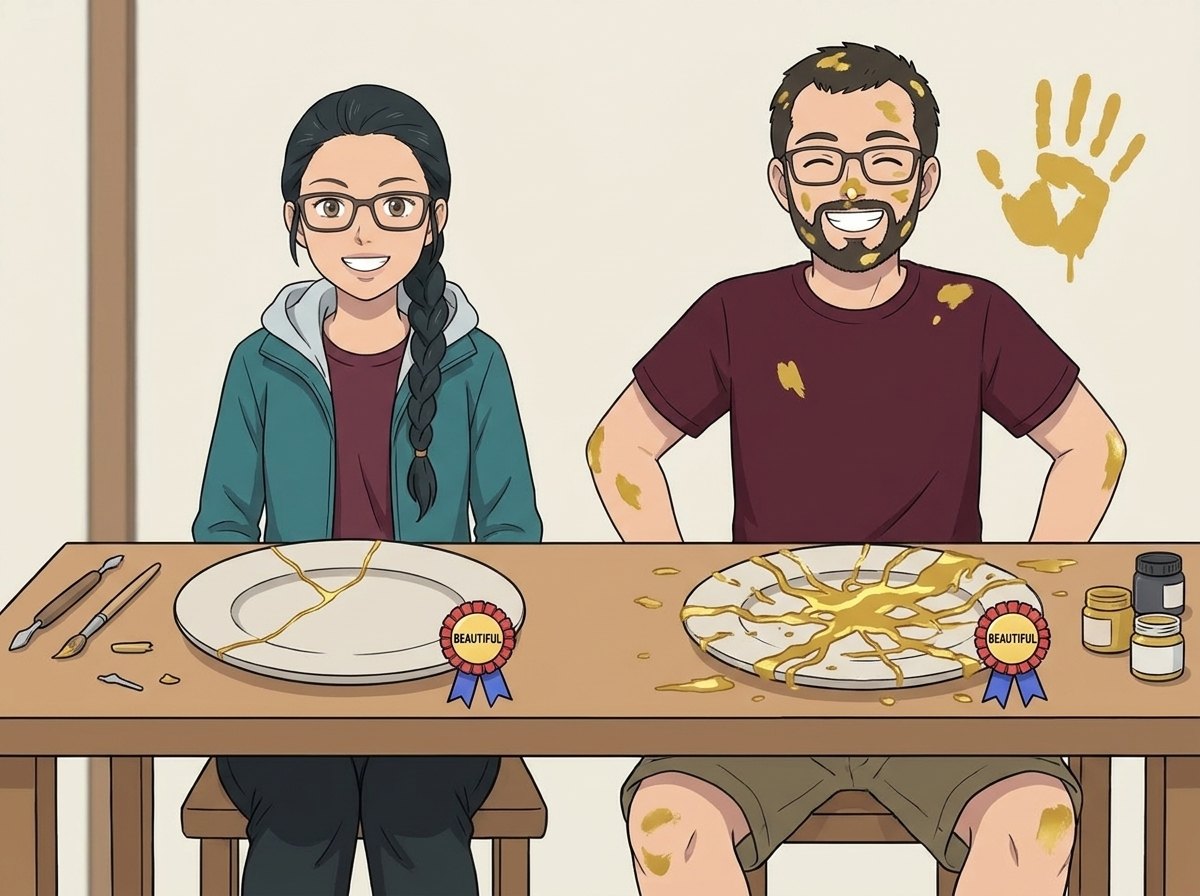
We each repaired a cracked plate. Jess painted her golden lines with the steady hands of a surgeon and made a neat golden river. I looked like a bull trying to glue back together the china shop it had just trampled.
Gold repair
But that is the whole idea. My secret hope was that Jess would apply the same wabi-sabi to her short-legged, easily distracted, first-time-travelling deer in headlights.
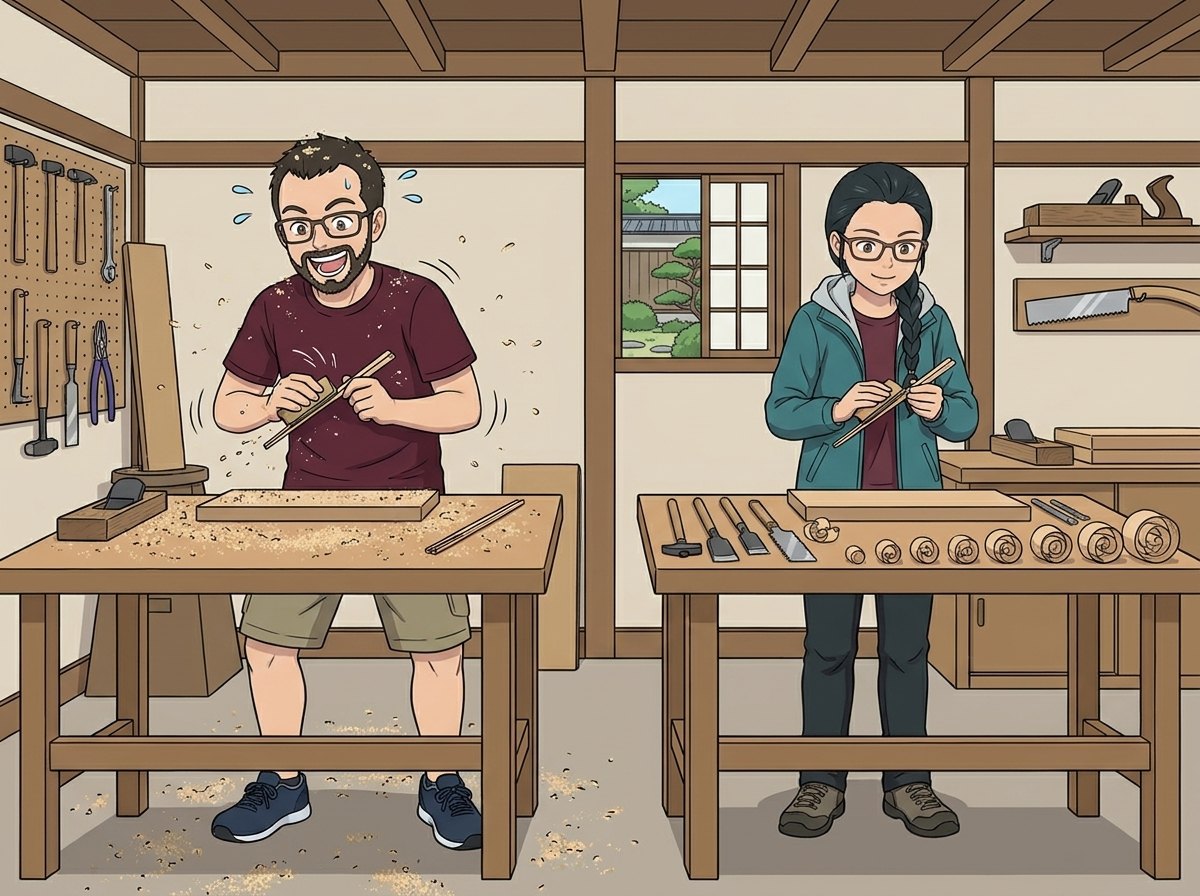
The rigged chopstick race Next, we made our own chopsticks from scratch, planing and sanding a stick of wood until it was smooth and straight.
Now, you know I am a woodworker. This was MY event. Jess knew it too.
So Jess hatched a sneaky plan. She picked the softest, easiest wood in the shop for herself. Then she handed me the prettiest wood on the rack, which just happened to be iron-hard timber that felt like carving a bowling ball.
The rigged odds
Even with her sabotage, my maker skills kicked into overdrive. It was the only activity in eleven days where I finished faster than Jess.
The chopstick race
She rigged the odds, and I still loved every second.
Japan fact file
The name of the person or business who donated each torii gate is painted in black on the back, along with the date. A big gate can cost more than a million yen.
Many people bow before walking through a torii, because they are stepping out of the ordinary world.
Gion is Kyoto's famous geisha district. In Kyoto they are called geiko, and the apprentices are maiko. They are highly trained performers in music, dance and conversation, and their wooden sandals go clip-clop on the stone lanes at dusk.
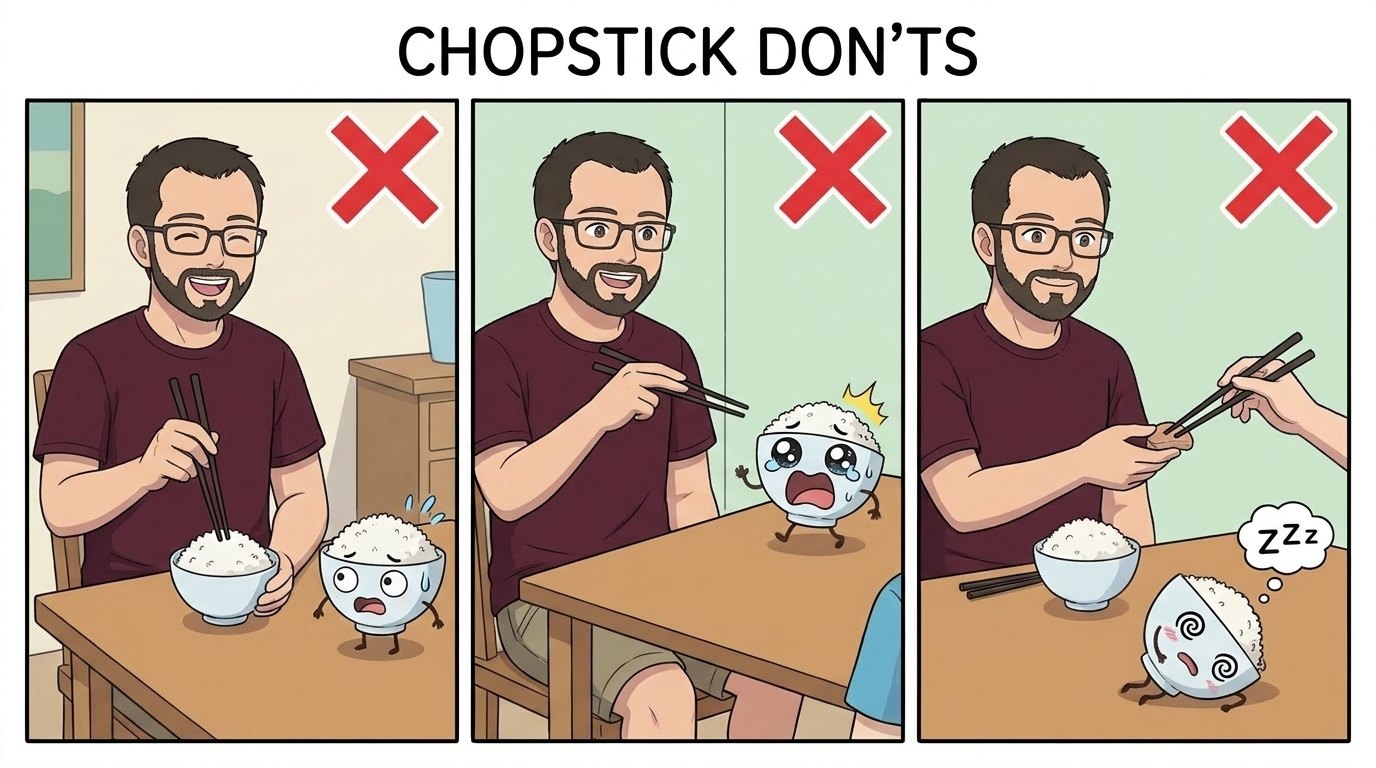
Chopstick manners: never stick them upright in your rice (that is only done at funerals), never pass food from your chopsticks to someone else's, and never use them to point at people.
One popular story says that, centuries ago, a Japanese ruler had a beloved tea bowl repaired with metal staples. People later developed more decorative ways to mend pottery, including kintsugi.
Chopstick manners
わびさび
Word of the day
Wabi-sabi
say it: WAH-bee SAH-bee
The beauty of imperfect things.
Like Dad's plate. Or Dad.
Dad's lesson
Mistakes can turn into the best parts of the story. Also: double-check where you dropped the pin.
Day6
Fire, Sparks and the Incredible Shrinking Knife
Sunday 25 OctoberKyoto
One small train up a mountain for me. One giant leap for Dad-kind.
Solo mission On Sunday, the training wheels came off. I had to get to a blacksmithing class in the hills outside Kyoto. By myself. Two trains and then the tiny Eizan mountain railway, with no Jess holding my sleeve.
I used the Golden Rule: station number, platform number, exit number. I checked the signs. I checked them again. I got on. I got off. I changed trains. I did not panic (much).
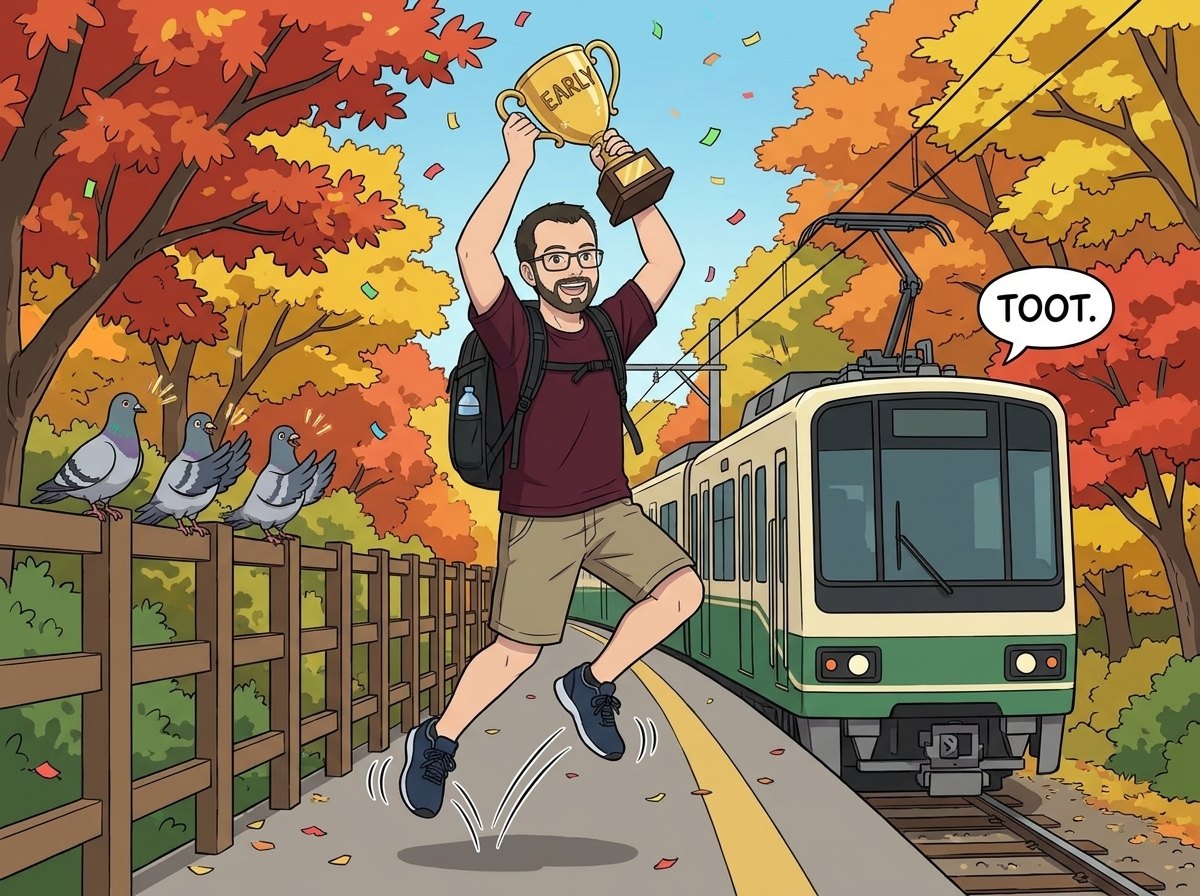
And I did not end up in Antarctica. In fact, I arrived EARLY. Early! Small win, very big deal. I may have done a little dance on the platform.
Early
My mission? To forge my very own Japanese steel knife with a master blacksmith.
The forge Jess sat this one out, which was wise, because her hair is long and the room was full of fire.
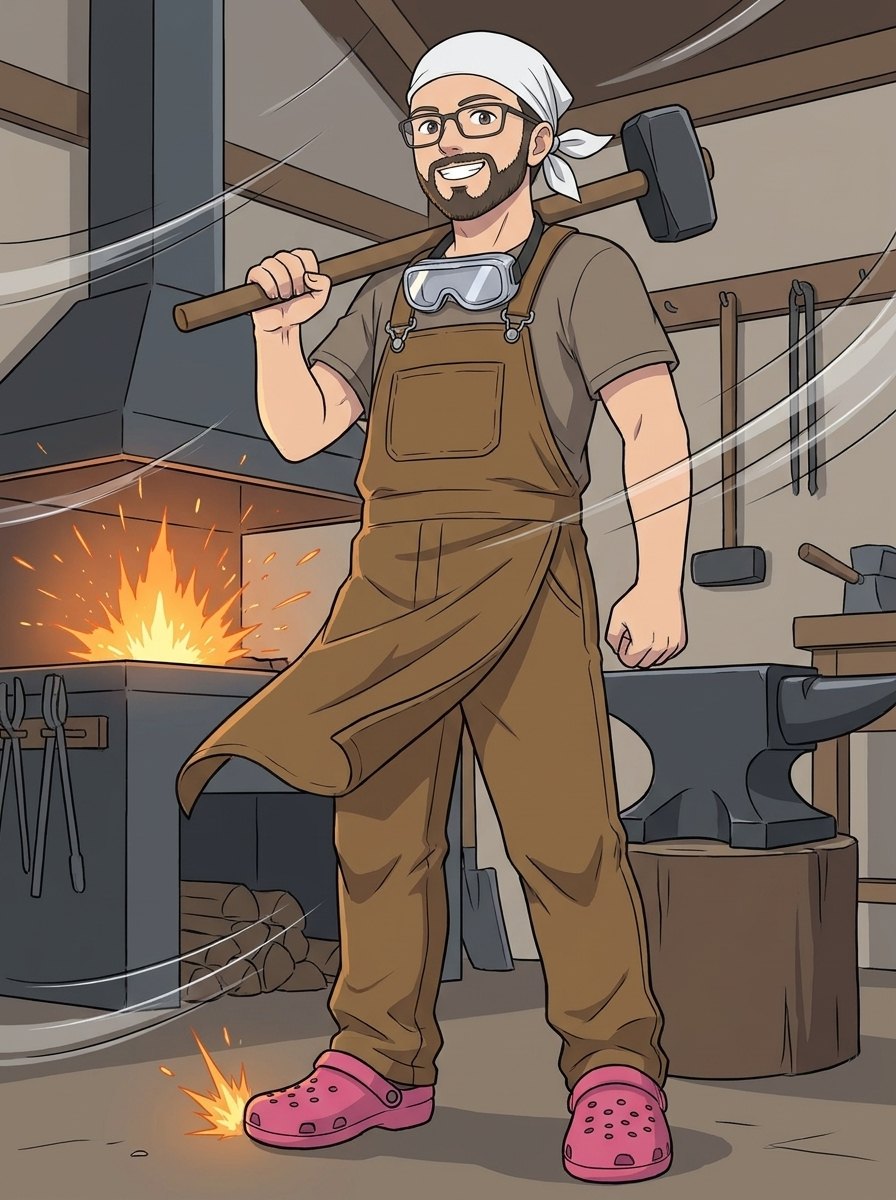
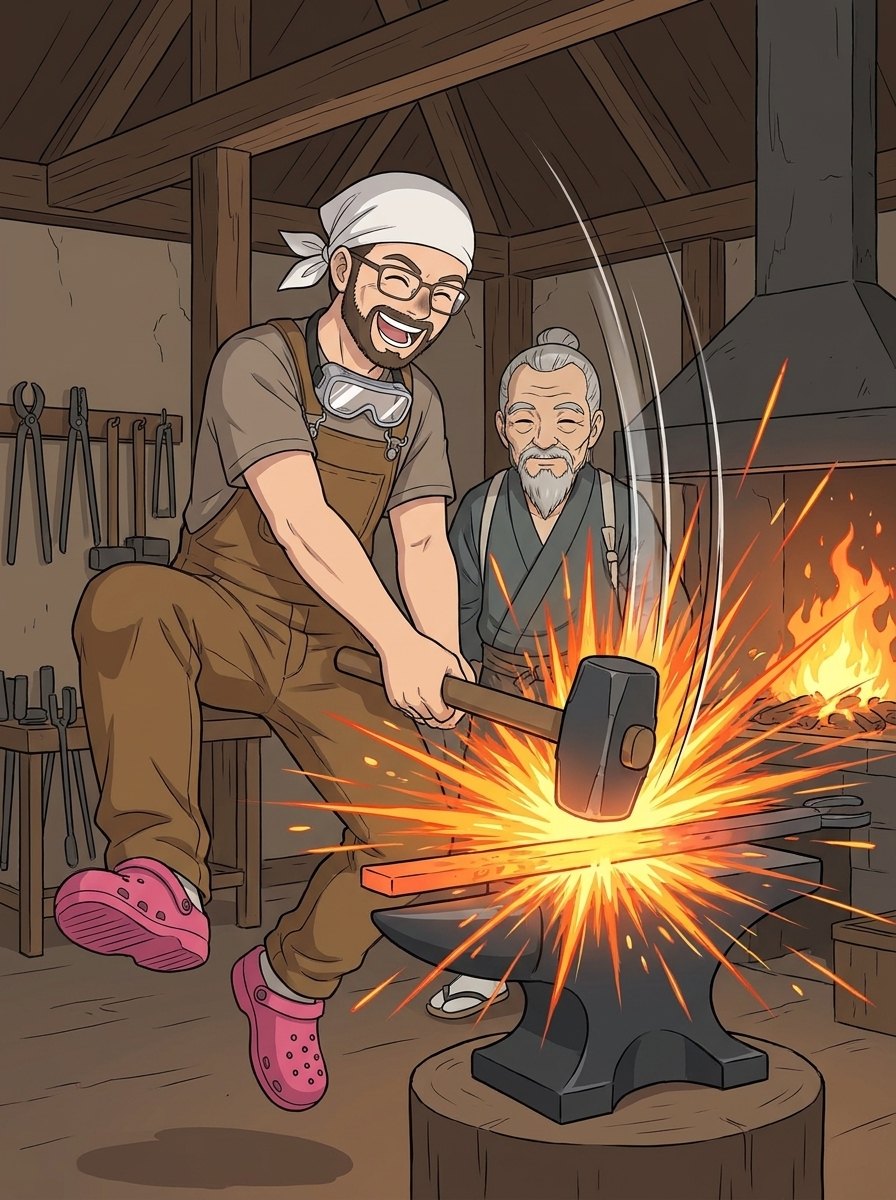
Everyone was given safety goggles, a bandana, cotton overalls and... rubber Crocs. Yes. Foam clogs. I was about to swing a heavy hammer at steel heated to a thousand degrees while wearing the same shoes you wear to the pool. While red-hot sparks rained across the floor, the two young assistants casually dodged them in open-toed ones.
Safety gear
My rule for safety in the shed at home is "do as I say, not as I do", so to be honest, for once the safety gear matched what I actually wear. (That is a joke. Mostly. Don't tell Mum!)
The master was a grizzled old blacksmith who spoke a little English. The assistants spoke none. The steel went into the fire until it glowed orange like a sunset, then onto the anvil, and I hammered it flat, and back into the fire, and hammered again.
The hammer swing
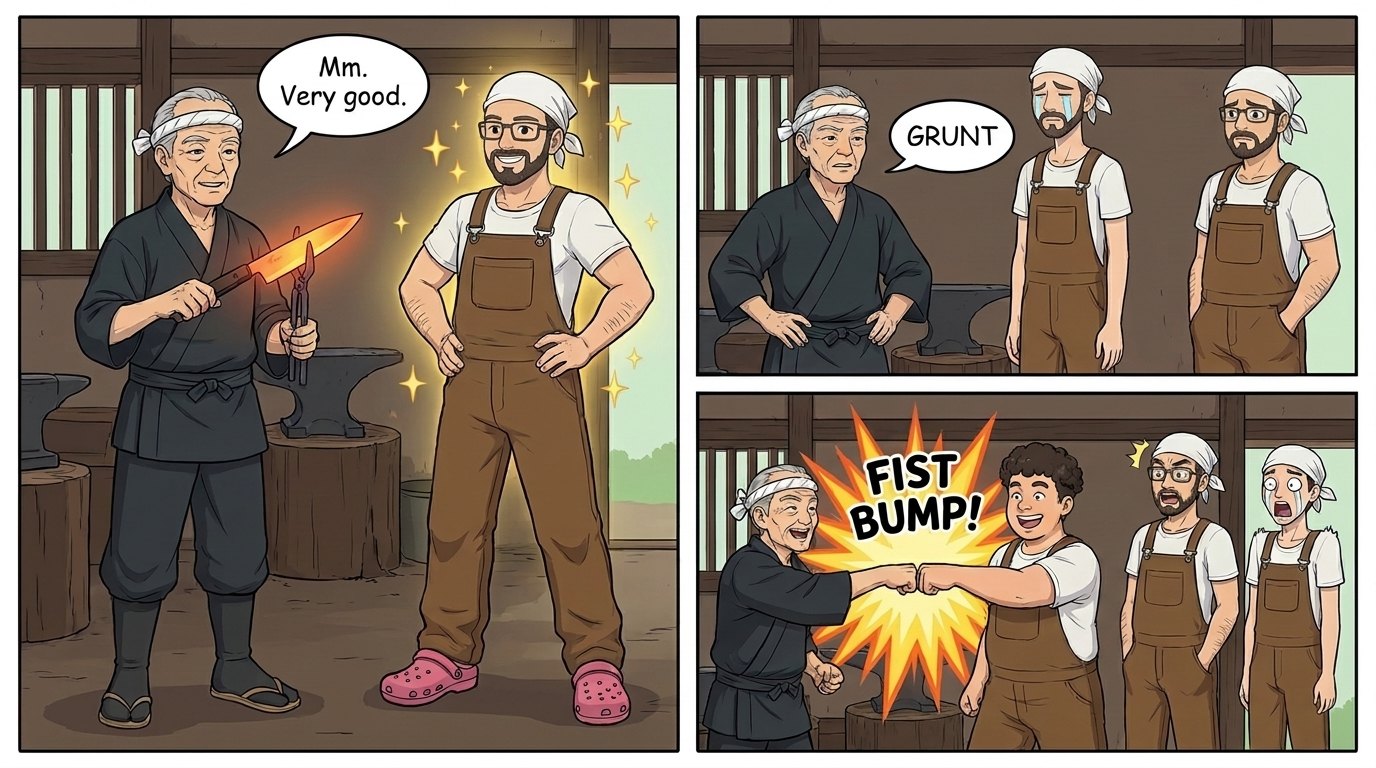
Every time the master inspected my blade, he would turn it over, nod and rumble, "Mm. Very good."
The poor bloke at the anvil next to me got a grunt. Every single time. Just a grunt. He kept whispering, "Why does he like yours so much?!" I was feeling very proud.
Then the man down at the end of the row got a FIST BUMP from one of the assistants. We were both extremely jealous.
Very good, grunt, fist bump
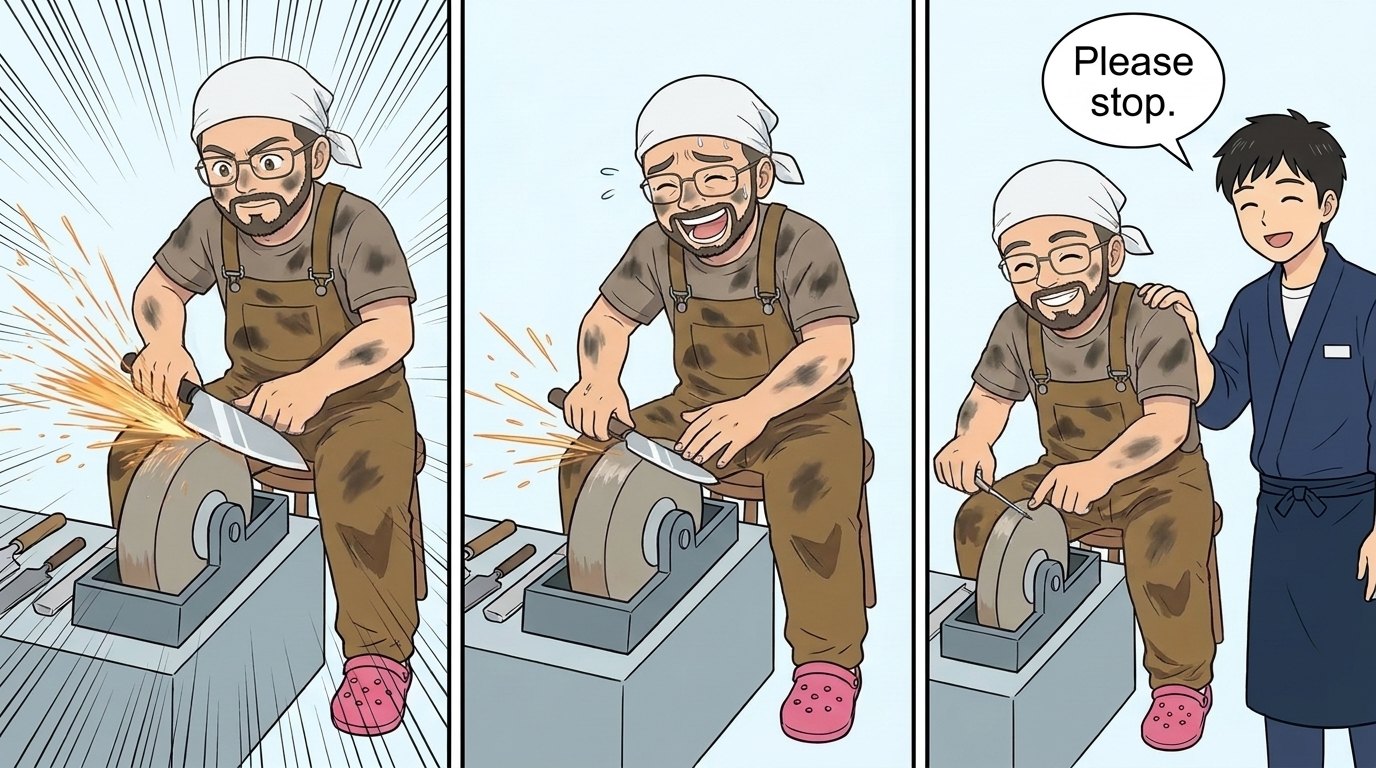
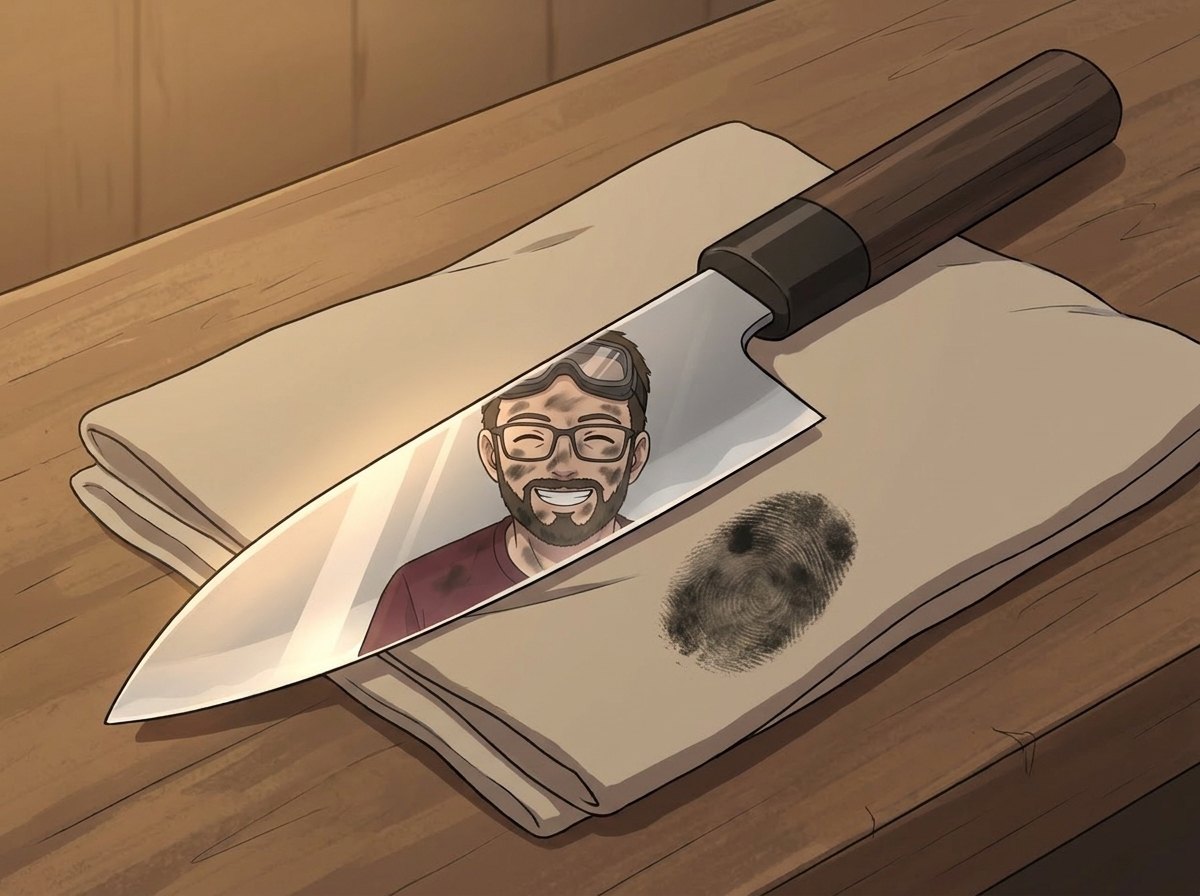
The grinder Then came the sharpening grinder, and this was so much fun! A tiny bump here. A little adjustment there. Just one more pass to get it perfect. Showers of sparks. I was having a blast.
Eventually one of the instructors wandered over, tapped me on the shoulder and gently explained that my knife was looking lovely, but I needed to stop now. It was getting thinner and thinner. If I kept going, there would not be any knife left.
Too much grinding
I was about five minutes away from turning a chef's knife into a toothpick.
I had travelled halfway around the world to learn an ancient Japanese craft, and it now included a highly accurate personality report. I overthink, so I overwork. Yesterday's lesson about wabi-sabi suddenly felt extremely relevant. Embrace the imperfection, Dad. Put down the knife.
(I was also just enjoying the sparks.)
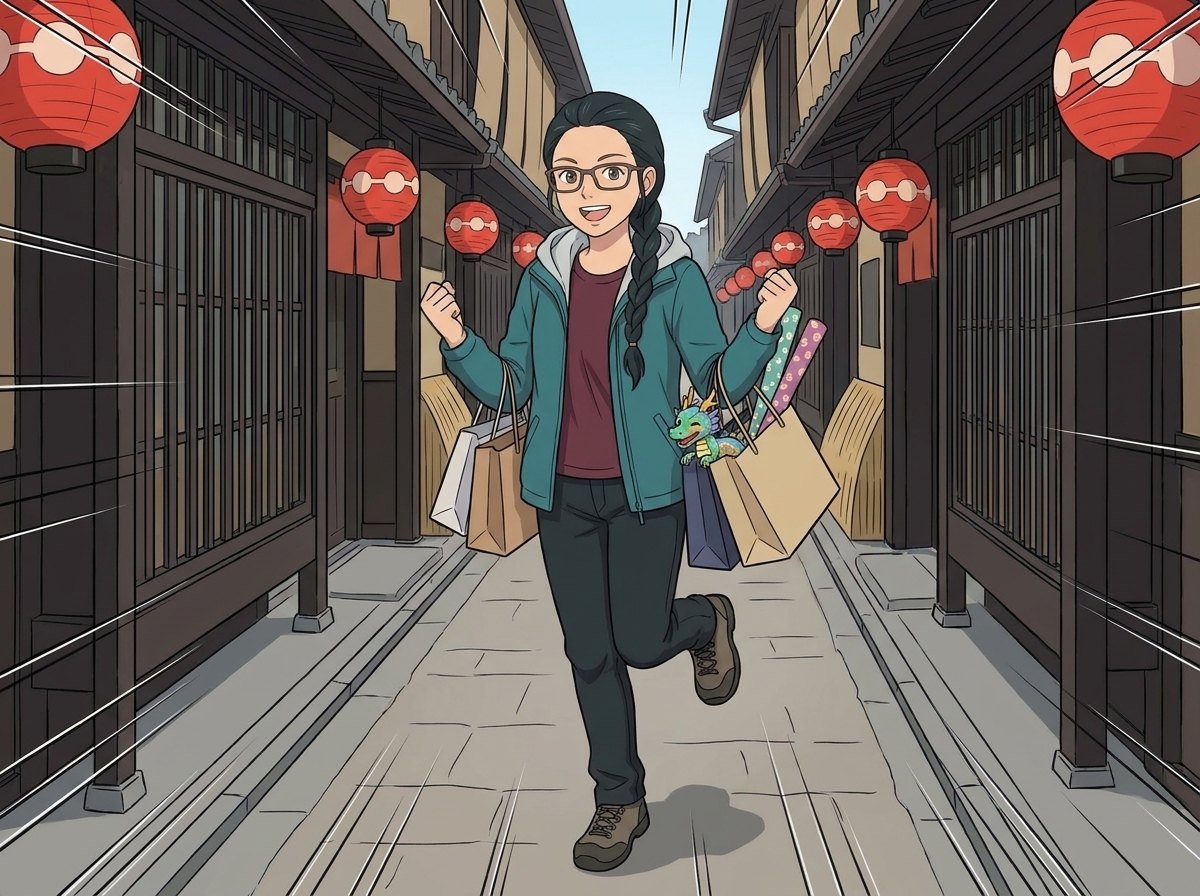
Meanwhile, in Gion While I was getting sooty in the hills, Jess spent the morning shopping her way through Kyoto's oldest streets. She came back with hand-blown glass dragons, beautiful handmade washi paper and chewy mochi rice cakes. None of which smelt of smoke.
Jess in Gion
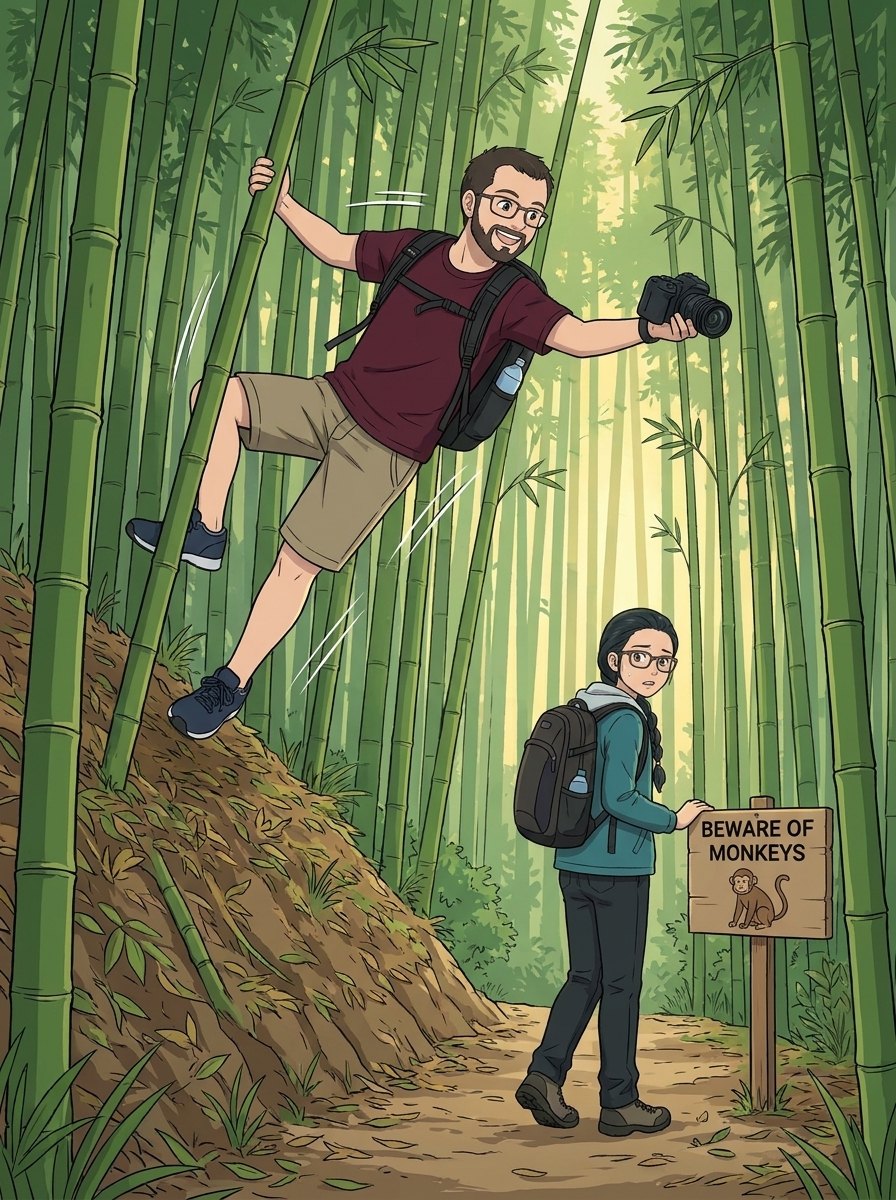
The bamboo forest We met up in the afternoon and set out to Arashiyama, where a path winds through a forest of bamboo so tall it blocks out the sky. The stalks creak and knock together in the wind, and the light comes through in thin green stripes.
On our way up to the bamboo forest, we stopped by some little street shops where I found a place selling traditional kimono fabric. Right there, I spotted the most beautiful scented mini kimono dolls made from real traditional kimono silk. Sophie, that was Part One of your doll quest sorted.
Naturally, I then climbed up a hill for a photo of the river gorge. Naturally, Jess waited sensibly at the bottom, next to a sign that said BEWARE OF MONKEYS.
Beware of monkeys
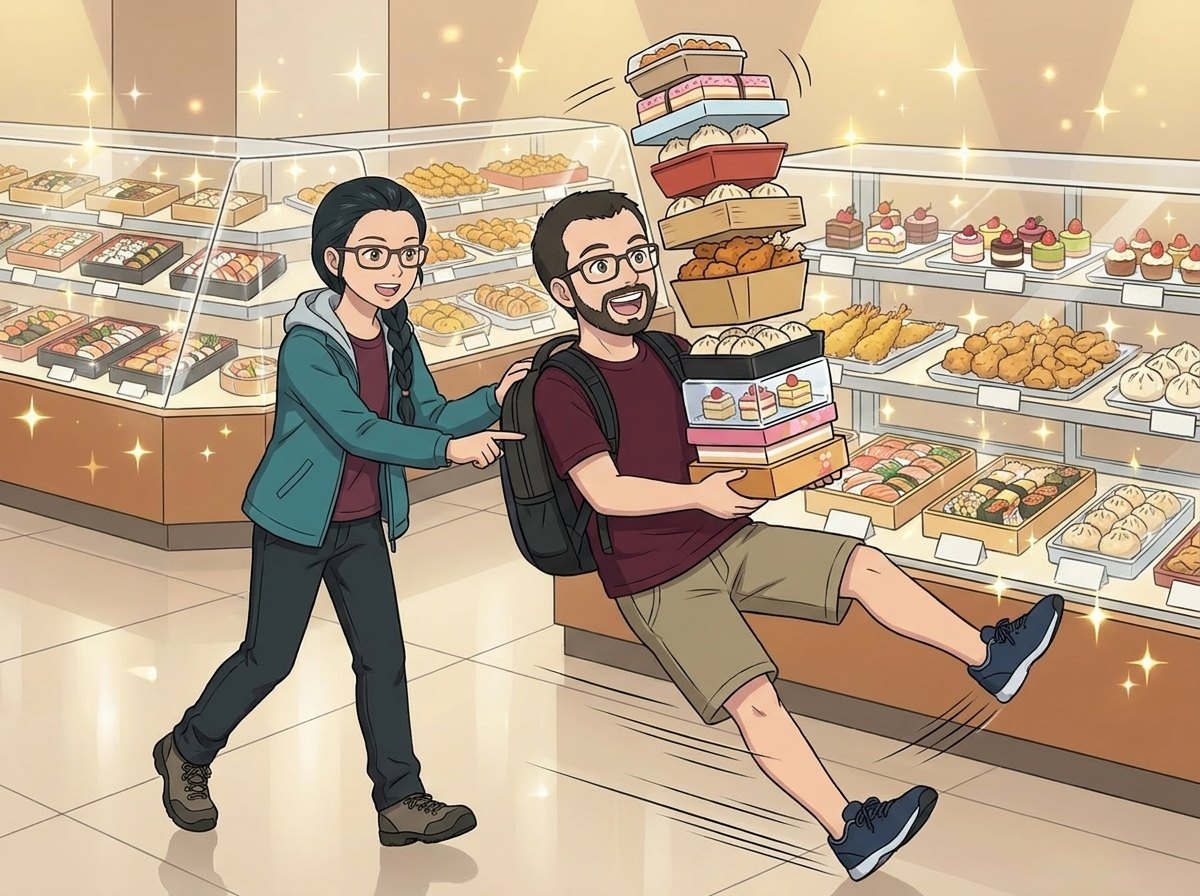
Depachika Dinner was Jess's discovery: the depachika, the food hall in the basement of a big department store. Imagine the fanciest food court on Earth. Sushi boxes, fried chicken, tiny perfect cakes, pickles, bento boxes, forty kinds of dumpling. We bought a bit of everything and took it back to the hotel. Delicious.
The food hall
One day. One handmade knife. One solo train trip. The knife survived my pursuit of perfection.
Just.
The finished knife
Japan fact file
The little Eizan railway that took me up the hill has a carriage with extra-big windows, built so passengers can look at the autumn leaves.
Bamboo is not a tree. It is a grass, the biggest grass in the world. Some kinds can grow almost a metre in a single day, which makes it one of the fastest-growing plants on the planet.
The monkeys at Arashiyama are Japanese macaques, also called snow monkeys. They live further north than any other monkey in the world. (We didn't see any monkeys that day.)
Depachika comes from depaato (department store) and chika (basement). Towards closing time the food gets discounted, and locals swoop in for bargains.
がんばって!
Word of the day
Ganbatte!
say it: gan-BAT-teh
Do your best! You can do it!
It is what we should always tell ourselves when we doubt ourselves or what we can do.
Dad's lesson
Know when to stop. Perfect is the enemy of finished. (Also, apparently, the enemy of having a knife at all.)
Day7
OH DEER
Monday 26 OctoberNara
With the tail end of a typhoon passing to the south of us, it rained like the sky had a hole in it. It was my favourite day of the whole trip.
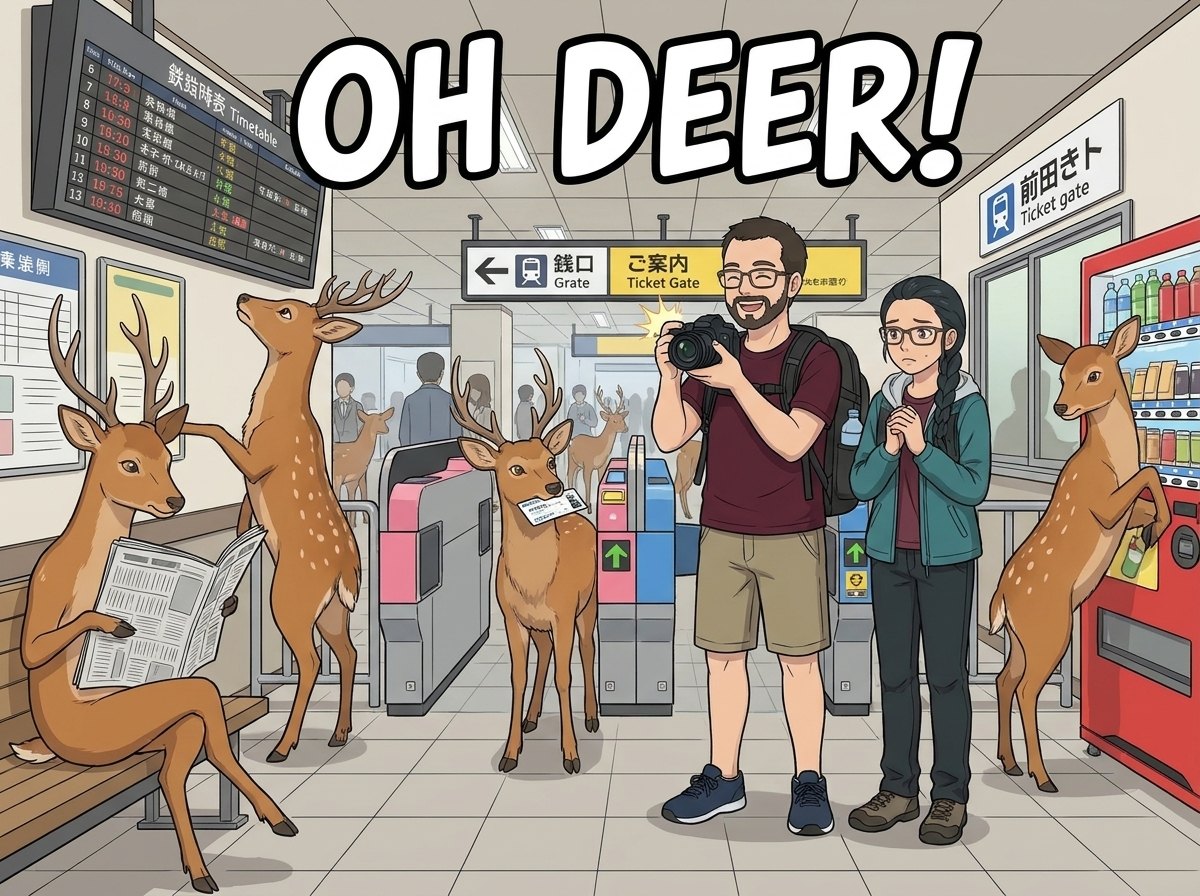
The welcoming committee Nara is a small city about an hour from Kyoto. It was Japan's very first permanent capital, and today it is famous for one thing: deer. More than a thousand of them wander the parks and streets like they own the place. Which, legally, they sort of do.
We stepped off the train and there were deer waiting in the station. Not near the station. IN it. Standing on the tiles like commuters and chilling out next to vending machines.
Deer at the station
The mugging Now, you need to know one crucial fact. Jess does not like animals. At all. So coming to Nara with me was a massive act of bravery.
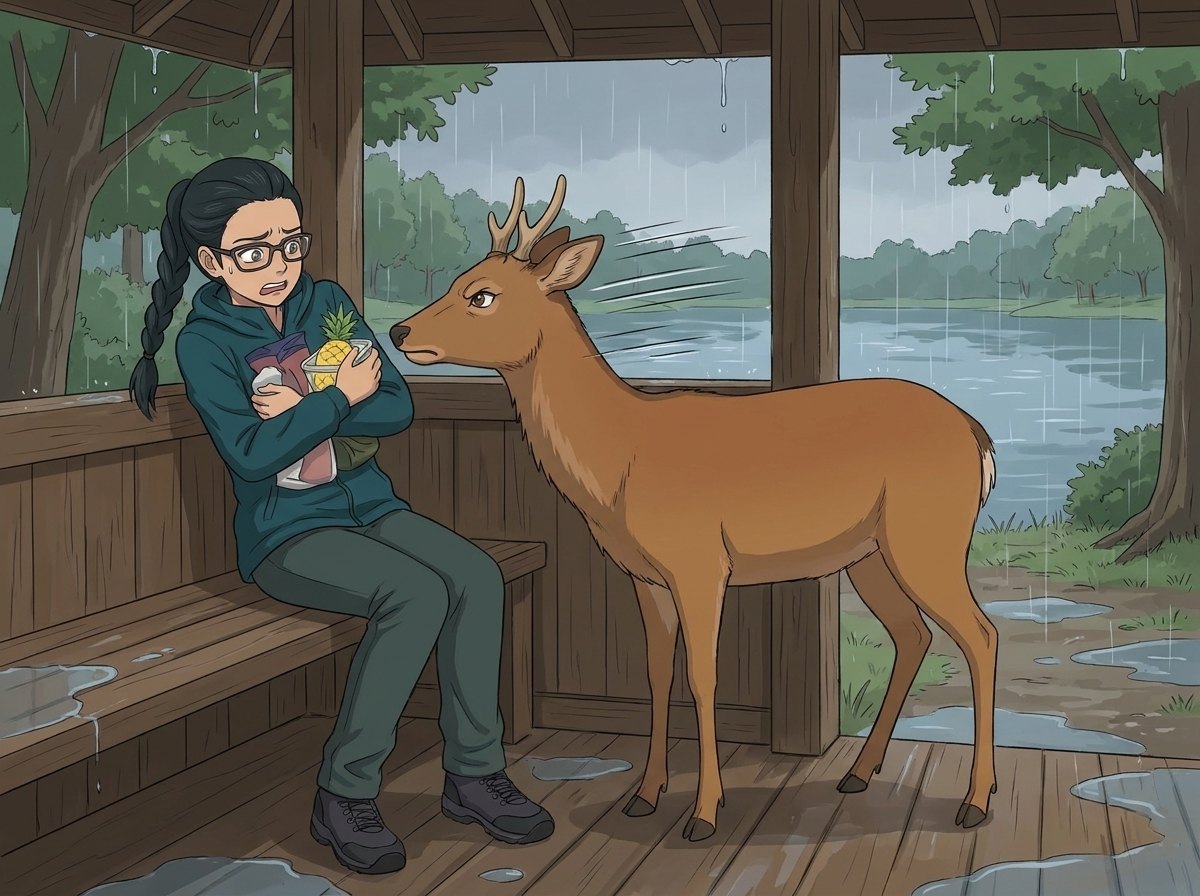
Five minutes into the park, we found a quiet little shelter by the lake to get out of the rain. One deer was already in there, soaking wet, also getting out of the rain. He took one look at Jess, one look at the snacks in her hand, and decided they were now his snacks.
He nudged. He nosed. He followed her round and round the shelter like a furry tax collector.
The mugging
As a loyal travel companion, I immediately sprang into action.
First, I took photos. Then a video. Then a few more photos, from a better angle. THEN I rescued her.
Jess was not impressed. The deer was delighted.
Jess escapes (and Sophie's Doll Quest heats up) Jess tapped out, very sensibly, and went shopping in the (dry) old town. While she was exploring, she came across an old timber shop selling all sorts of beautiful wooden crafts, scrolls, manuscripts and treasures. Inside, she discovered a huge collection of Japanese dolls, both commercial touristy ones and authentic, old traditional ones.
Sophie, this is where your doll quest got serious.
Jess started sending me photos of the dolls, asking if any of them were right for you, at the exact moment I was in the park fighting off a deer that was trying to eat my backpack. I texted Jess back with tips on what to look for to tell an authentic traditional doll from a touristy one, though my messages made very little sense because I was actively getting headbutted by an impatient teenage deer while typing.
Before Jess headed back to Kyoto, she dropped a pin on the map to show me exactly where the timber shop was. (The right pin, naturally.)
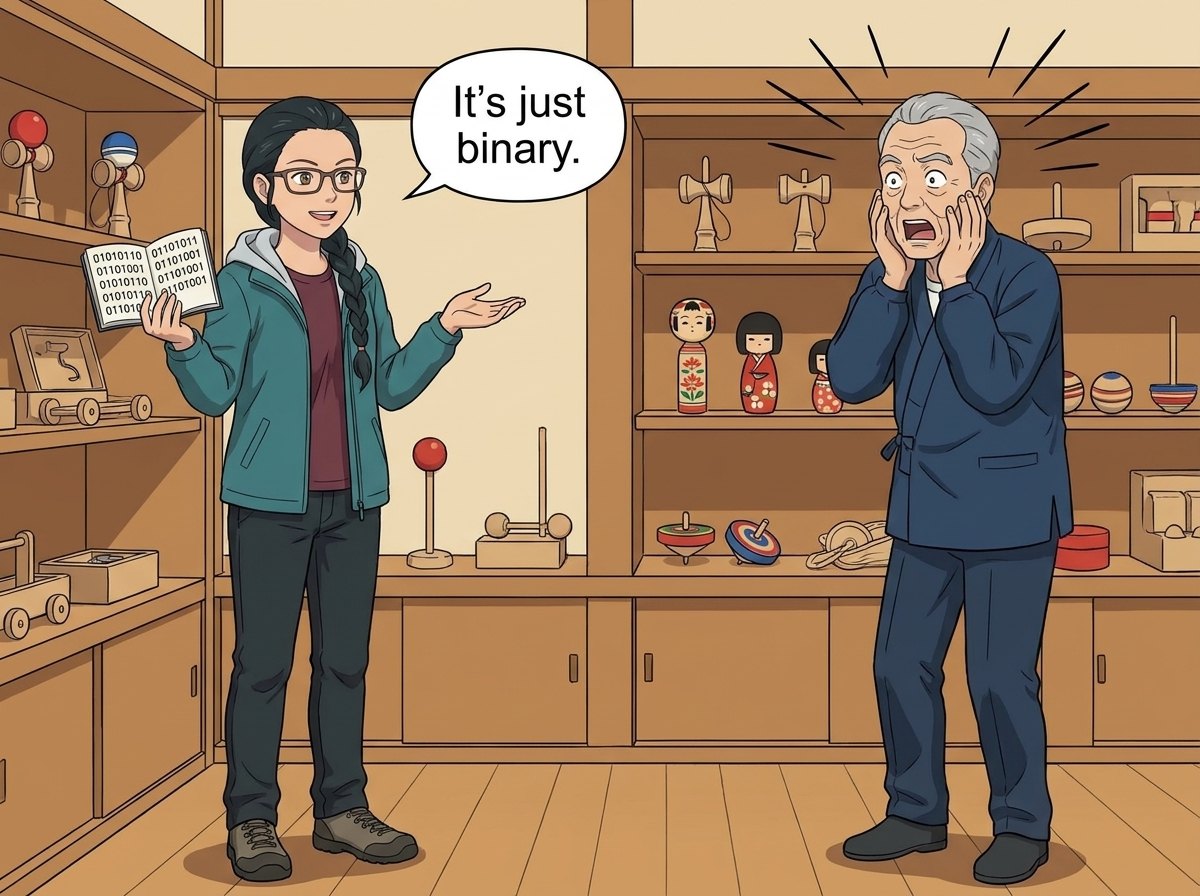
Then she went to a toy museum full of old Japanese puzzles, and solved the one puzzle that fools absolutely everyone. The museum guide was so impressed he nearly fell over.
"It's just binary," said Jess.
The puzzle champion
(Binary is the counting system computers use, with only 1s and 0s. There are 10 kinds of people in the world: those who understand binary, and those who don't. Ask Jess to explain the joke.)
Five hours in the rain Meanwhile, I wrapped the Canon in a plastic bag and spent five glorious hours marching through the pouring rain, having the time of my life.
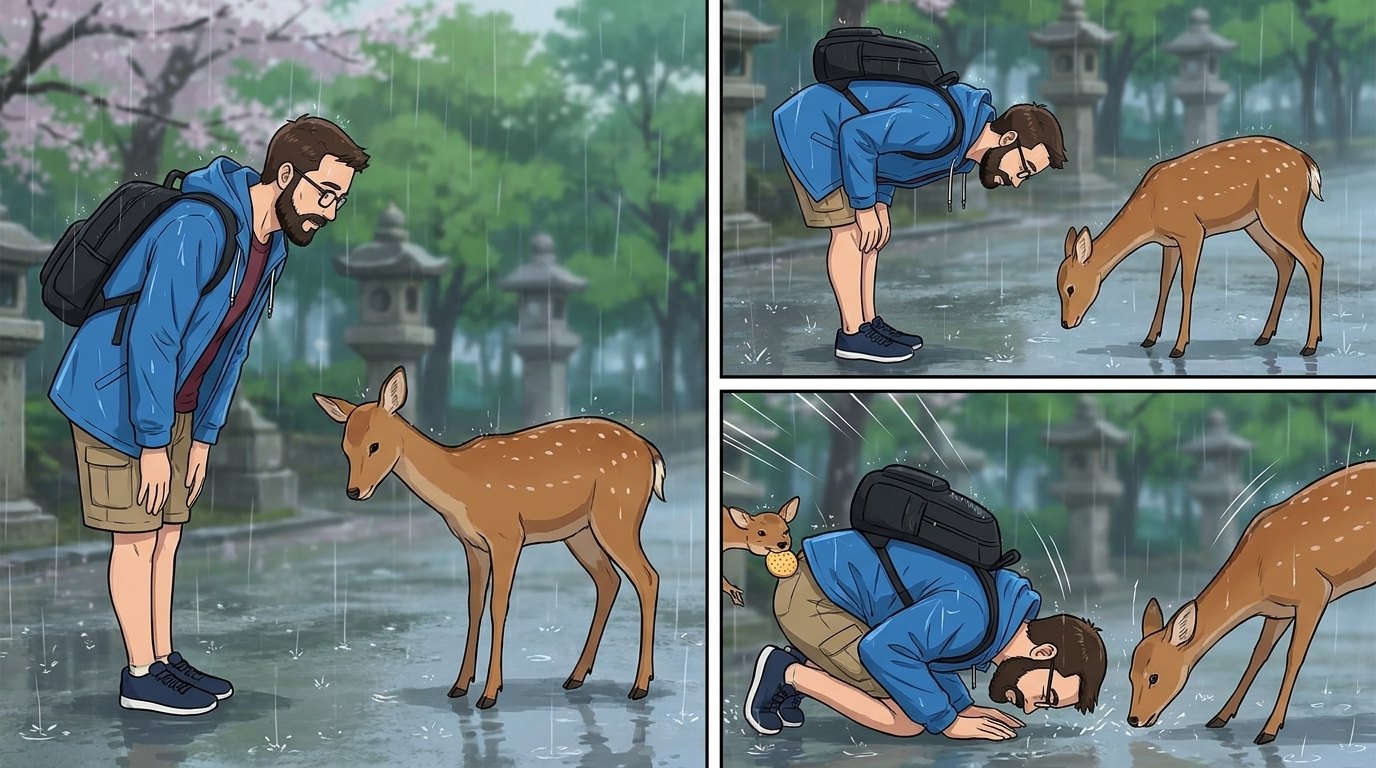
The deer near the temples bow to you. You bow, they bow, you give them a cracker. You buy the crackers from little stalls, and the deer know EXACTLY what the stalls are. The moment you buy a packet, you have friends. Lots of friends. Friends with no manners.
The bowing lesson
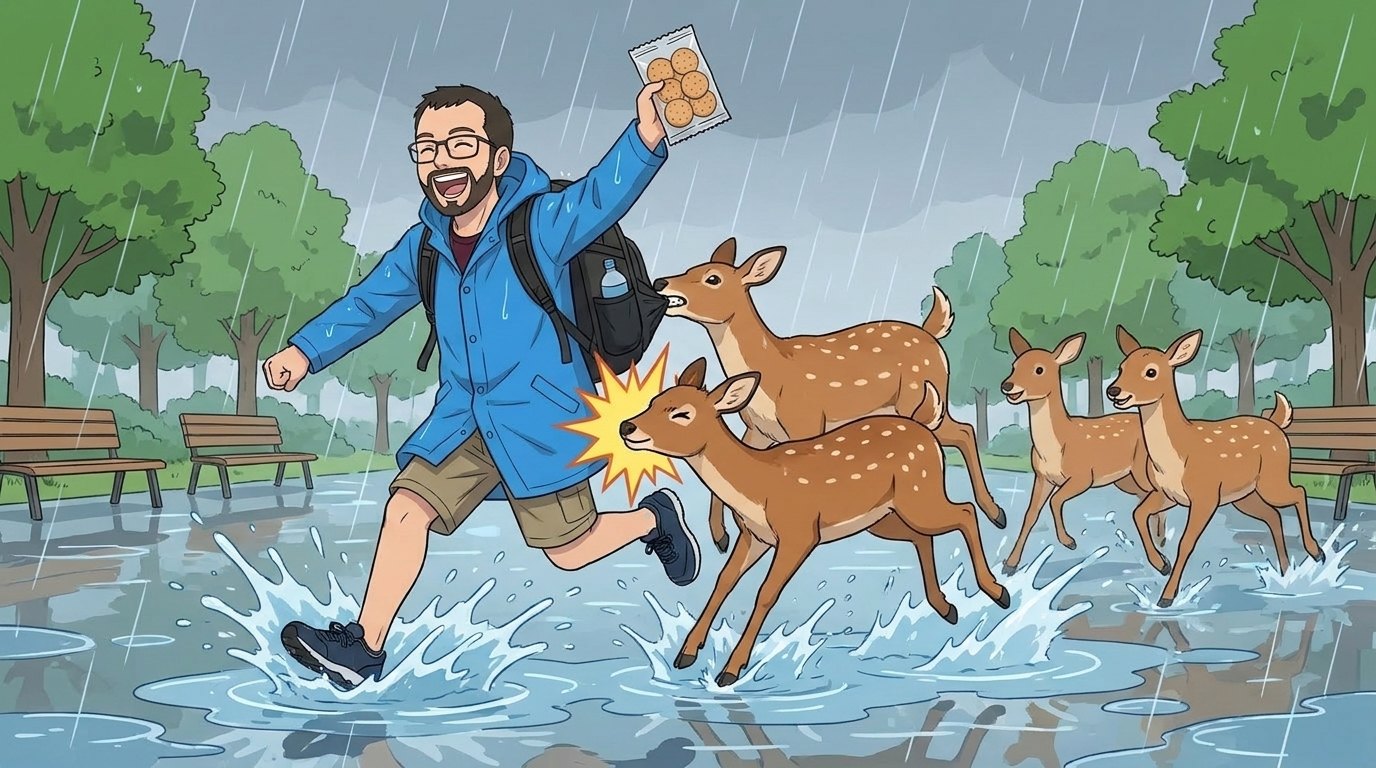
The teenage deer are the worst. If you are slow with the cracker, they headbutt you. I collected several headbutts and loved every one. One deer decided my backpack looked tasty and tried to eat it. Another followed me for a full ten minutes making a noise like a squeaky door.
The teenage deer gang
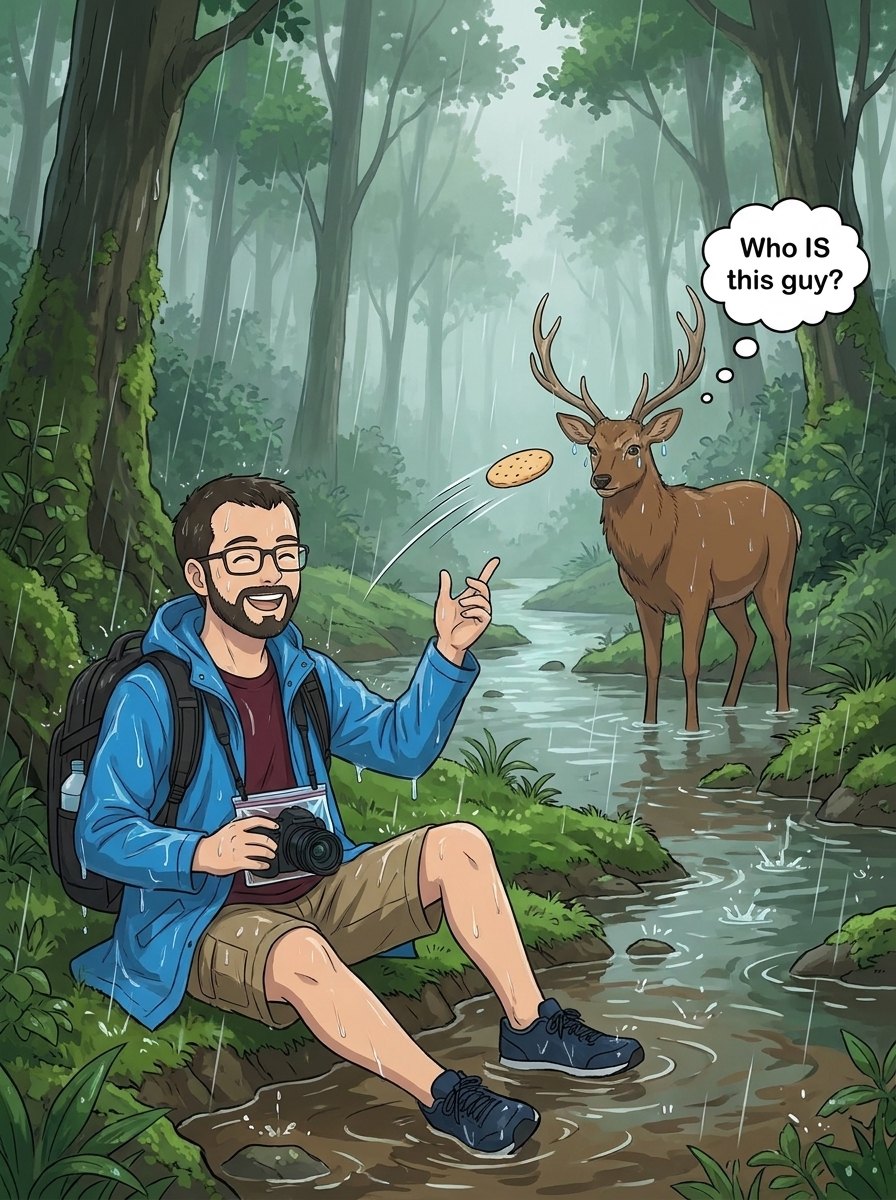
The buck Deep in the back forest, down a hidden path with nobody else around, I found him.
Boss battle 5DAD IN THE MUDVSTHE WILD NARA BUCK
A big wild buck with a full crown of antlers, much more wary of people than the bowing deer back in the park. He was nervous. I wanted a photo. He wanted a significant amount of personal space.
So I did the only sensible thing. I sat down in the mud in the pouring rain and started frisbee-ing crackers at him. One by one. For about twenty minutes.
Dad and the buck
Slowly, slowly, he came closer. He crossed the flooded stream. The deer behind me, which were more used to people, got scared of HIM and ran away. He was too shy to take a cracker from my hand, but he got close enough that I could see raindrops on his eyelashes. And the points of his antlers.
For one second I thought: this is how it ends. Alone, in a muddy forest in a typhoon downpour, poked by a deer. The newspaper headline wrote itself.
DAD POKED BY DEER. JESS NOT SURPRISED.
The newspaper
But no. I got the shots. Some of the best photos I have ever taken. Looking back, kids, I should have given that wild deer more space, especially with those sharp antlers. Do as I say, not as I do. (Yes, the same safety rule as the blacksmithing class!) The buck watched me go. I like to think we are friends now.
He remains unconvinced.
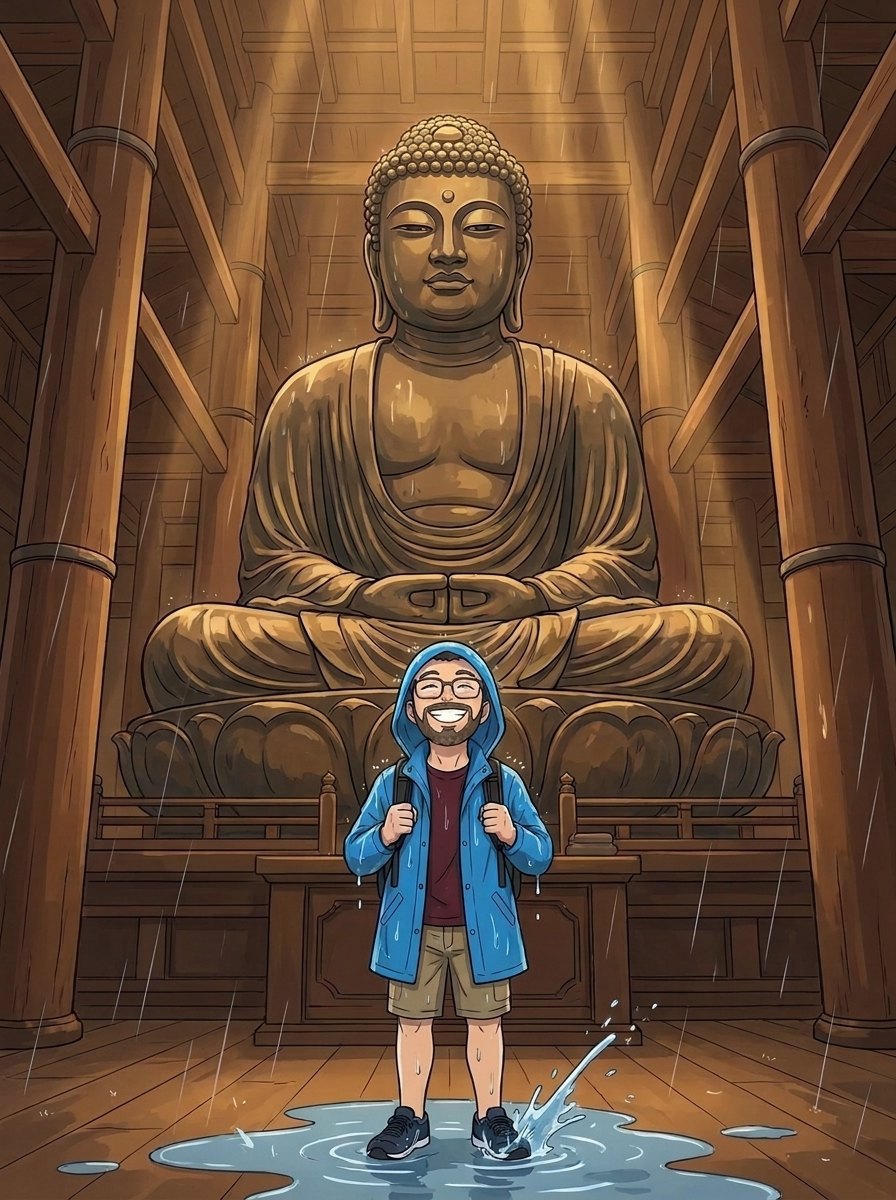
The Giant Buddha Soaked to the bone, I squelched up to Todai-ji temple. Inside one of the biggest wooden buildings I have ever seen sits the Daibutsu, a bronze Giant Buddha as tall as a four-storey building. His hand alone is bigger than me.
The Giant Buddha
It was made nearly 1,300 years ago, by hand, by people with no cranes, no computers and no electricity. I stood there dripping and just stared. It's amazing what people are capable of achieving.
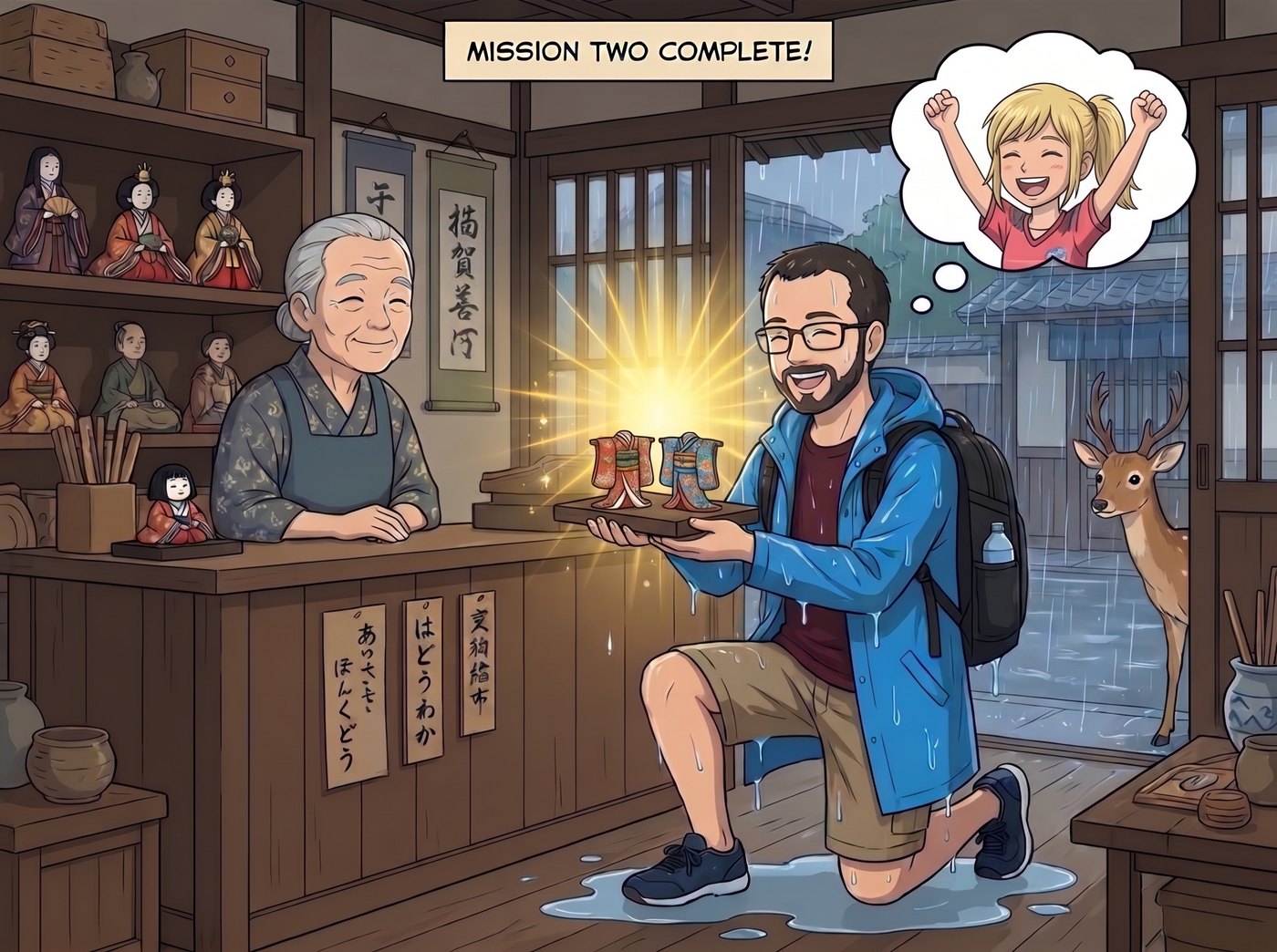
Mission Two: Complete! Before catching the train back to Kyoto, I followed Jess's map pin down to the old timber shop. I inspected the dolls carefully, even getting AI to help double-check them, until I found the absolute perfect traditional doll for you, Soph, to complete the set alongside the scented silk kimono dolls from the bamboo forest. I wrapped it up tightly in plastic so it wouldn't get a single drop of water on it, tucked it safely inside my soaking-wet backpack, and ventured back to Kyoto.
Mission Two complete
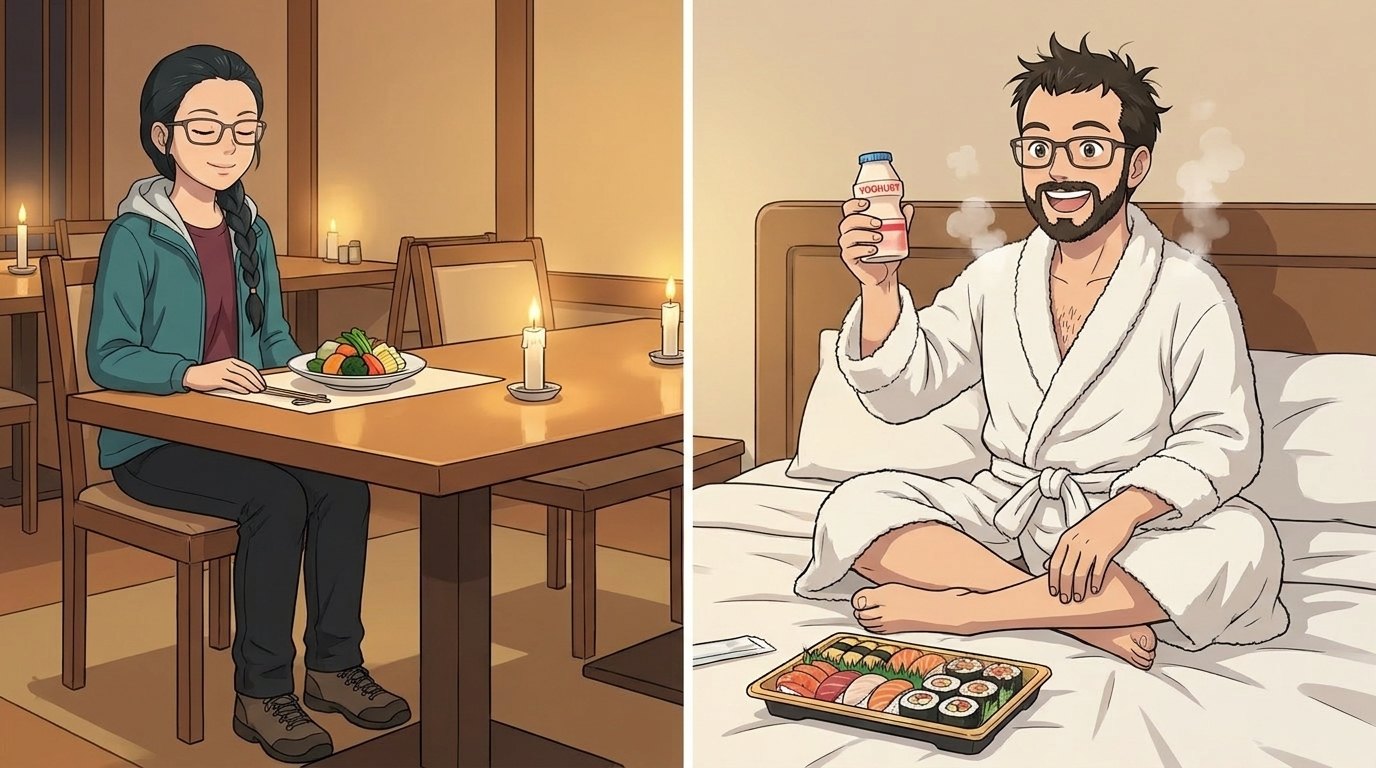
Two feasts Back in Kyoto, Jess had found a restaurant that served dinner at her perfect speed: tiny beautiful dishes of Kyoto vegetables arriving slowly over two and a half hours. She was in heaven.
Her dinner started while I was still up a mountain in the rain. It finished after I had caught the train back, had a hot shower, thawed out my frozen toes and eaten my own fancy feast: convenience-store sushi and a tiny bottle of Yakult.
Two feasts
We both had a great day.
Japan fact file
Nara became Japan's first permanent capital way back in the year 710. Before that, the capital moved every time a new emperor took the throne.
For hundreds of years, hurting one of Nara's deer was a very serious crime. Today they are protected as a National Natural Monument.
Every autumn, some male deer have their hard antlers removed in a centuries-old ceremony to help prevent injuries during the breeding season. Their antlers grow back the following year.
The Great Buddha of Todai-ji weighs about 250 tonnes. The temple hall was once even bigger than it is now. There is a hole in one of the wooden pillars the same size as the Buddha's nostril, and children who crawl through it are said to get good luck. (There was a local Japanese school excursion there, and the children were all crawling through the hole, so I couldn't attempt it. Probably just as well, as I don't think I would have fitted anyway!)
Traditional Japanese dolls, such as wooden kokeshi and dolls dressed in silk kimono, have been crafted and painted by hand for hundreds of years. Some handmade dolls have a maker's mark or signature, but not all do. Careful hand-painted details, materials, craftsmanship and information about the maker can help you recognise traditional work.
鹿
Word of the day
Shika
say it: SHEE-kah
Deer.
As in, oh shika, there are deer in the train station.
Dad's lesson
Sometimes the plan is to have no plan. Sit in the mud, wait, be patient, and the shy deer comes to you. (Also, keep your crackers in a zipped pocket. Also, buy gumboots.)
Day8
The Man Who Raced a Bullet Train
Tuesday 27 OctoberKyoto → Nagoya → Tokyo
Tuesday was Shinkansen day: our ride on the world-famous Japanese bullet train.
Today I learnt two things about bullet trains. They are very fast. And they are much, much longer than they look.
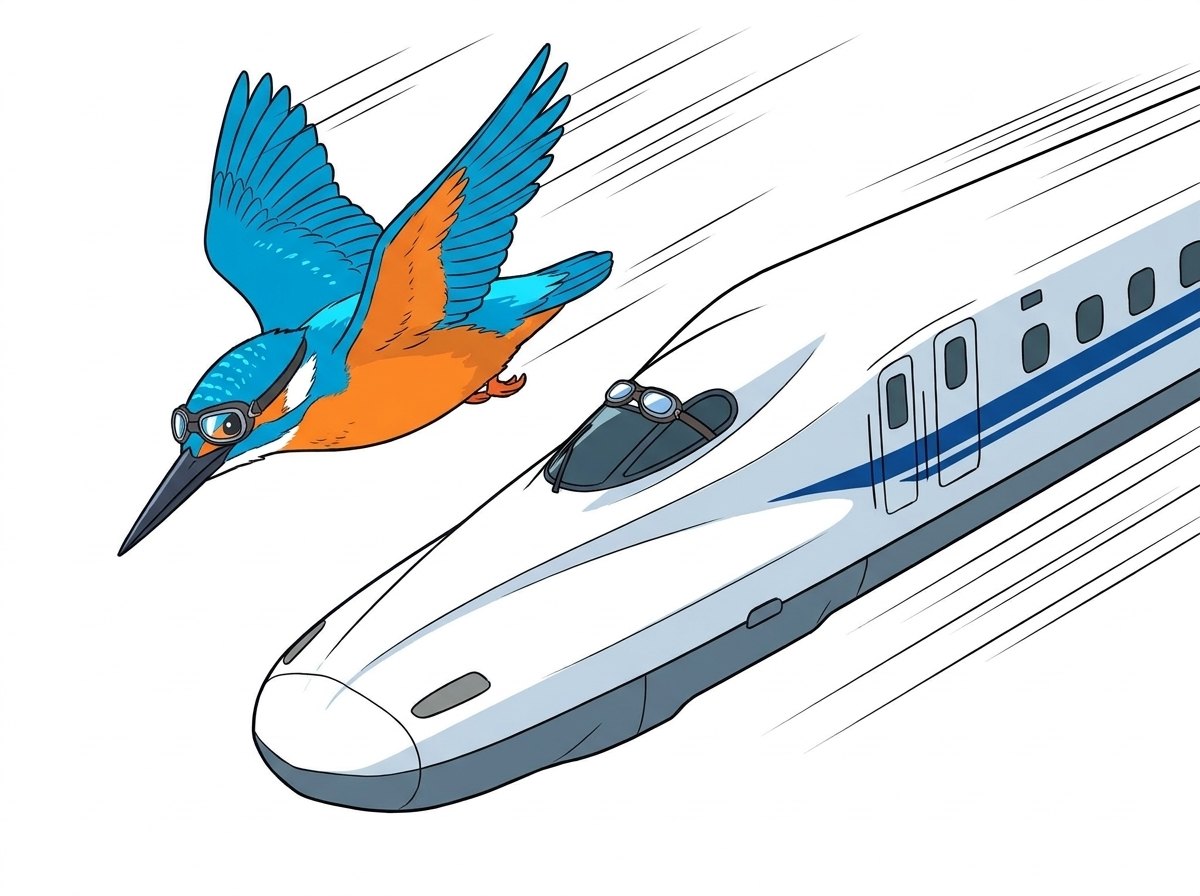
The kingfisher nose
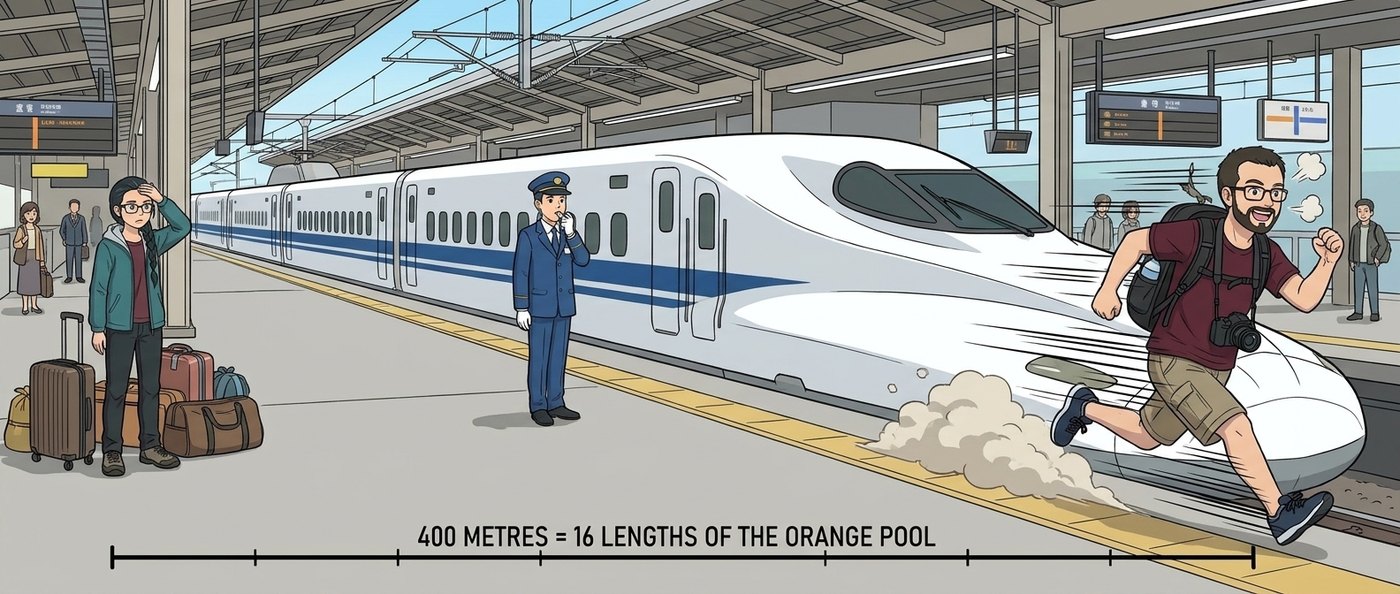
The race We got to the platform at Kyoto Station early so I could film a Shinkansen leaving. We were standing at the back end of the train. I figured the front could not be far. These trains are only three or four carriages long, surely? A casual jog would get me to the nose for the perfect shot of it pulling away.
Kids, a Shinkansen is sixteen carriages long. Four hundred metres! That's 16 lengths of the Orange indoor pool (25 metres per length)!
CHIME!The departure melody started playing.
HISS!The doors slid shut. My casual stroll became a power walk.
PANT!The power walk became a jog, and the jog became blind panic.
WHEEZE!The panic became a full-blown sprint, camera bouncing, backpack flapping, Jess somewhere far behind shaking her head.
Most people probably just thought I was running late for the train. They had no idea I was racing it for a photo.
I reached the nose and hit record with about two seconds to spare.
Racing the bullet train
Our own train was the next one, which was lucky, because I needed a sit-down.
On board The train pulls out smoothly, and then it accelerates. And accelerates. And KEEPS accelerating. Houses blur. Rice fields streak. Mountains slide past like a painting on wheels.
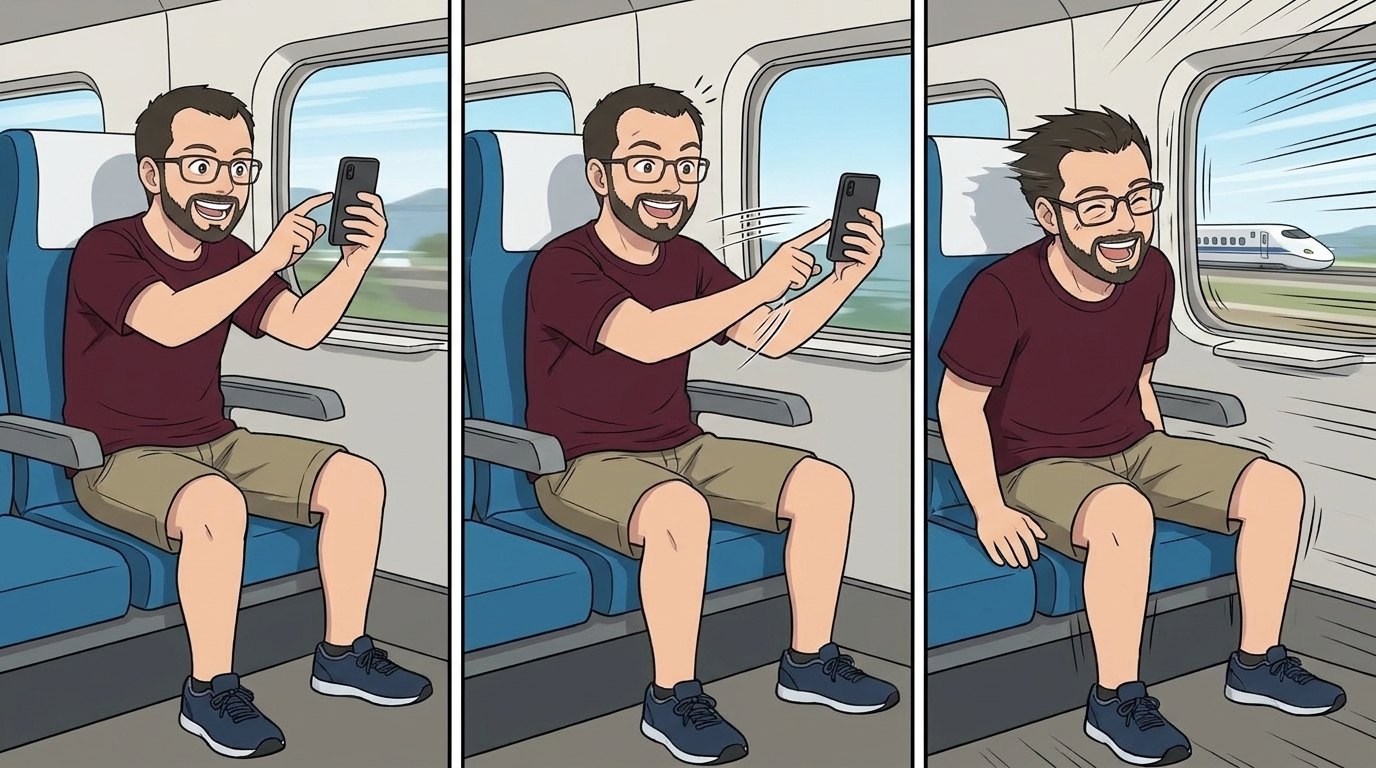
I wanted a video of another bullet train passing us in the other direction at full speed. Every time I saw one coming and pressed record, it had already gone. Blink and you miss it. Literally.
Blink and you miss it
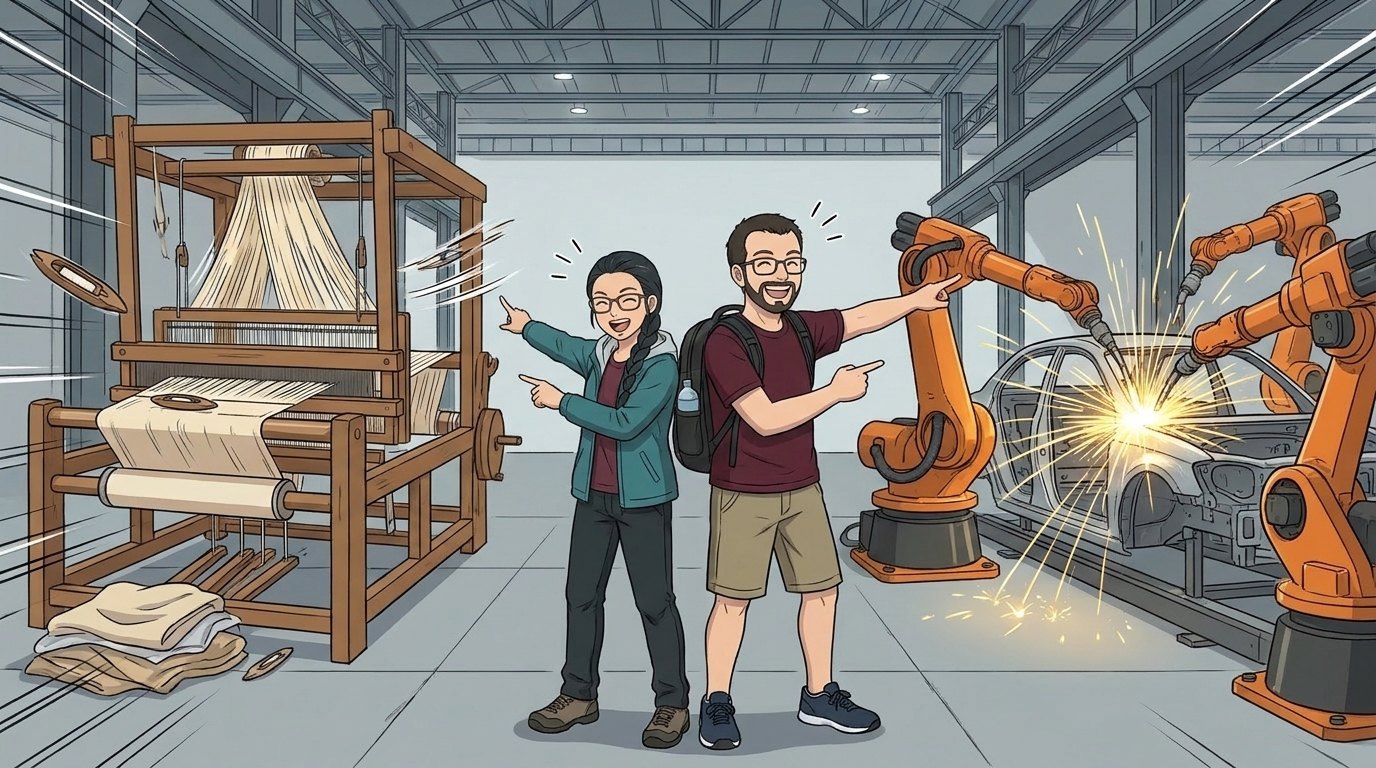
The Toyota museum, Nagoya We hopped off halfway, in Nagoya, to visit the Toyota Commemorative Museum. Did you know Toyota did not start out making cars? It started out making weaving machines.
Both of us were in heaven, because it is a WORKING museum. Every single machine runs. You start with someone spinning cotton by hand, then a wooden loom, then a clanking steam-powered loom, then a computer-controlled loom that weaves actual photographs into fabric.
Then you walk through a door and there are giant metal presses stamping out car parts, and robot arms welding a car body together right in front of you, sparks flying.
Looms and welding robots
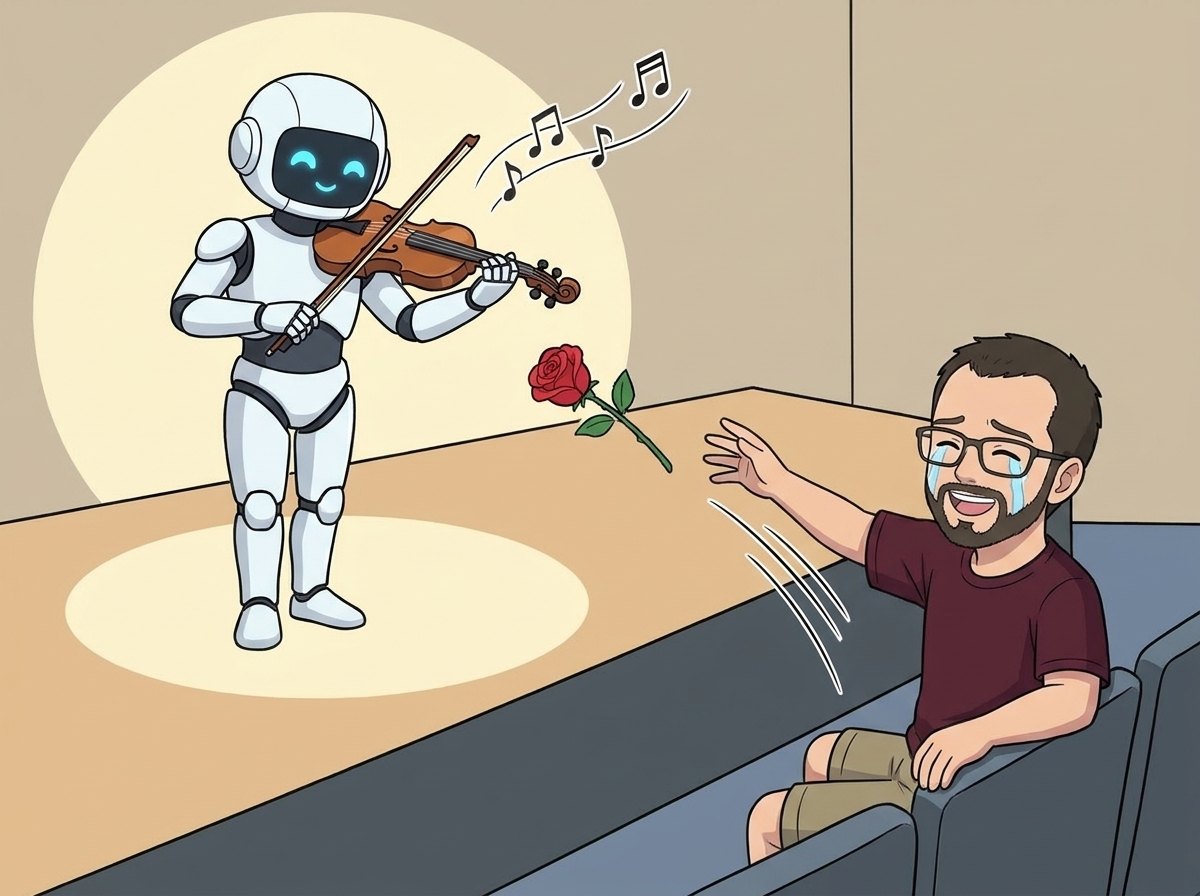
And I met a Toyota robot that plays the violin. Properly plays it. With a bow, and real mechanical fingers.
The violin robot
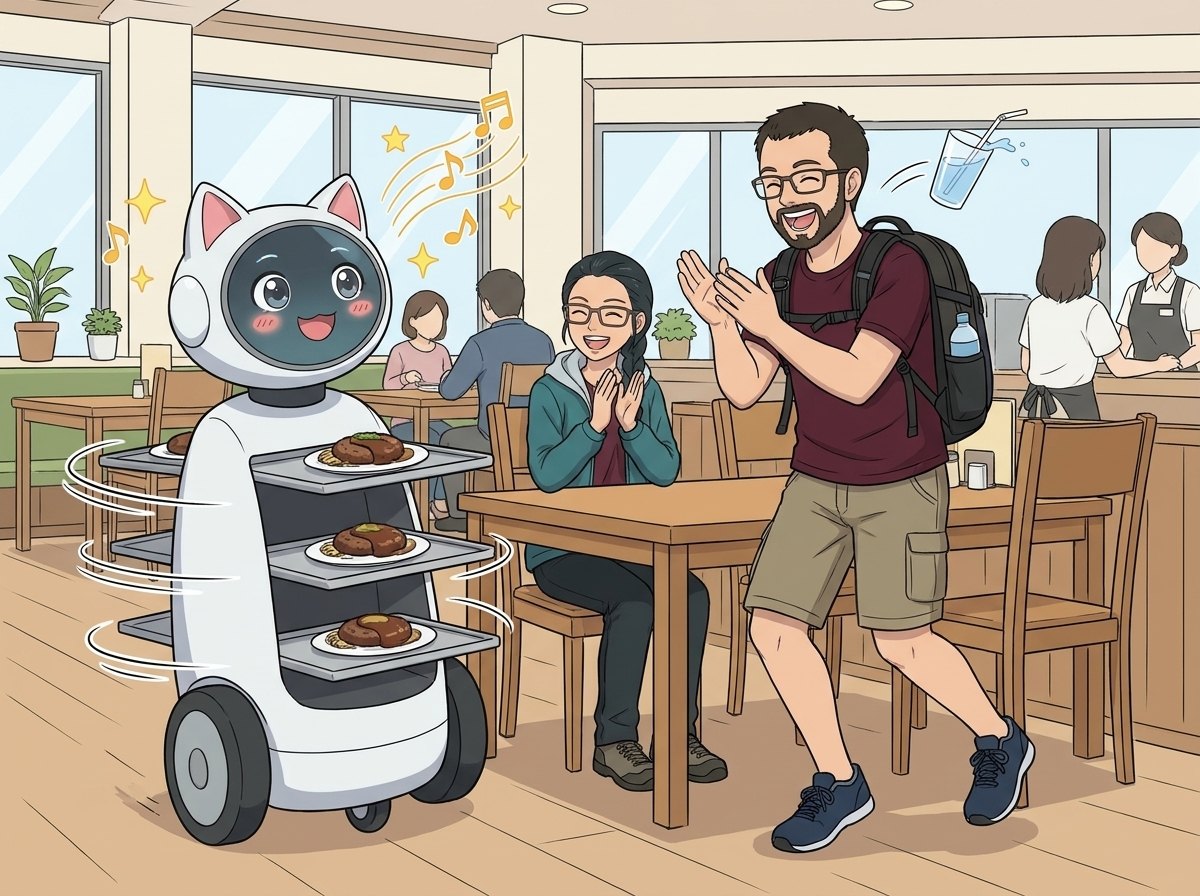
The robot cat By evening we had zoomed into Tokyo, one of the biggest cities on the planet. Dinner was at a family restaurant called Gusto, where the food was delivered to our table by a singing, one-metre-tall robot vacuum with cat ears and glowing anime eyes. It rolled up, waited for us to take our plates, did a celebratory spin and trundled back to the kitchen.
The robot cat waiter
I would have ordered more food just to see it again.
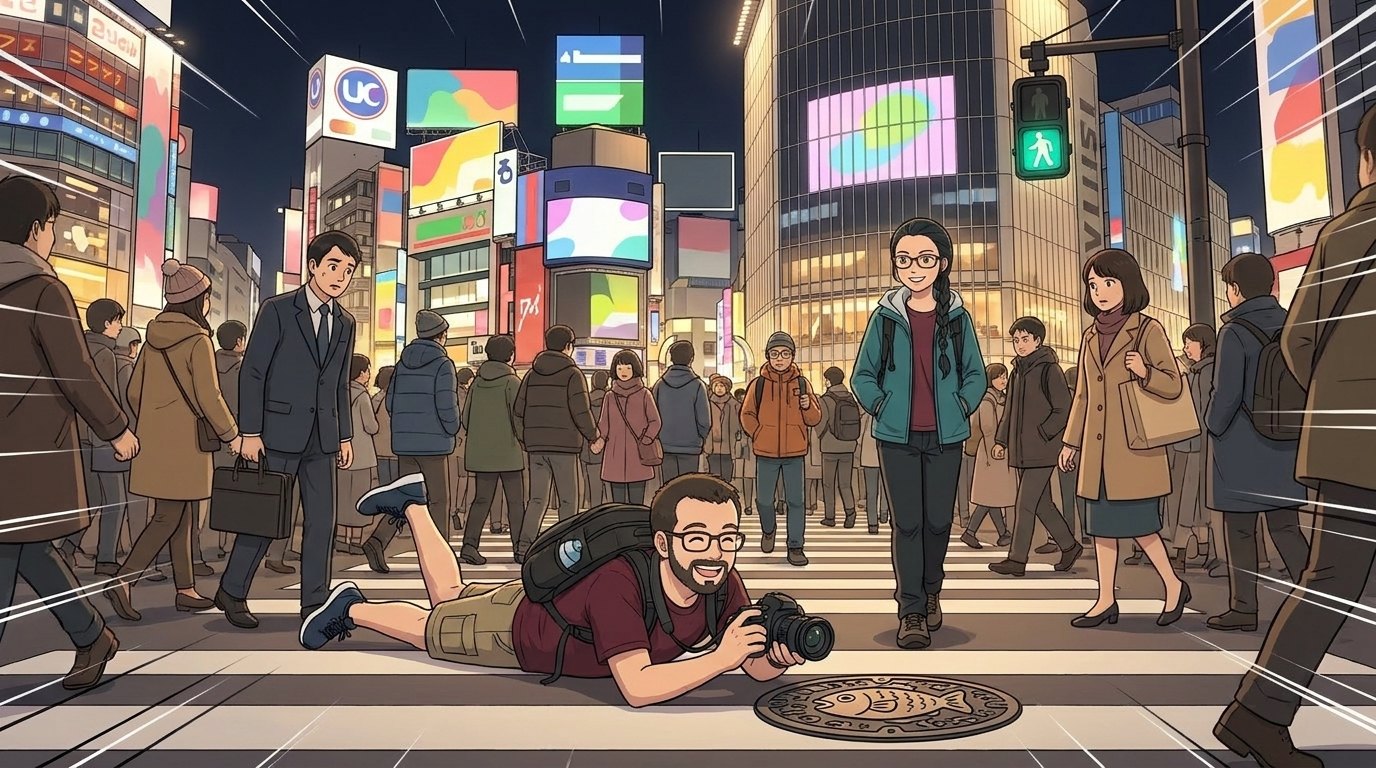
Shibuya Crossing Afterwards we dived into the busiest pedestrian crossing in the world. When the lights change, up to three thousand people cross at once from every direction, and somehow nobody bumps into anybody. People in character onesies drive past in real-life Mario Karts. Influencers sprint to the middle for their photo and sprint back before the lights change.
Shibuya Crossing
It is chaos. It is wonderful.
I told Jess that at HER pace, Shibuya Crossing must feel like a sleepy little seaside village. She was extremely proud of this.
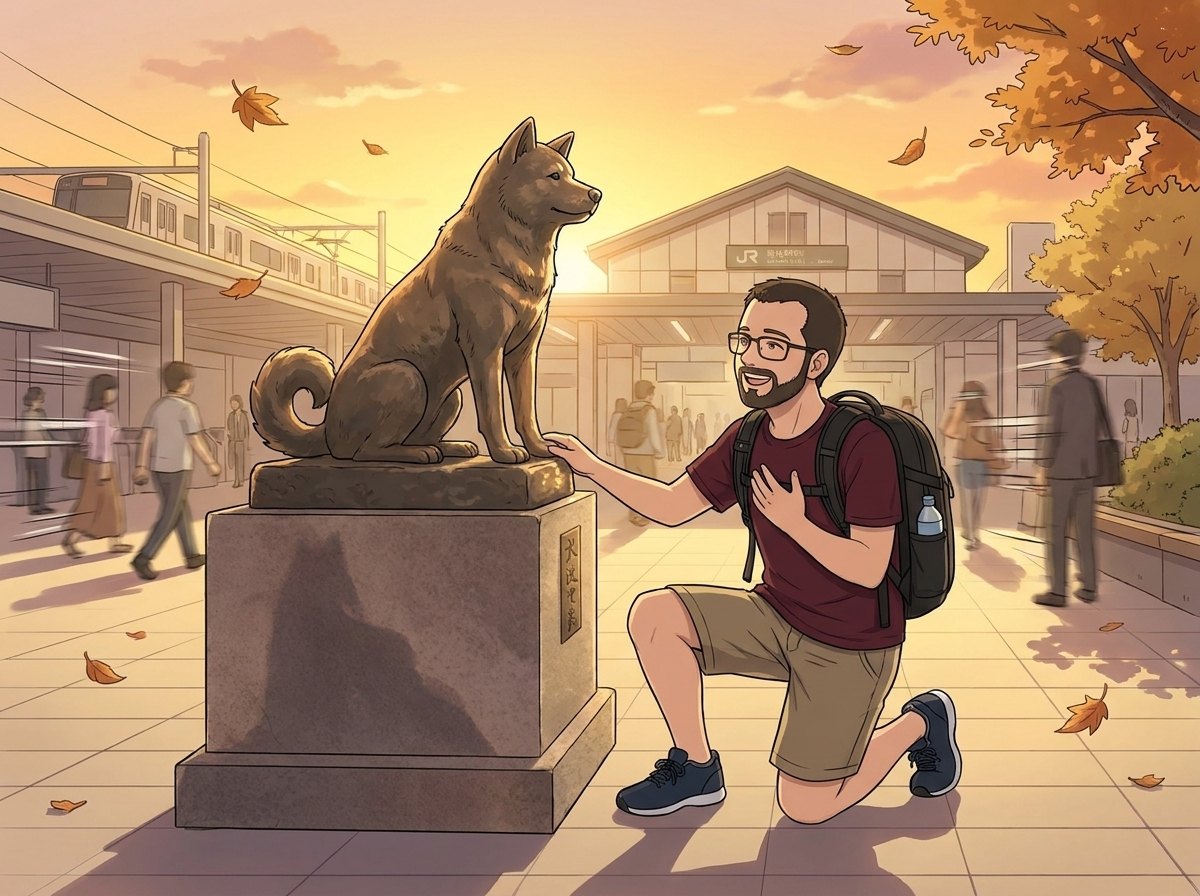
Near the station is a statue of a dog called Hachikō, the most famous dog in Japan, and a popular place for friends to meet. Hachikō kept returning to Shibuya Station to wait for his owner, even after his owner died. He waited for years, and people loved his loyalty so much that they made him a statue.
The loyal dog
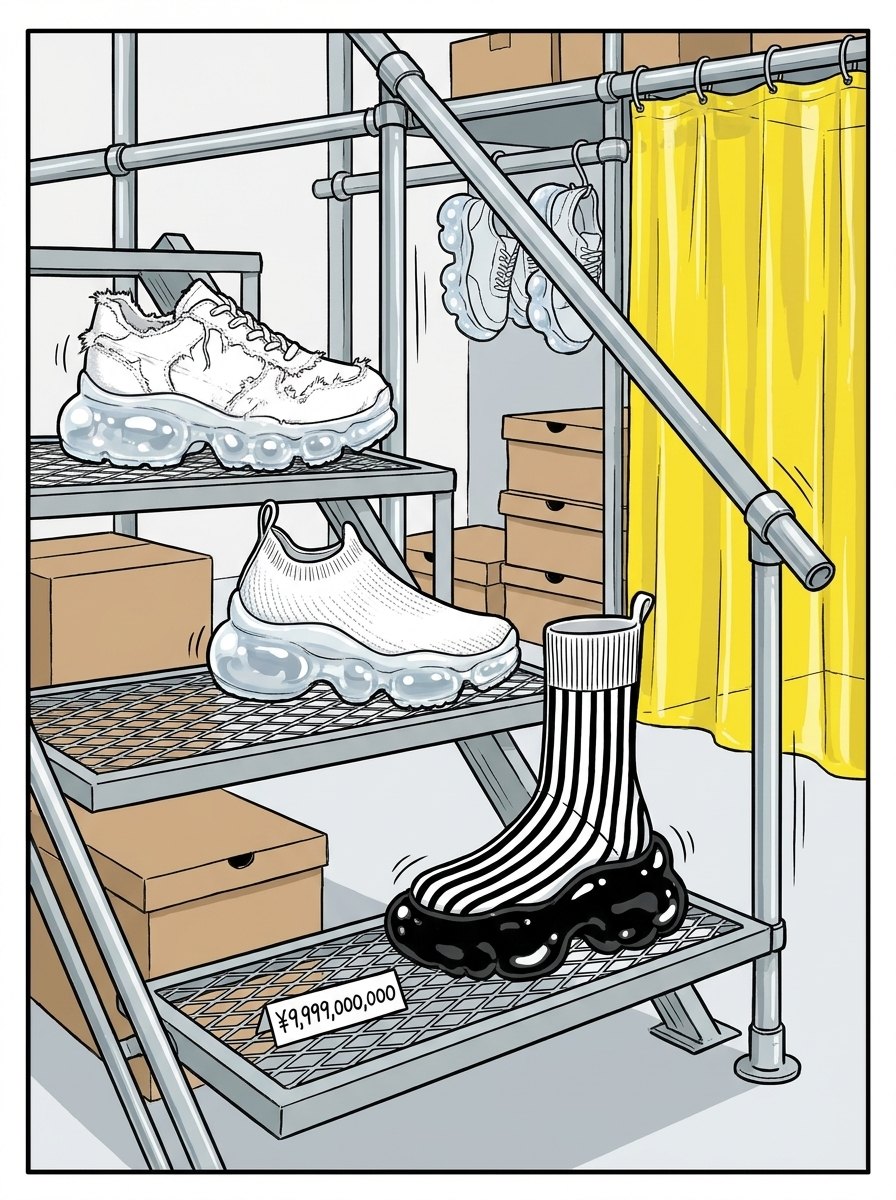
The shoes Somewhere in Shibuya we found a shop selling the most ridiculous pair of shoes ever made. They were enormous, lumpy monsters of shoes, like someone had strapped two giant, bumpy pillows to their feet. And they cost more than a car! Yes, those were real shoes. No, I did not buy them!
The shoes
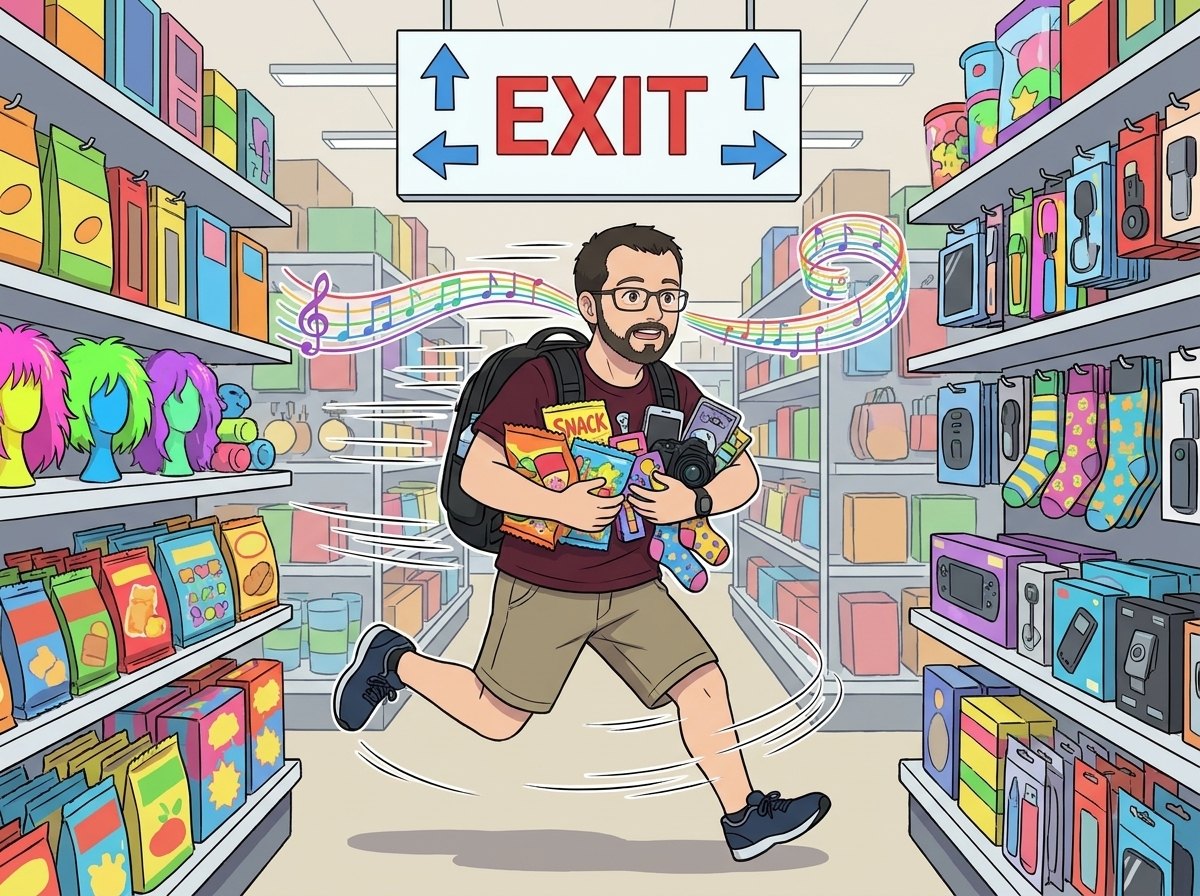
Donki We finished the night inside our first Don Quijote megastore, or "Donki": a towering discount maze packed floor to ceiling with everything from samurai-sword umbrellas to giant Kit Kats. It is the easiest shop in Japan to walk into and the hardest to find your way out of.
The whole time, a hypnotic theme song played on repeat. "Don, Don, Don, Donki..."
Lost in the megastore
It is now permanently stuck playing inside my brain.
Japan fact file
The Shinkansen first ran in 1964. The line we rode, the Tokaido Shinkansen, reaches speeds of up to 285 kilometres an hour. In more than 60 years, not a single passenger has died in a crash on a Shinkansen. These trains are famous for running remarkably close to schedule, even in a country that experiences earthquakes and typhoons.
A cleaning crew of 22 people cleans an entire Shinkansen in 7 minutes, then bows to the passengers getting on. People call it the "seven-minute miracle".
Toyota started in 1926 as a company making automatic weaving looms. Sakichi Toyoda invented a loom that stopped itself when a thread broke. His son used the money to start building cars in the 1930s.
Rubbish trucks, delivery trucks and even reversing vans in Japan often play little tunes instead of beeping. Japan is basically one giant musical toy box.
すごい!
Word of the day
Sugoi!
say it: soo-GOY
Amazing! Wow!
Say it at the bullet train, the robot cat and the price of those lumpy shoes.
Dad's lesson
A big Japanese railway station is not one station. Tokyo has more than a dozen different train companies, and several of them can share one giant station, stacked on top of each other underground like a giant layer cake, each with its own ticket gates. It is like a Rubik's Cube inside another Rubik's Cube. Golden Rule, Dad. Station number, platform number, exit number. Ignore everything else.
Day9
Boiled Like a Dumpling and the Night the Walls Moved
Wednesday 28 OctoberTokyo
Warning: this chapter contains a bathhouse, an earthquake and a toilet. Not all at once. Nearly.
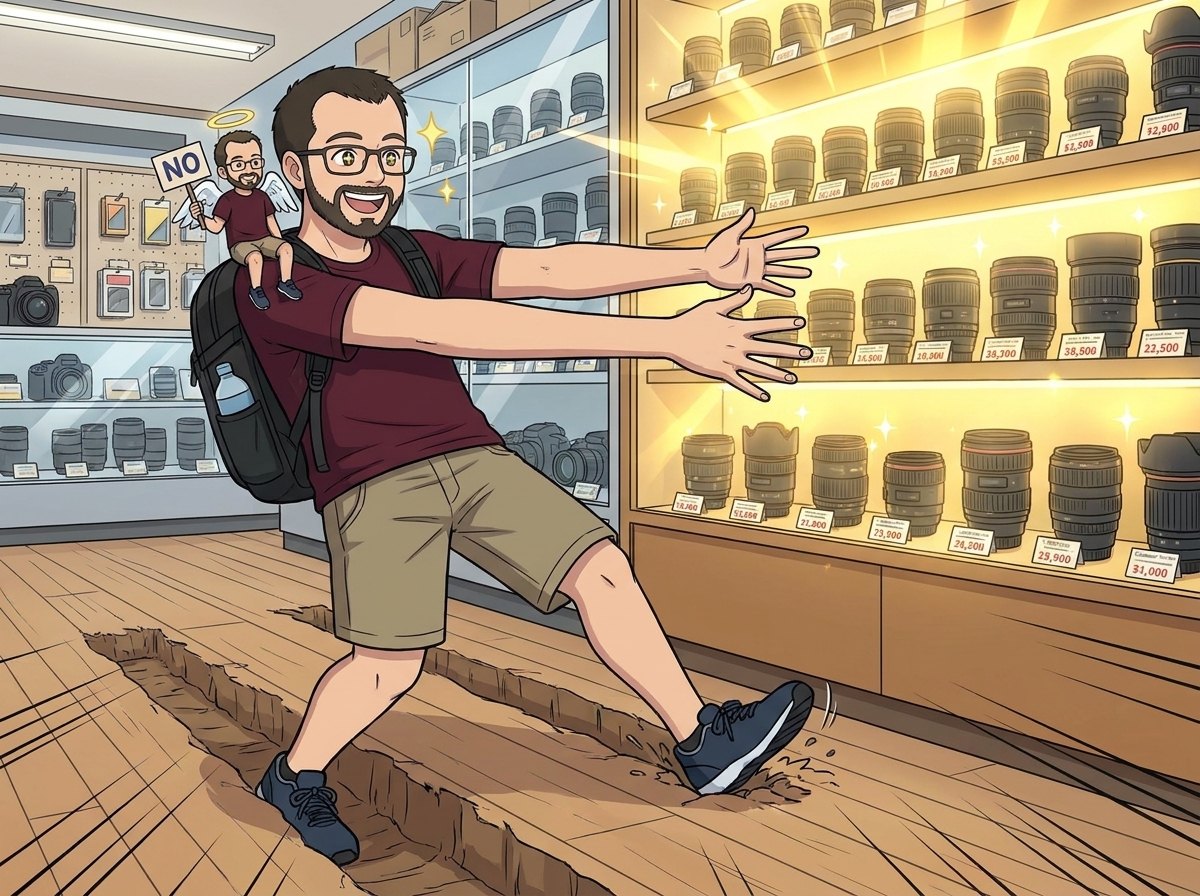
Camera heaven Wednesday in Shinjuku was a test of willpower. Shinjuku has camera shops that go up floor after floor after floor. New cameras. Second-hand cameras. Lenses as long as your arm. I walked through all of them with my hands behind my back like a man in a museum.
I did not buy a lens.
Willpower
Please understand the significance of this moment. Somewhere, a tiny bell rang to announce that Dad had successfully resisted temptation. I want this recorded officially, because it may never happen again.
We also found Daiso, a shop where almost everything costs a hundred yen (about a dollar), and where useful little objects seem to multiply every time you turn around. Where has this been all my life?
And Jess found the bakery in the basement of the Isetan department store. She can find pastries the way a shark can detect a fish, only with better manners.
Pastry radar
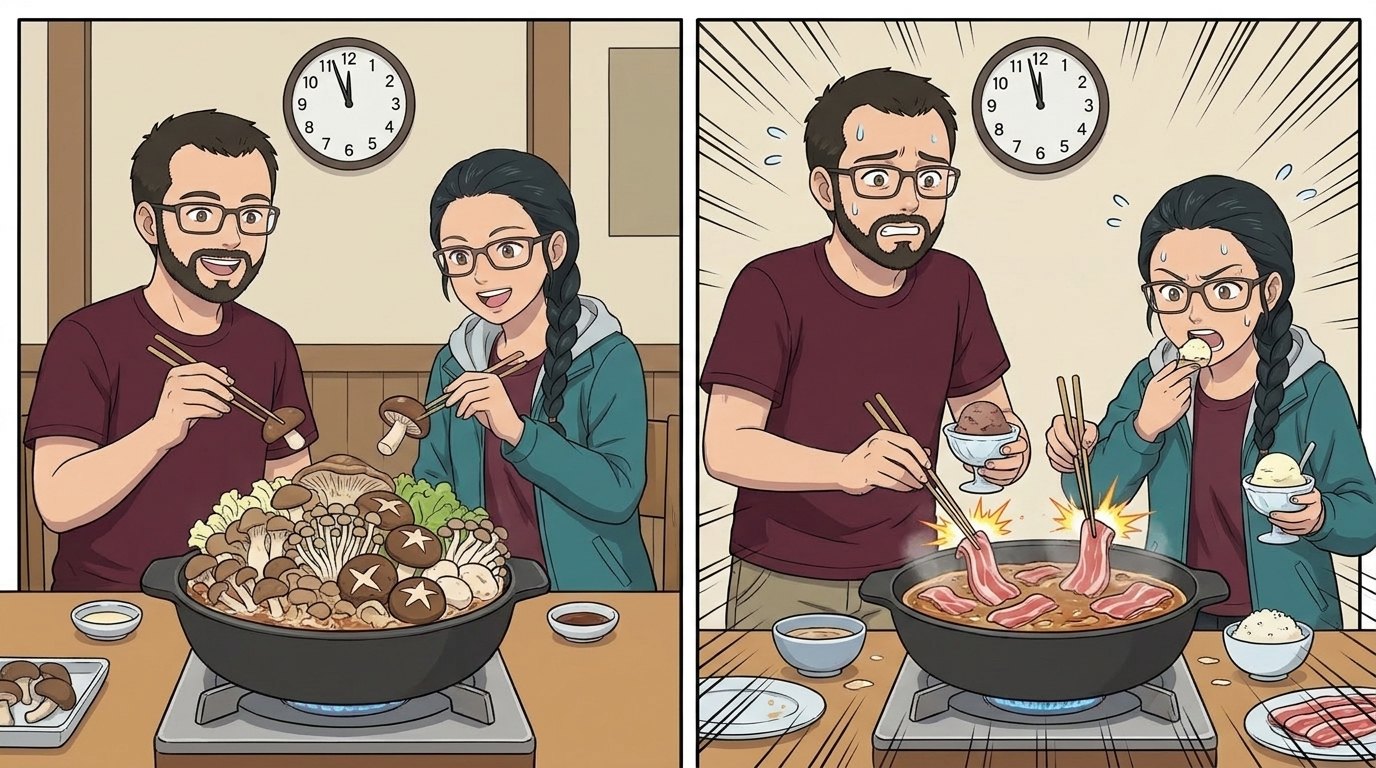
Shabu shabu Lunch was all-you-can-eat shabu shabu: a bubbling pot of broth on your table, and plates of thin meat and vegetables that you swish through the hot soup to cook. You get ninety minutes.
We spent eighty-five of them building an increasingly magnificent mushroom soup, adding more mushrooms, tasting, adding more. With five minutes to go we remembered the steak, the pork and the ice cream, and ate them all at once.
Mushroom soup
Delicious. Badly planned, but delicious.
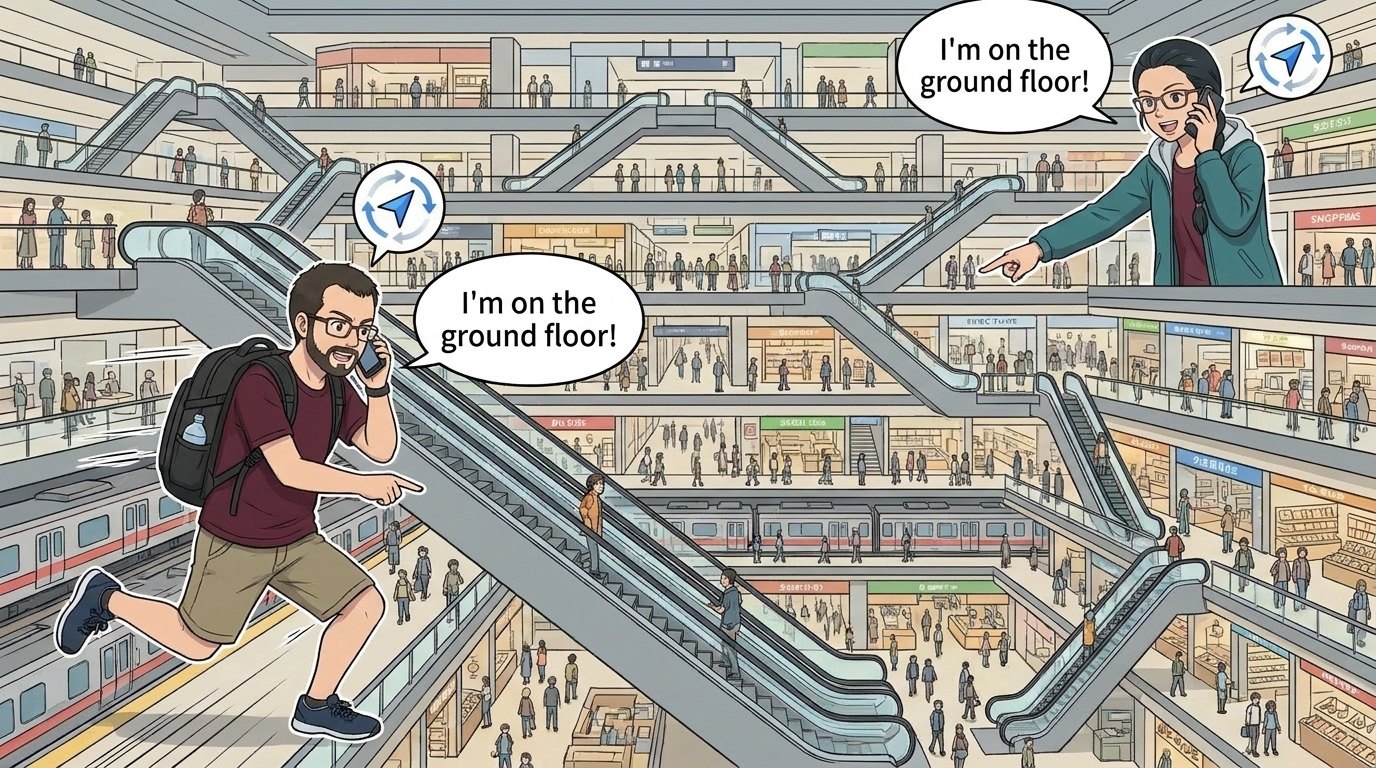
Lost Shinjuku's underground shopping centres are so huge, and stacked on so many levels, that our phone maps went completely haywire.
Which is how Golden Retriever Dad and Bullet-Train Jess lost each other. Twice. In one afternoon.
Both of us were certain we were on the ground floor. The map on our phones disagreed with both of us and kept jumping around to prove it. Jess walks at the speed of light. I stop for shiny things. We found each other both times, and I think losing each other only twice in eleven days is a small miracle.
The ground floor
The onsen Our hotel, the Dormy Inn, had its own separate communal bathing areas for men and women.
They are hot spring baths called onsen, and that night I decided to be brave. Then I walked in and still could not work out the system.
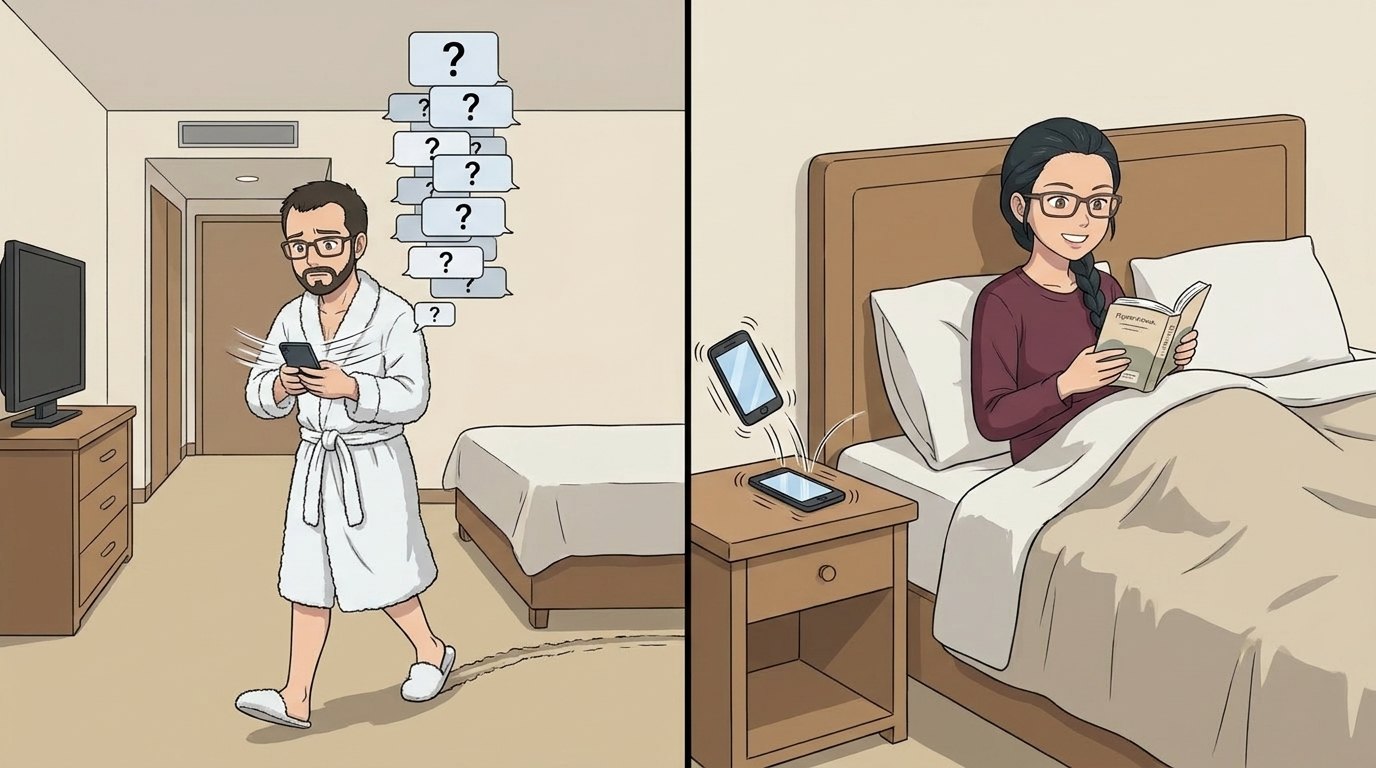
Fifteen questions
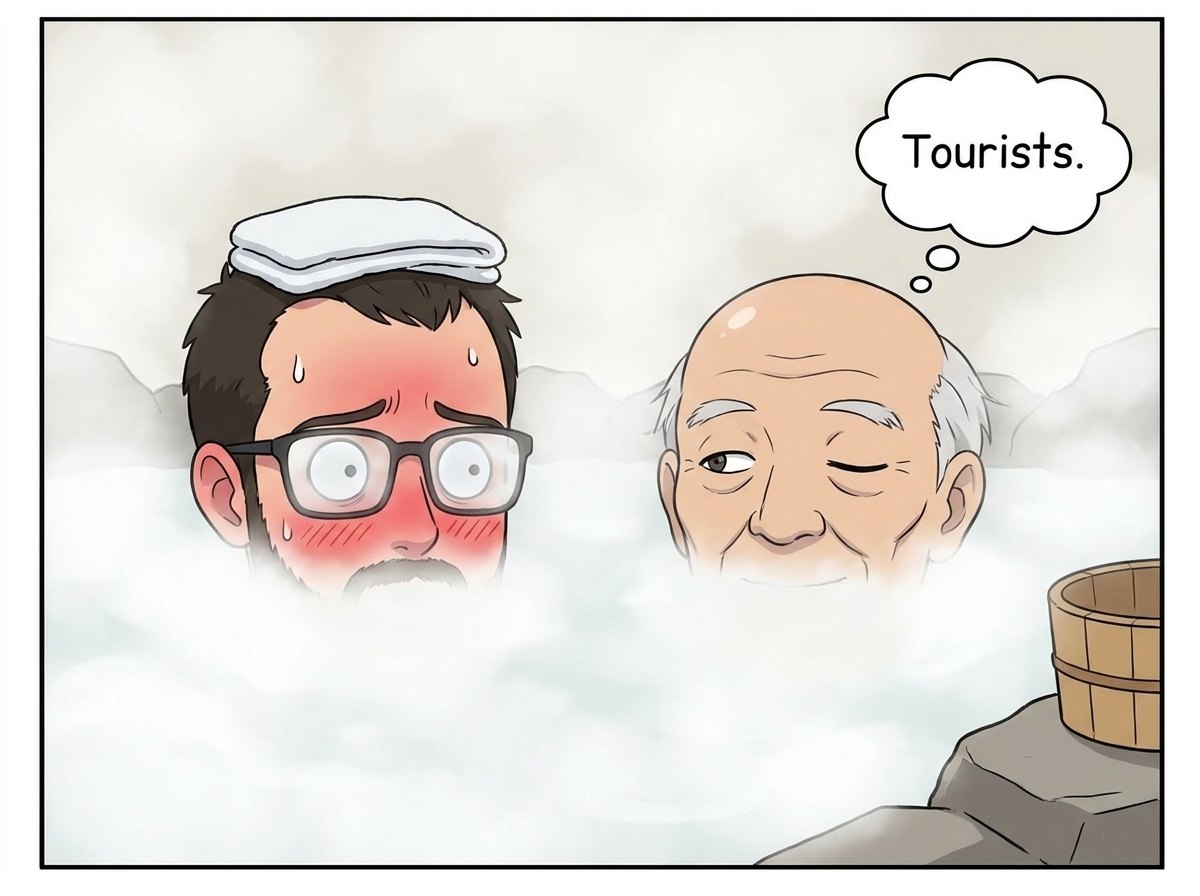
Everybody in there is very relaxed about the whole thing. I wanted to make sure I didn't do the wrong thing and offend anyone. So there I stood, holding a very small towel (for my head apparently), blinking like a deer in headlights, while naked elderly Japanese gentlemen strolled past thinking, "Tourists!"
The onsen
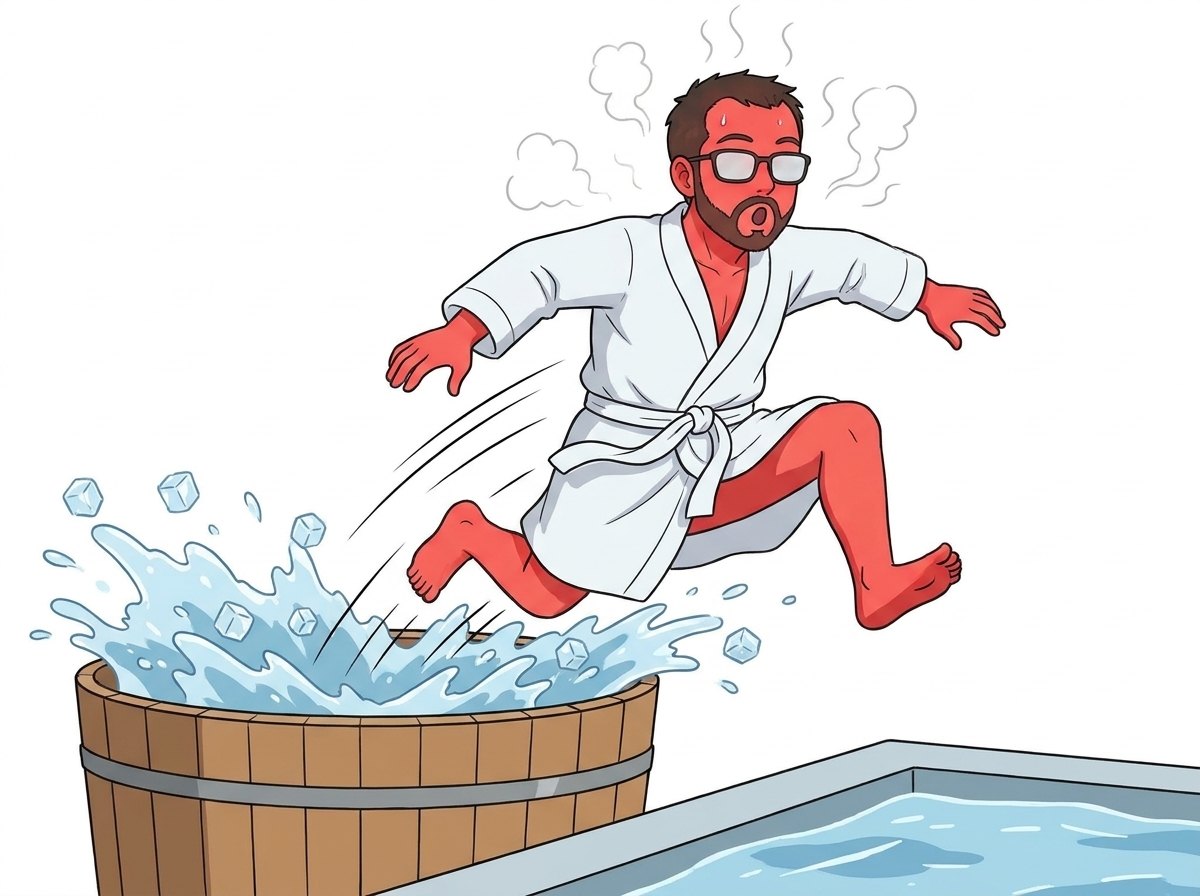
Once I had worked out the sit-down scrub, I climbed into the steaming bath, which was approximately the temperature of molten lava. Within three minutes I was cooked like a pink pork dumpling. I jumped under a freezing shower. I tried the outdoor bath. I boiled again. Cold shower again.
Boiled dumpling
It is meant to be relaxing?!
I could not test the sauna, because it was completely full of a giant Nordic Viking dad and his Viking sons.
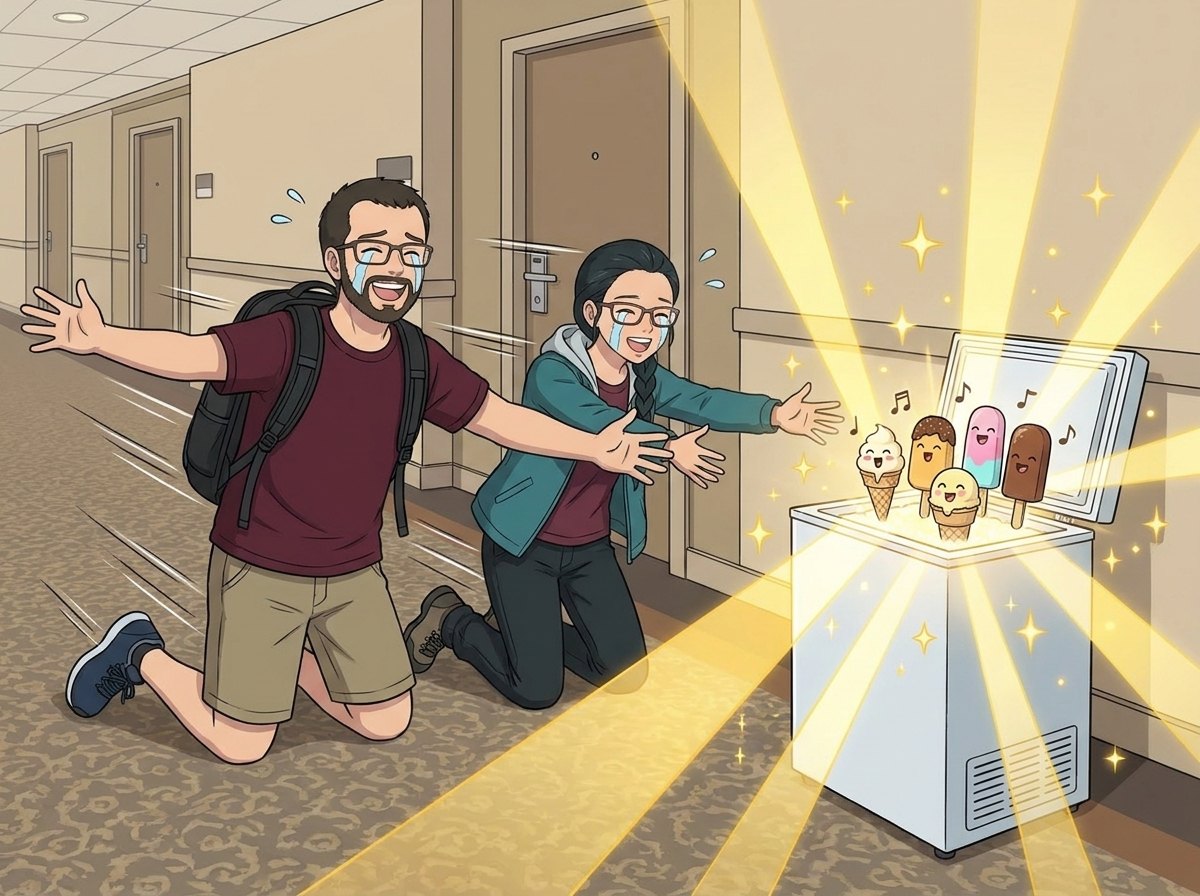
Free ice cream But here is the real reason you go to the Dormy Inn. Outside the baths there is a freezer. The freezer is full of ice creams. The ice creams are FREE.
The holy freezer
After boiling myself like a dumpling, a free ice cream (or two) was the one part of the onsen ritual I understood instantly and completely.
Jess and I made it a nightly tradition to raid the freezer after a long day. Then a morning tradition. Every single day we were at the Dormy Inn, we ate free hotel ice cream for breakfast, no adults present. Combined with a frankly impressive number of meals from convenience stores, our eating habits were more like unsupervised kids in an ice cream shop... literally some days.
No regrets.
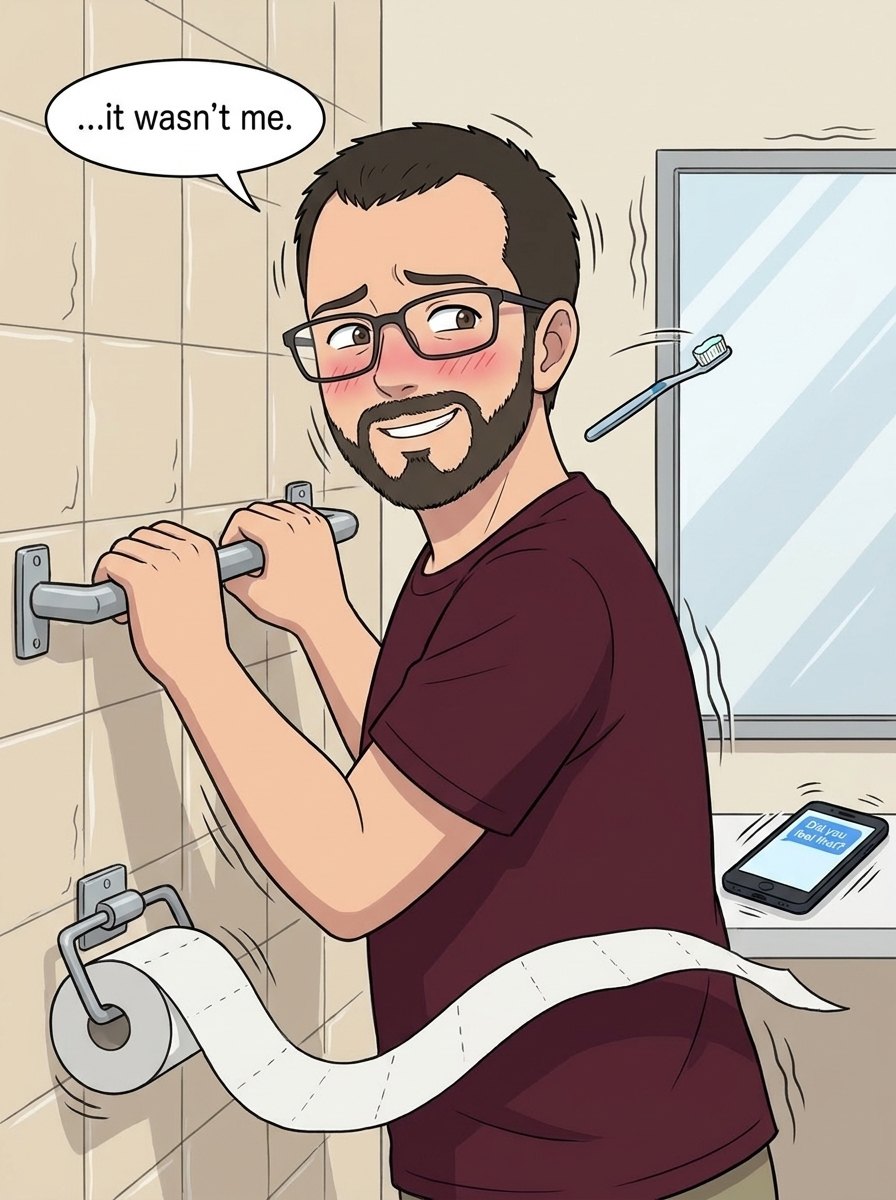
The midnight shake-up Seven minutes past midnight. I was on the toilet. (I know. I was not expecting this many toilet stories either.)
The walls started shaking. Properly shaking. The water in the bowl sloshed. My first thought was: what have I EATEN?
Then my phone buzzed. A message from Jess: "Did you feel that?"
I was not entirely sure how to apologise.
The earthquake
Jess, in her room, had assumed there was a sumo wrestling match going on in the other room. Then we both realised at the same moment.
EARTHQUAKE.
Magnitude 5.5, about 90 kilometres east of Tokyo, deep beneath northeastern Chiba Prefecture. We felt the shaking all the way in our hotel. The buildings swayed gently and then settled, just as they are designed to do.
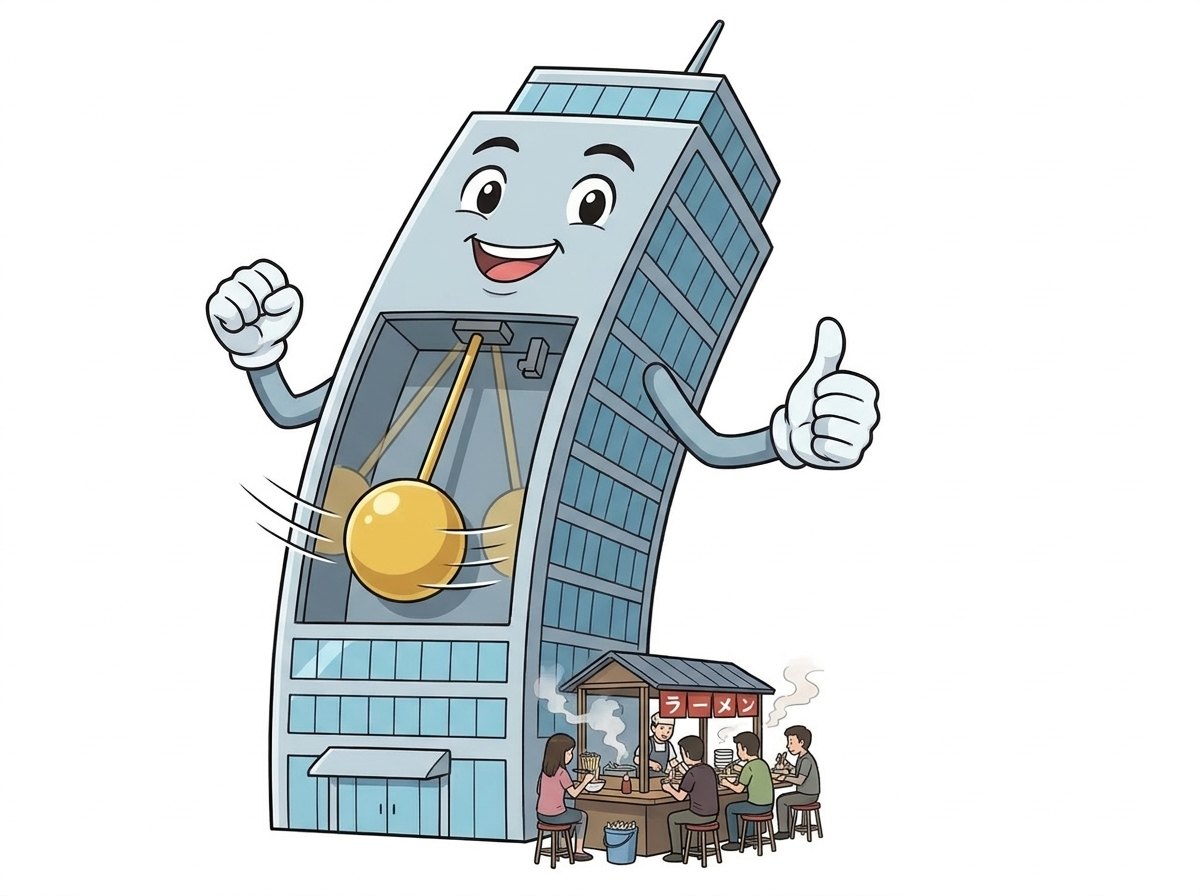
How buildings sway
We asked an AI chatbot what it was all about. It basically shrugged and said, "Japan has over a thousand earthquakes a year. Welcome to Tokyo."
Nine days in, and Japanese toilets were still finding new ways to surprise me.
Japan fact file
Shabu shabu is named after the sound. "Shabu shabu" is the swish-swish noise the meat makes as you wave it through the broth.
More onsen manners: tie up long hair, keep your little towel out of the water (balance it on your head like the locals), and no splashing.
Japan experiences frequent earthquakes because several giant plates of the Earth's crust meet beneath and around its islands. Buildings are built to sway instead of snap. Some skyscrapers have enormous weights inside, like giant pendulums, to steady them.
Phones in Japan can sound a loud earthquake alarm a few seconds before strong shaking arrives. Schools practise earthquake drills the way we practise fire drills.
Shinjuku Station is the busiest railway station in the world, and its complicated network has more than 200 numbered exits. Yes. Two hundred.
地震
Word of the day
Jishin
say it: JEE-shin
Earthquake.
Hopefully you never need it. I did.
Dad's lesson
If there is ever a big earthquake, not just a little rumble, protect your head and shelter under a sturdy table if you can. Stay away from windows and things that might fall. Wait until the shaking stops, then follow local safety advice. I survived our little midnight shake-up by doing what any brave adventurer would do: sitting on the toilet and wondering what on earth I had eaten.
Day10
Ninjas, Thunder Gates and the Midnight Padlock Quest
Thursday 29 OctoberTokyo
For our final full day, we hit fast-forward.
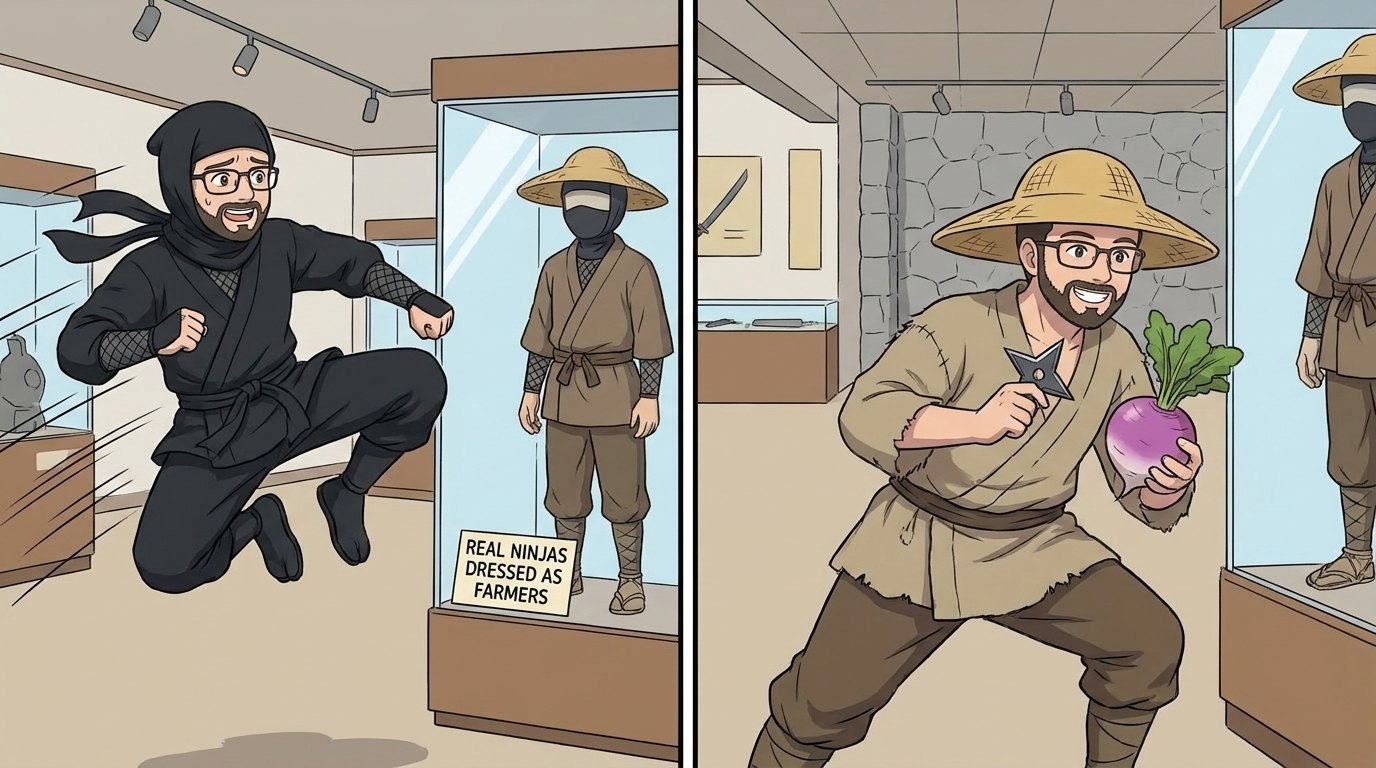
Ninjas We started at the Ninja Museum where I learnt that real ninjas were actually spies. (See the Fact File. It is a good one.)
Real ninjas
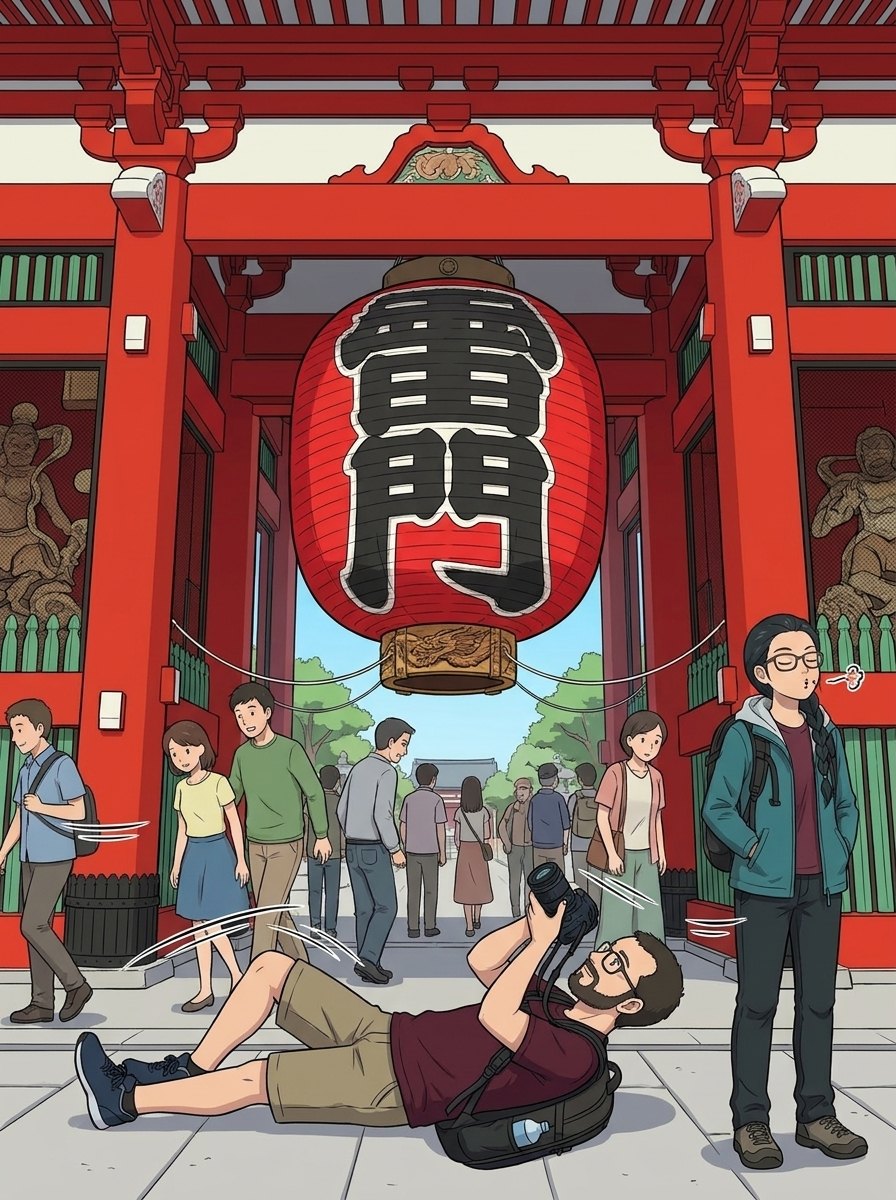
Senso-ji Then to Tokyo's oldest temple, Senso-ji, which is THE tourist spot in Tokyo, and the crowds proved it. You enter through the Thunder Gate, under a giant red paper lantern nearly four metres tall, then walk up Nakamise, a shopping street that has been selling souvenirs and snacks to pilgrims for more than 300 years.
Under the lantern
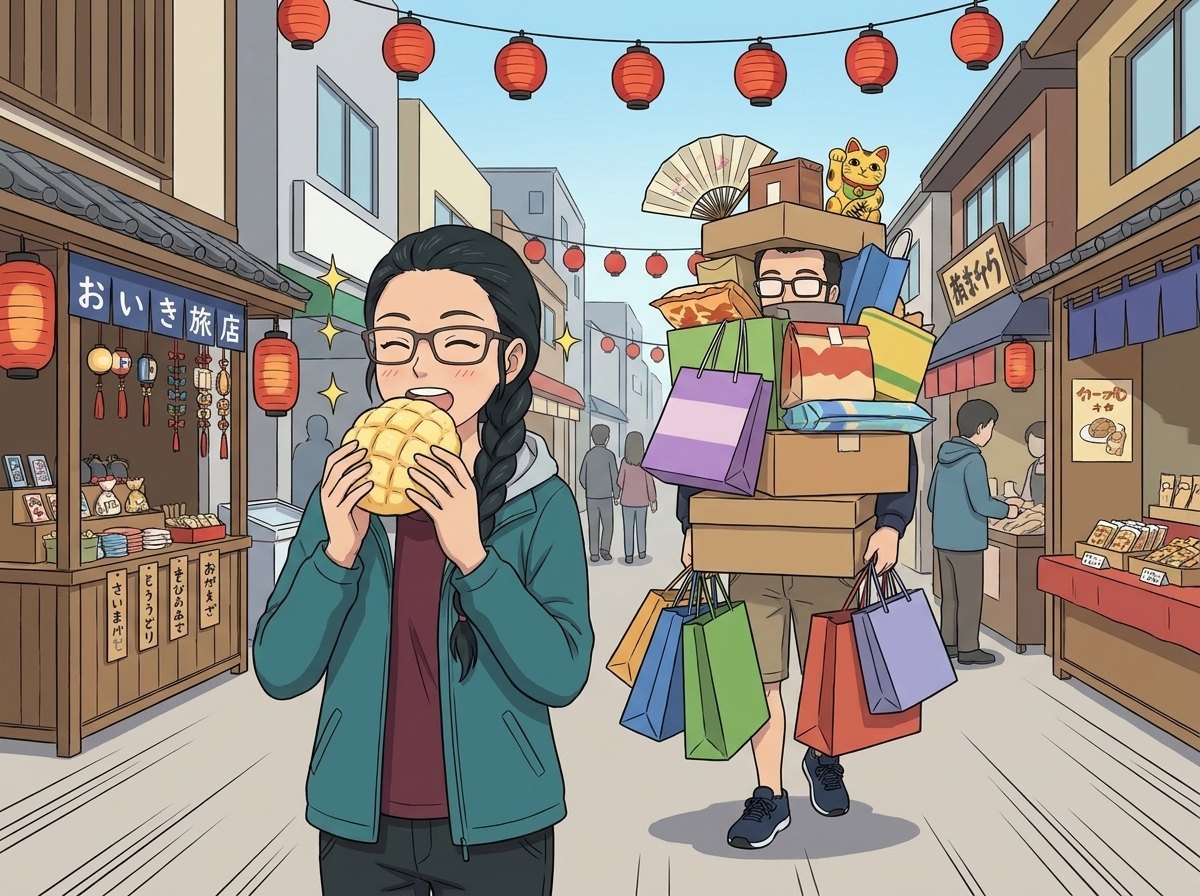
Jess bought melon bread. I bought... let us just say the suitcase was getting heavy.
Melon bread and shopping bags
In front of the temple is a huge bronze cauldron of burning incense. People waft the smoke over their heads and bodies, because some people believe it brings good health and wisdom.
I did not need to do any wafting. I don't think I need to get any smarter!!
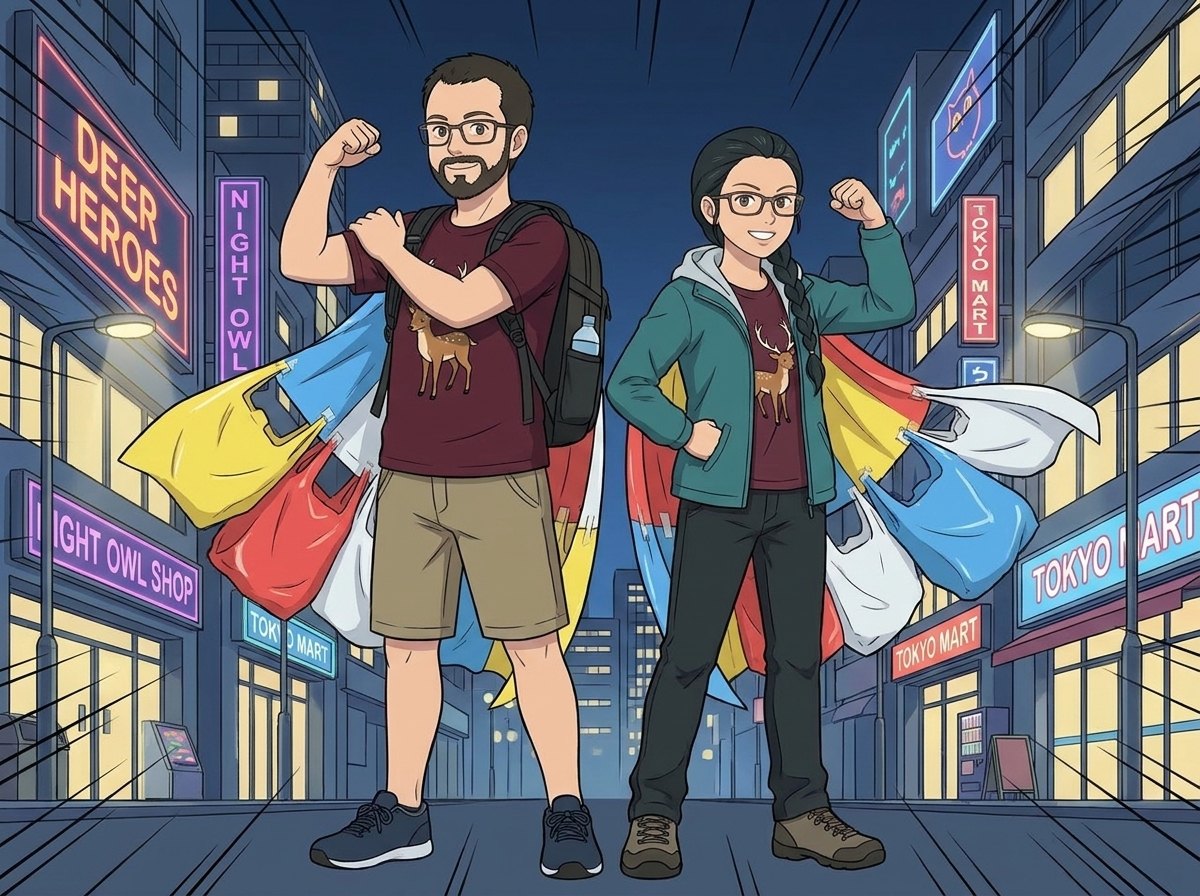
Akihabara Next, Electric Town. This is the neighbourhood for anime, gadgets and everything that beeps, glows or has a battery. We designed custom T-shirts for the family.
Custom T-shirts
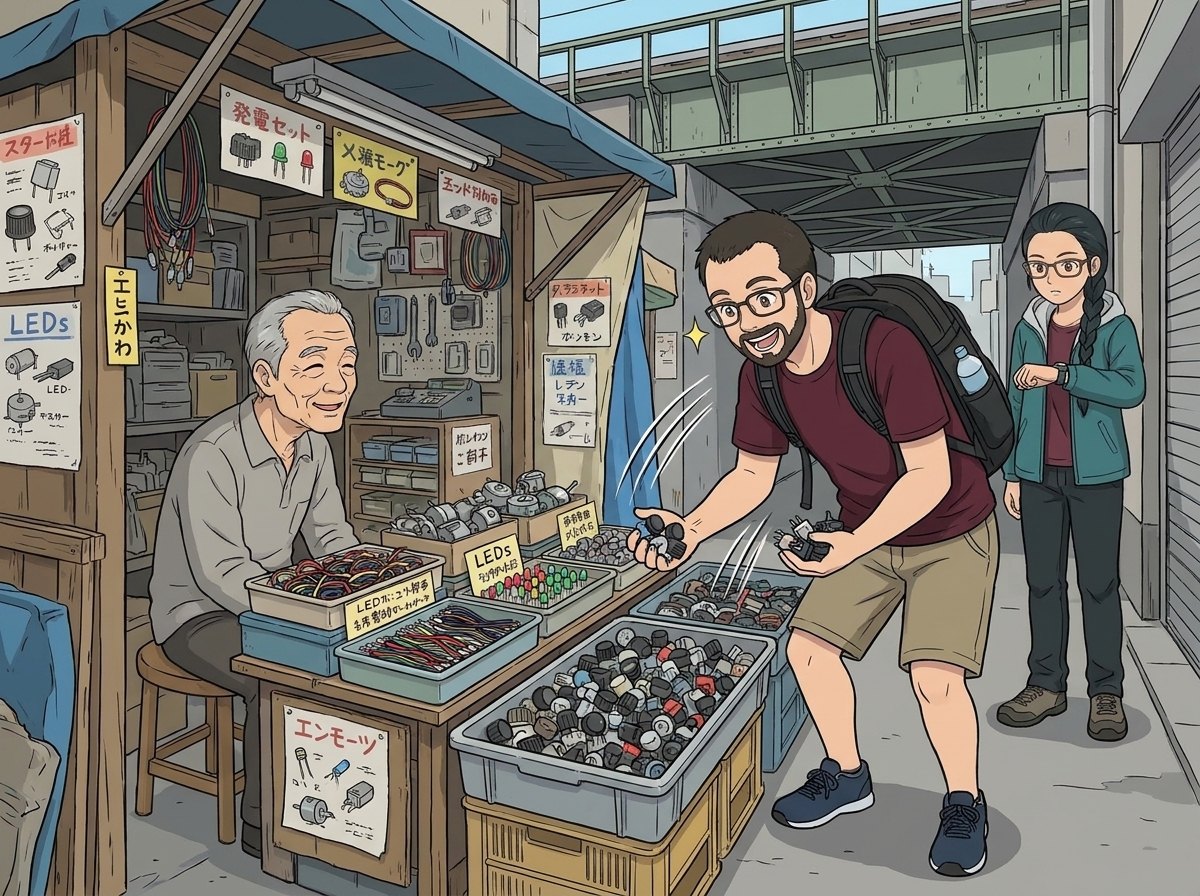
Then I found the Radio Center alleys: tiny stalls under the railway tracks selling individual switches, wires, LEDs, motors and knobs, run by old men who have sat there for forty years.
Electric Town
After that, Jess's Pastry Radar guided us to a bakery called Rituel for spiral croissants and custard buns. Priorities.
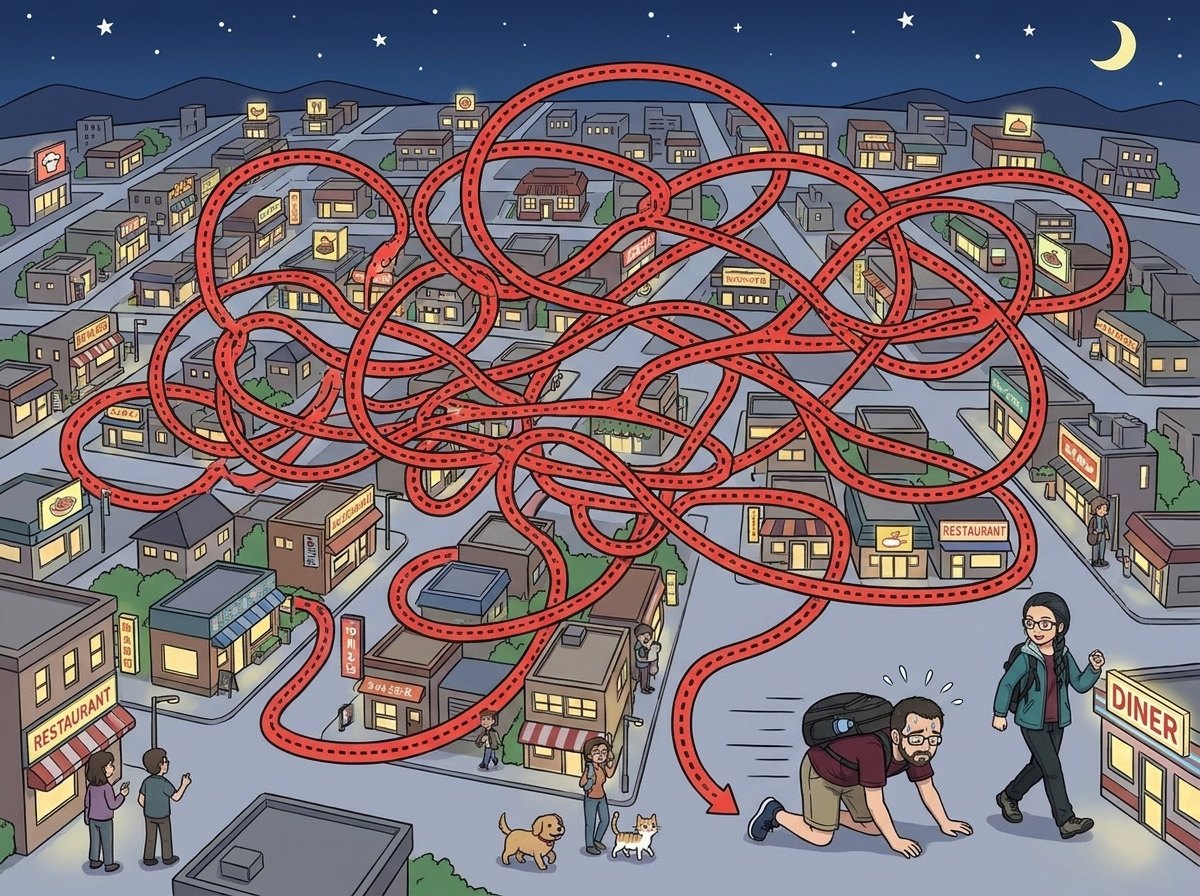
The 500-kilometre dinner For our last Japanese dinner, Jess was determined to find the perfect restaurant. So we walked. We walked past ramen shops, sushi bars, yakitori grills and noodle houses. We read menus. We compared menus. We walked some more. I estimate we covered five hundred kilometres.
The 500-kilometre walk
At nine o'clock at night, starving, we had three options:
A super-fancy traditional restaurant costing about $500 a head, with no guarantee of a table.
The free late-night ramen back at the hotel.
Denny's: American-style family restaurant.
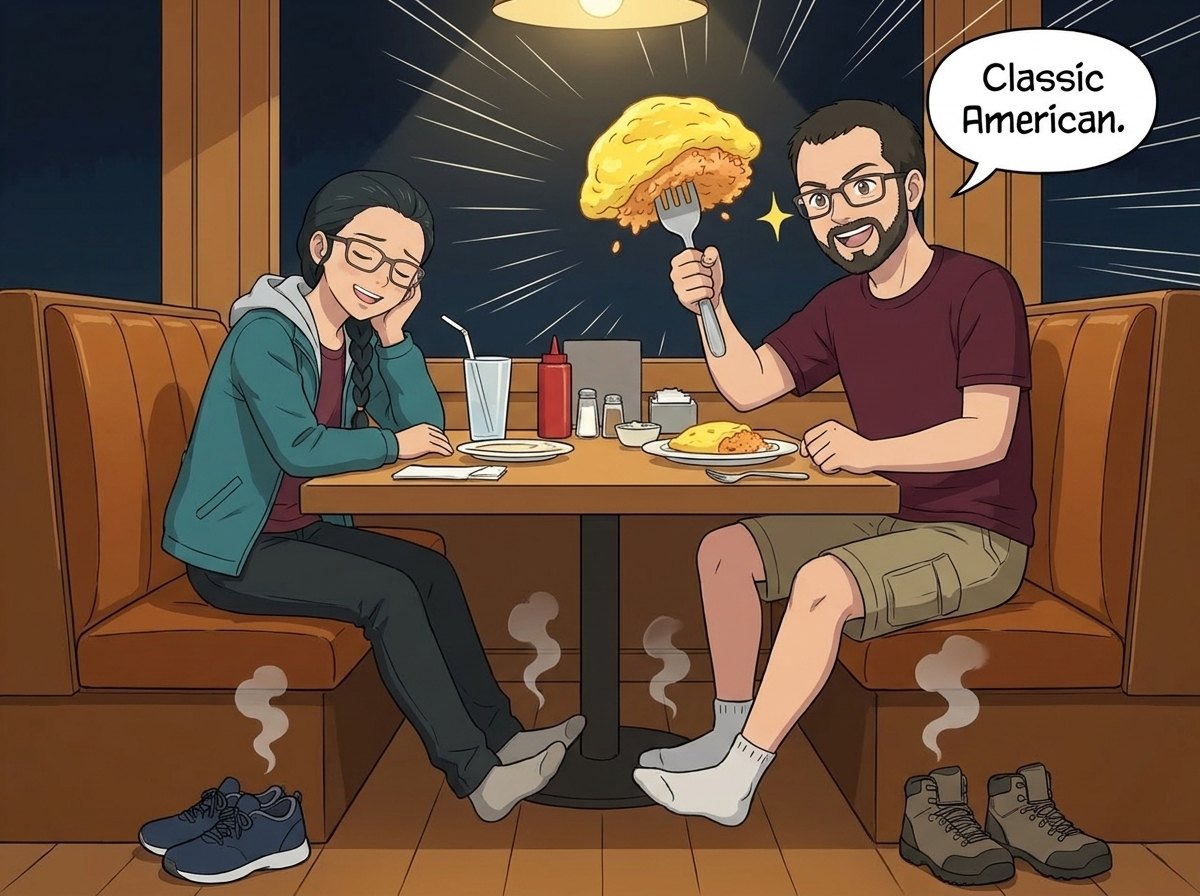
We had never been to a Denny's. So, in Japan, on our final night, we went to an American diner.
For the full classic American experience, I ordered omurice, a fluffy Japanese omelette wrapped around fried rice, with wood ear mushrooms on top. It was great... I don't think that is on the menu at the American ones!
Classic American
The Midnight Padlock Quest At eleven o'clock that night, back in my room, disaster struck.
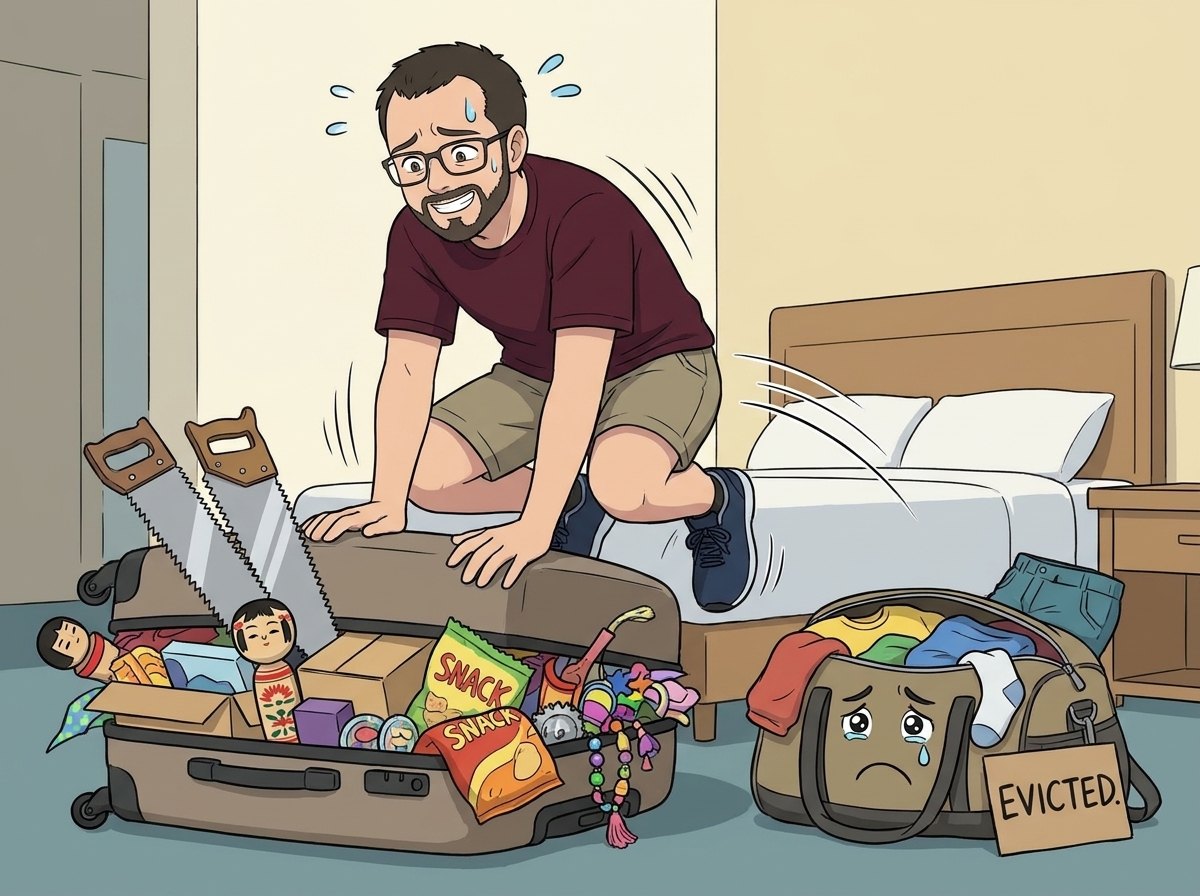
I tried to pack my suitcase and discovered it was now 100 per cent souvenirs! Saws, a hand-forged knife, Pokémon cards, Sophie's dolls, and lots of other stuff. There was no room left for clothes. My clothes had been evicted into a flimsy duffel bag.
Evicted
A duffel bag with no lock.
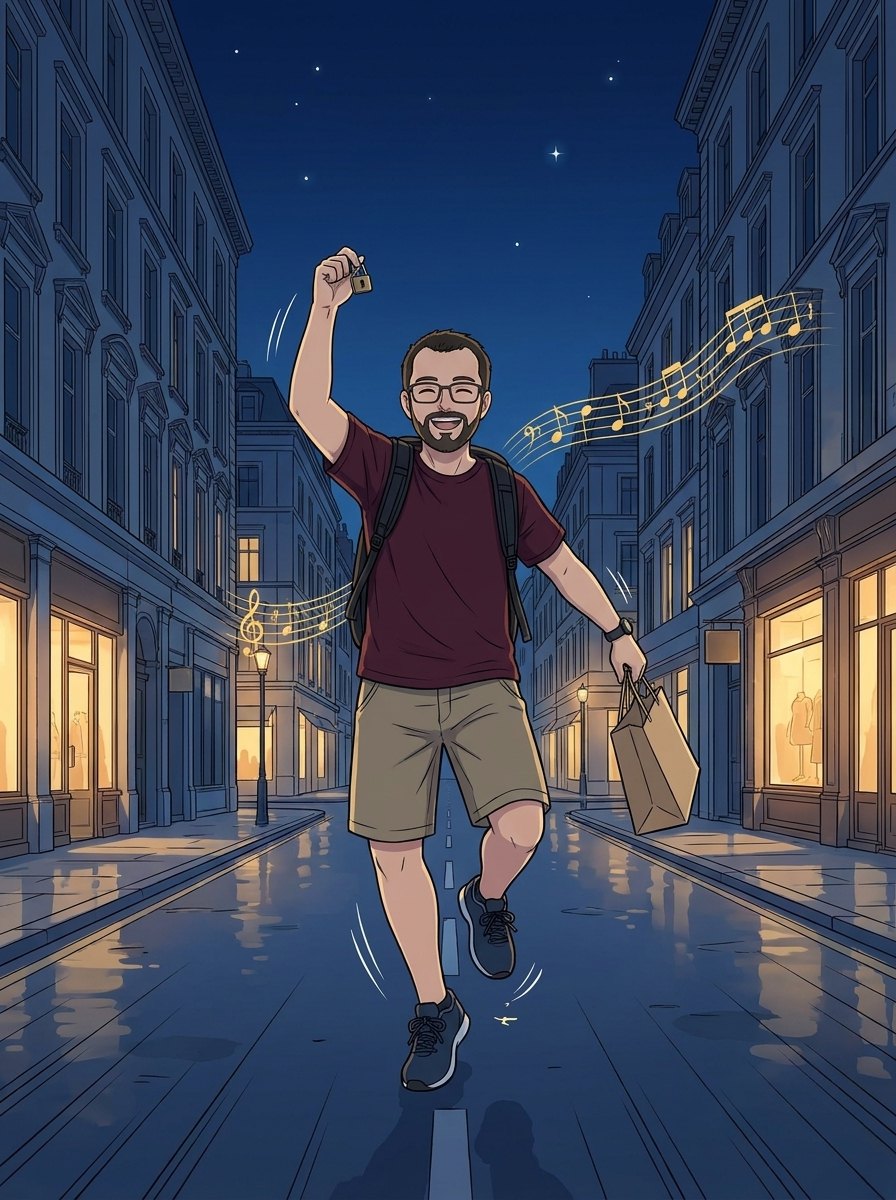
So while Jess sensibly went to sleep, I caught a late train back into the city to the 24-hour Donki to buy a padlock. This was one-third necessity, one-third being far too wound up to sleep before our 3 am start, and one-third an excuse to hear "Don, Don, Don, Donki" one last time.
At least I am honest about the maths.
I bought the padlock. (And a few other things.) Then I walked back through Ginza, Tokyo's fanciest district, at midnight: empty streets, glowing shop windows, the whole city humming quietly to itself. I got back to the hotel at half past one in the morning.
Midnight Ginza
There is something wonderful about wandering through Tokyo in the middle of the night.
There is something slightly less wonderful about doing it because you bought so many souvenirs that your clothes no longer qualify for secure storage.
Japan fact file
Real ninjas did not wear black pyjamas and throw stars at everyone. They came mostly from two mountain regions, Iga and Koga, and were hired by warlords as spies and scouts about 500 years ago.
Senso-ji was founded in the year 645, nearly 1,400 years ago. Legend says two fishermen brothers pulled a tiny golden statue out of the river in their net, and the temple was built to house it. Nobody is allowed to see the statue, not even the monks.
The giant lantern at the Thunder Gate weighs about 700 kilograms. On the underside is a carved wooden dragon that almost everyone walks under without noticing.
At most temples you can buy an omikuji, a paper fortune, for about a hundred yen. If you get a bad one, you tie it to a rack at the temple and leave the bad luck behind.
Akihabara got its nickname Electric Town after World War Two, when street stalls selling radio parts sprang up near the station and later moved in under the train tracks. Some of those stalls are still there.
Omurice, hamburger steak and curry rice are called yoshoku: Western food that Japan adopted over a hundred years ago and made its own. The Japanese version of Denny's has a totally different menu from the American one, serving corn soup and omurice and other Japanese meals.
すみません
Word of the day
Sumimasen
say it: soo-mee-mah-SEN
Excuse me, sorry and thank you, all in one word.
The most useful word in Japan. I used it about two hundred times a day, mostly while squeezing past people with a backpack.
Dad's lesson
The whole trip was a tug of war between me hunting souvenir shops and Jess hunting food shops. Looking at my suitcase, I think I won. Looking at Jess's photos of pastries, I think she did.
Day11
The Bowing Deer Comes Home
Friday 30 OctoberTokyo → Sydney
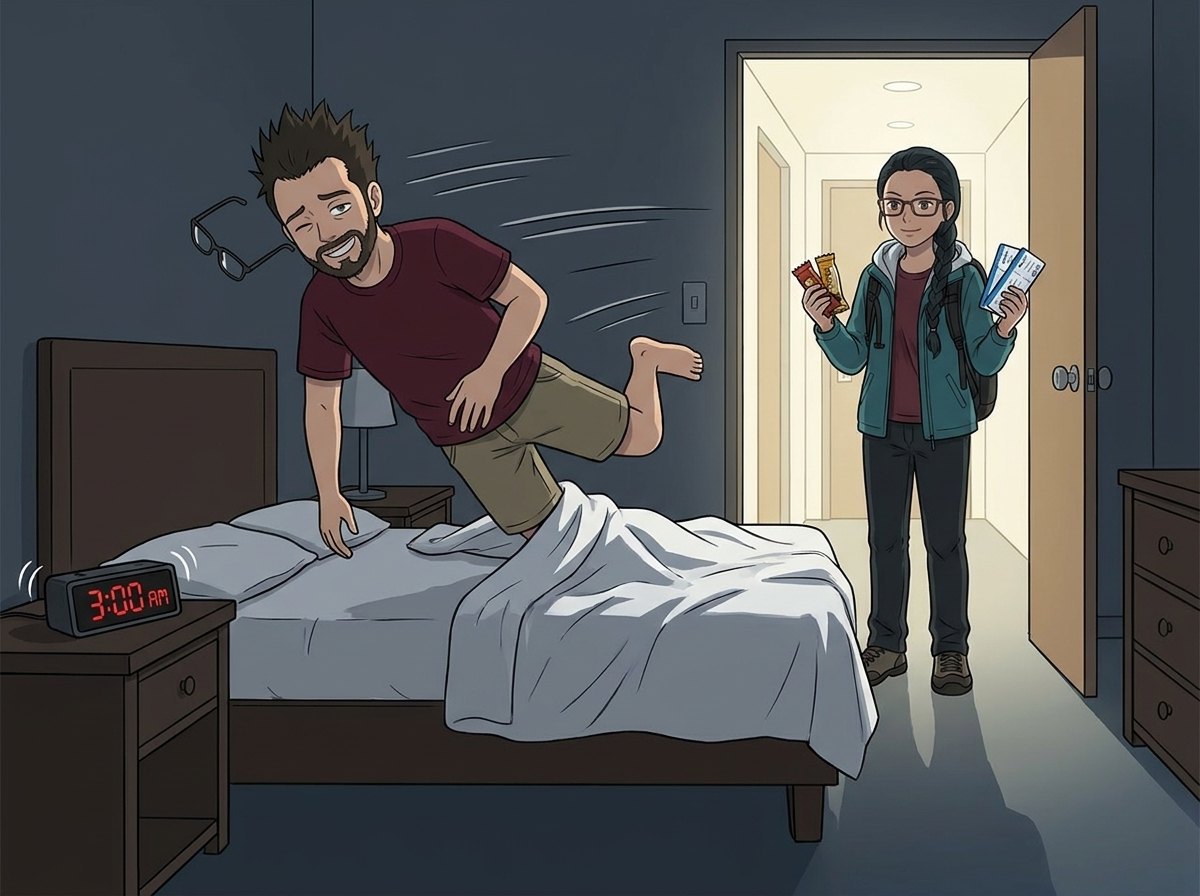
I did not sleep at all that night. I just lay in bed for 90 minutes playing the Donki song in my head.
Then the alarm went off at 3 am. Jess, naturally, was already dressed, packed and holding a snack.
Three in the morning
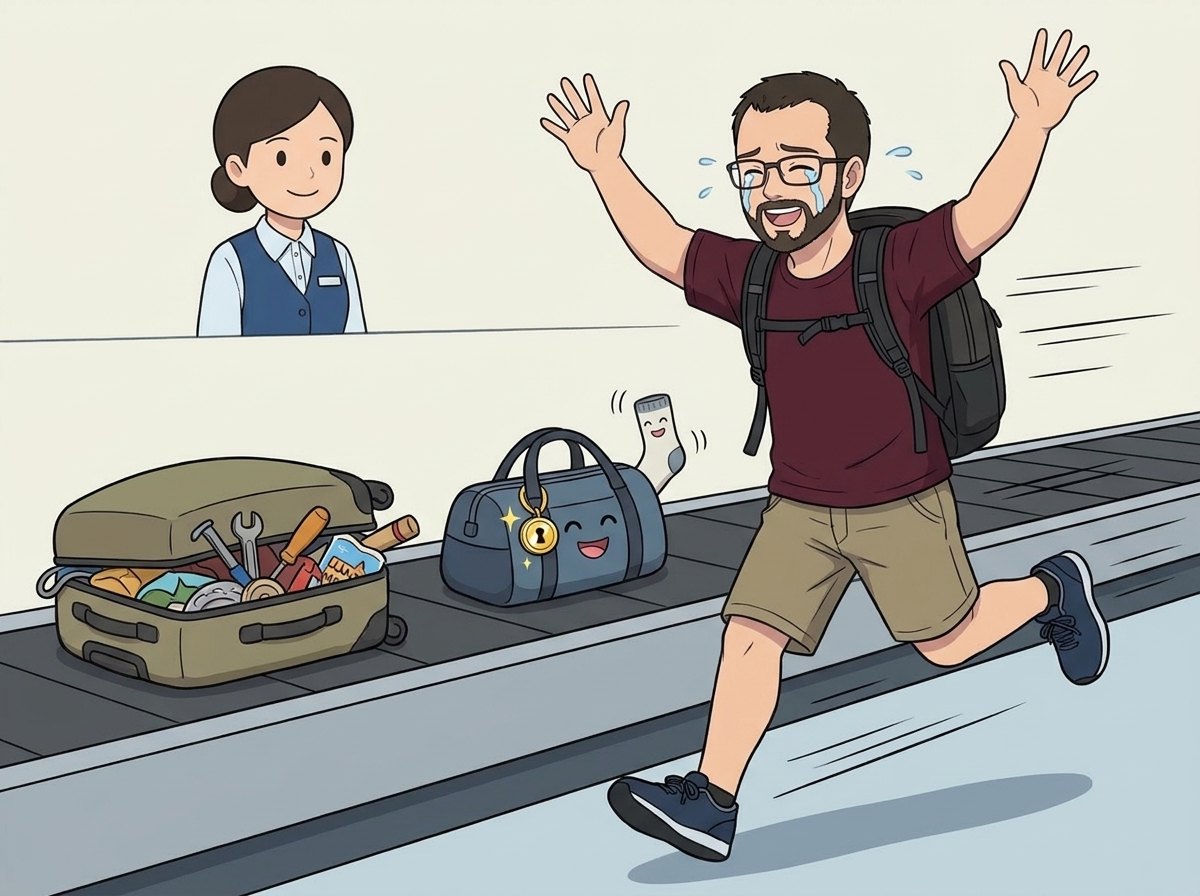
Haneda Airport We checked in my suitcase full of tools and my duffel bag full of clothes, now wearing its brand-new padlock like a medal. Nobody questioned why a man would fly nine hours with a bag of saw blades and one pair of socks. Japan is polite like that.
The conveyor belt
The flight home Sayonara, Japan!
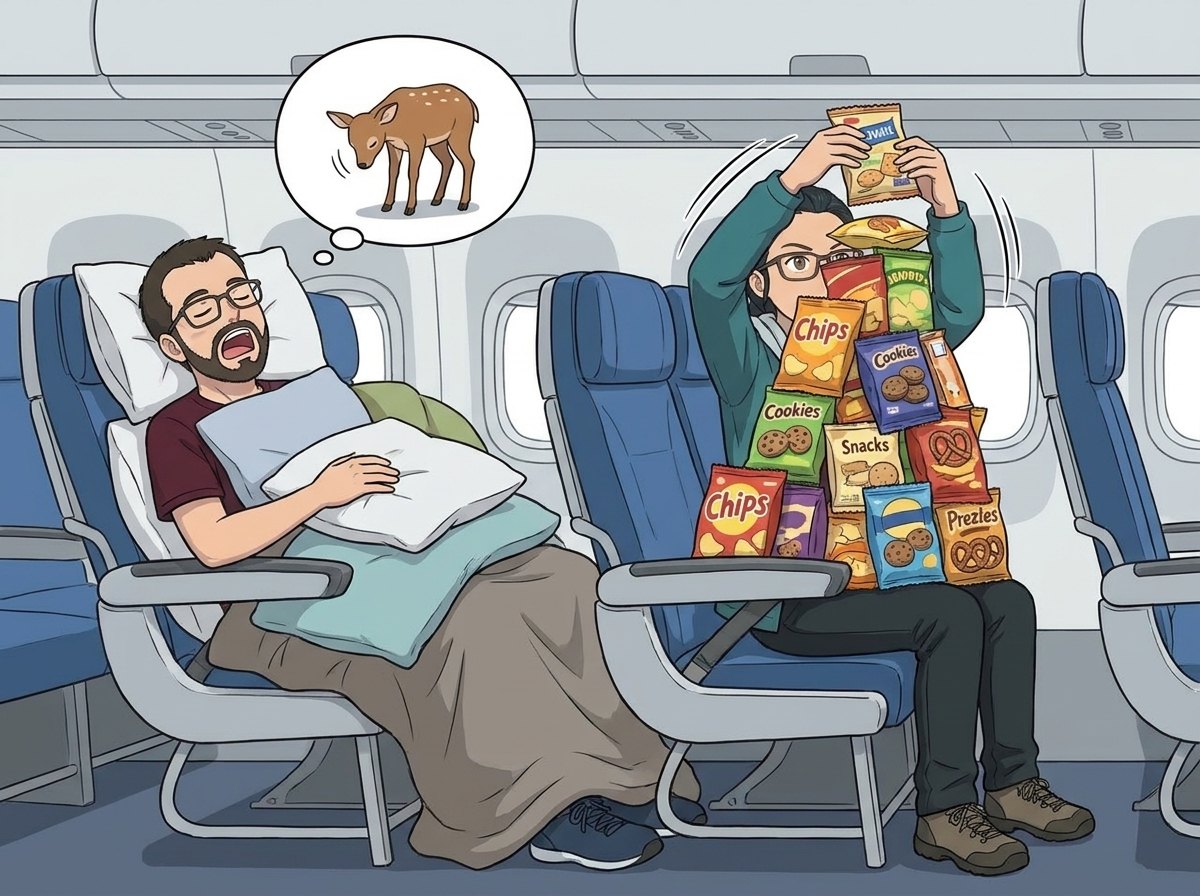
Here is a simple trick to make an ordinary economy seat feel like a billionaire's private jet. Step one: fly a budget airline on the way over. Step two: fly Qantas home. Suddenly you have a pillow! A blanket! A screen with movies! Meals that come to you! Snacks, endless snacks! It felt like royalty.
I napped and snored. Jess collected every single snack that went past, like a squirrel preparing for winter. We each finished the holiday doing what we do best.
Snack pyramid
The last laugh There was one final comedy moment, high above the ocean.
Remember how nobody in Japan understood my toilet question, so I had to do a small worried toilet dance instead?
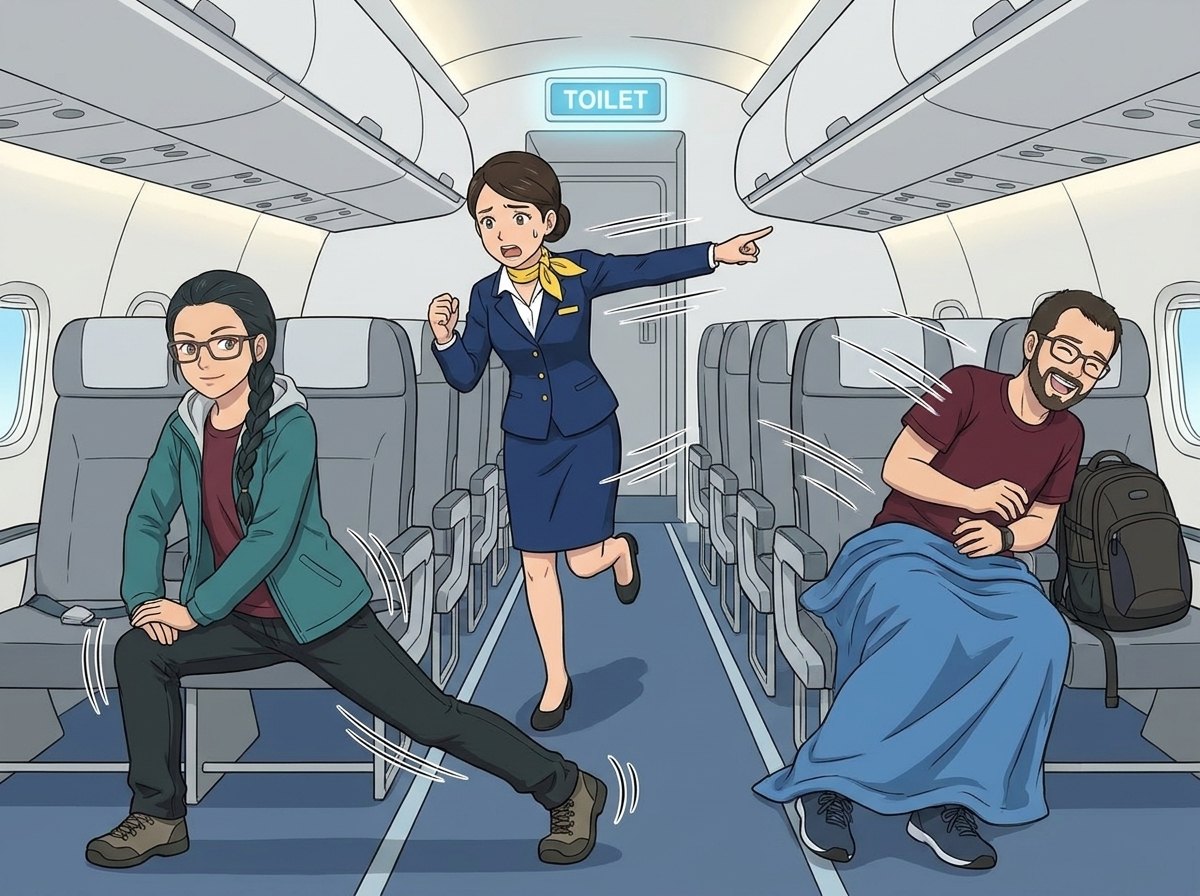
Halfway home, Jess stood up in the aisle to stretch her legs after sitting for hours. She was doing a few lunges and wiggles. The cabin crew rushed over, looking worried, and quietly asked if she was desperate for the toilet.
The stretch
After eleven days of me and my toilet stories, that felt like the universe having the last laugh.
Japan fact file
Haneda is one of two big airports in Tokyo and one of the busiest in the world. It sits on reclaimed land in Tokyo Bay, and it is famous for being spotless. It has won awards for its cleanliness.
The flight from Tokyo to Sydney takes about nine and a half hours and covers nearly 8,000 kilometres, which is about a fifth of the way around the whole Earth.
When you leave Japan, the ground crew often line up, wave and bow as the plane pushes back. Watch for it next time you fly out.
ありがとう ございました
Word of the day
Arigatou gozaimashita
say it: ah-ree-GAH-toh go-zai-MASH-tah
Thank you for everything that has happened.
The special past-tense thank you that you say at the very end. To Japan. And to Jess.
Dad's lesson
You do not have to be good at travelling to have a great adventure. You just have to say yes, bring a camera, and go with someone who knows where the bakery is.
The Final Verdict
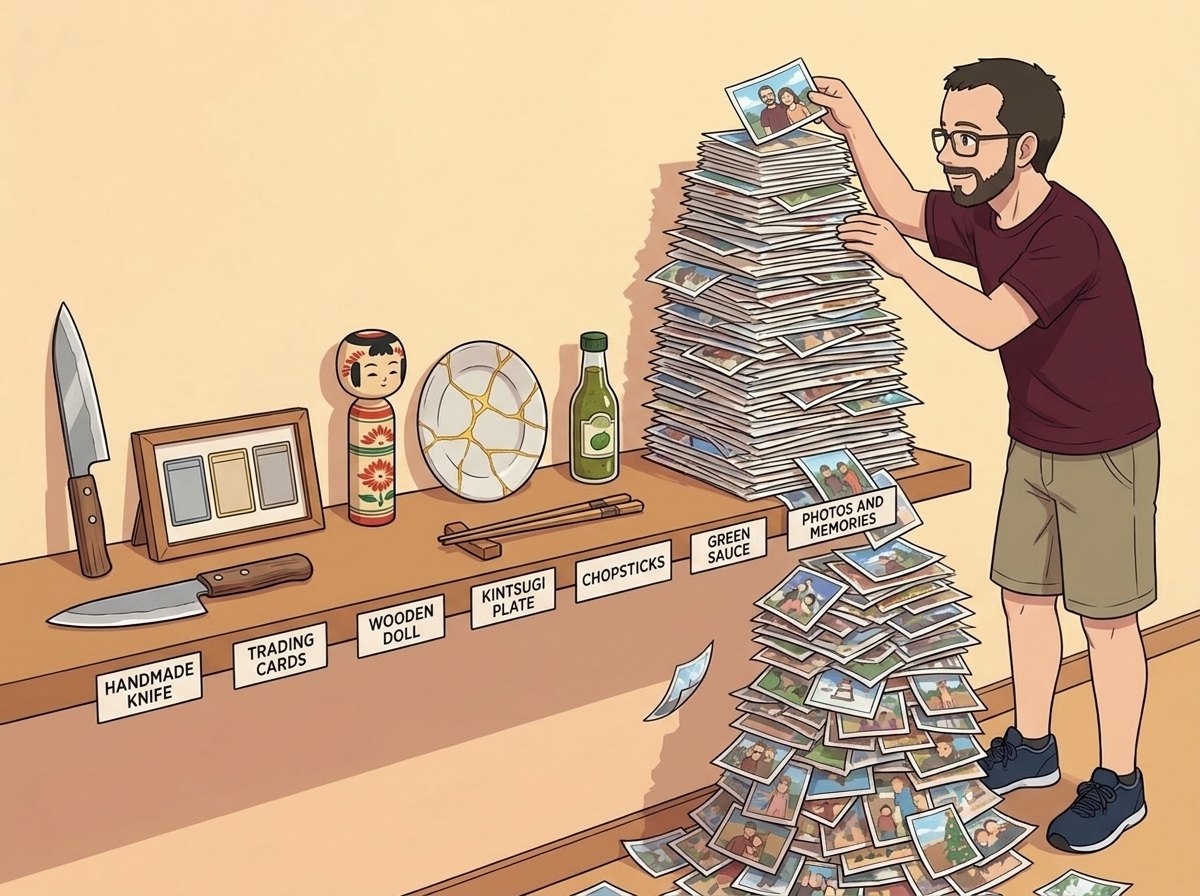
Eleven days. Five cities. Thousands of photographs. A handmade knife. One wrong taxi pin. One earthquake. One deer who tried to eat my bag. Several deer who headbutted me. A Bulbasaur, an Ivysaur, a Venusaur, AND a mint-condition original 1996 Pocket Monsters Bulbasaur card. Scented silk mini kimono dolls and a genuine traditional Japanese doll from Nara. A whole herd of bowing deer photos. More knowledge about Japanese toilets than any person should have.
The trophy shelf
Jess kept us moving, fed, organised and pointing in the right direction (except when I tried to help). She made sure I saw the busiest shopping street in every city. I photographed almost everything that was not moving, and most of the things that were.
I loved the ancient temples built by hand, the robots, the trains, the food, the beautiful messy neon alleys, and the way even the smallest everyday thing, a drain cover, a vending machine, a jingle on a truck, could feel like an adventure.
The only thing that could possibly make the next trip even better is bringing you three: Mummy, Sophie and Walter, along with me. Mostly because I really need someone to help carry the camera bag.
I went to Japan as a deer in headlights.
I came home as a BOWING deer in headlights, with a knife I made myself, a suitcase bursting with treasures for you two, a brain still singing the Donki song, and a camera full of photos that may take until our next holiday to sort through.
Would I do it all again? Absolutely.
Would Jess take me again? I will let you know once she has recovered.
THE END
Dad's Mini Japanese Dictionary
Every Word of the Day in one place. Test each other.